DNA on zip ties exposed the attacker who tortured a farmer’s family with an iron in Mykolaiv region
The escape route was recorded by cameras and phone billing records, and a magazine from the stolen starting pistol was found in the trunk of his car


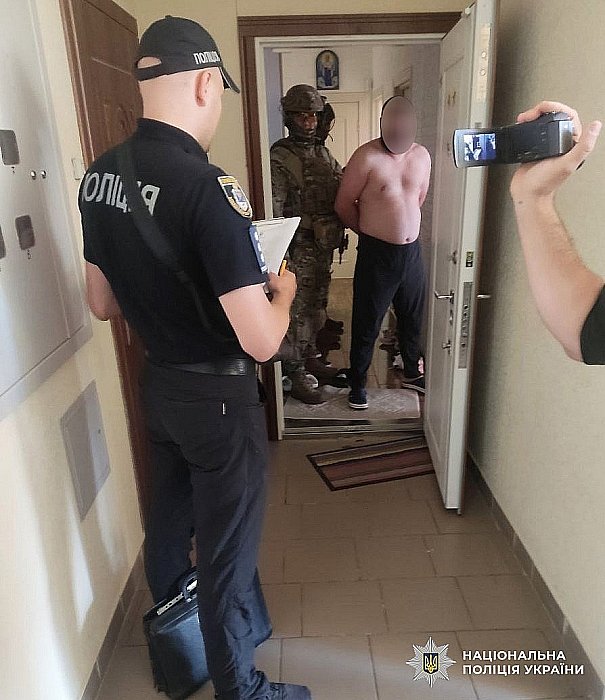
The Pervomaiskyi City District Court of Mykolaiv Oblast found a native of Odesa Oblast guilty of a violent robbery of a farmer’s family, committed under martial law. For the crime, the court sentenced him to 12 years of imprisonment with confiscation of all property belonging to him.
The decision was published in the unified register of court decisions.
As established by the court, on the evening of December 6, 2023, the accused together with an accomplice, whose identity has not yet been established, planned in advance an attack on the house of the head of a farming enterprise in the Kryvoozerska community. The attackers came to the house dressed in clothing resembling military uniforms, wearing balaclavas and carrying objects resembling assault rifles.
Taking advantage of the fact that the homestead was located on the outskirts of the village, the perpetrators entered the yard without hindrance. They tied up the farmer and his wife with plastic cable ties and began to demand money and valuables.
These people said that he was calling Russia and told him to hand over the phone. Each of them had a shortened rifle in his hands; they pointed the rifles at him. He realized that they were not military and grabbed a rifle, twisted it, after which he received a blow to the head. He did not see what he was hit with. The attackers spoke Russian, with a little Surzhyk, called him “batya”; “batya” is not a word specific to the Kryvo Ozero settlement,” — it is stated in the case materials.
To force the victims to reveal where their savings were kept, the attackers threatened the man with a rifle and a knife, promised to cut off his ear, placed a switched-on iron on his back, stepped on his feet and twisted his joints, inflicting severe physical pain.
Fearing for their lives, the couple indicated where the money was kept. The attackers stole USD 4,000, UAH 20,000, a magazine from a starter pistol, after which they fled, leaving the homeowners bound. Total losses amounted to UAH 167,347.
The couple managed to free themselves with the help of a knife and run to the neighbors, who called the police.
During the inspection of the scene, investigators found the house completely overturned: open cabinets, scattered items, shoe prints on the table. In the house and the summer kitchen they found cut plastic cable ties that had been used to bind the victims, as well as two laptops, two mobile phones, a subscriber terminal and other property hidden in a pillowcase that the perpetrators had tried to take away.
In addition, forensic experts recorded fingerprints, shoeprints and other physical evidence. During a repeated inspection of the territory, plaster casts of shoe impressions were made near the garage, the gate and the vegetable garden. All items discovered were recognized as physical evidence and were seized.
In court, the defense attempted to declare the results of the inspection inadmissible as evidence, arguing that consent to conduct investigative actions had been given only by the victim’s wife. However, the court noted that the couple lived together in the house, and therefore the woman’s consent was sufficient and complied with legal requirements.
One of the key pieces of evidence was the result of a molecular-genetic examination. On the plastic cable ties used to bind the victims’ hands, experts found the DNA of an unidentified man. Later this genetic profile matched the DNA of the accused.
The court also noted that the accused for a long time refused to voluntarily provide DNA samples. In the court’s view, such behavior indicated an attempt to avoid detection, since it was known that biological material from one of the attackers had been found at the crime scene.
In addition, during the investigation, investigators analyzed footage from the “Safe City” surveillance system and private cameras. According to the investigation, after the attack the suspects fled in a VAZ-2121 “Niva” car, which was recorded on the Odesa–Kyiv highway shortly after the crime. Analysis of telephone connections also showed that the accused’s mobile phone at the time of the crime was in the coverage area of a base station corresponding to the perpetrators’ escape route.
During a sanctioned search of the accused’s place of residence, law enforcement officers found in the car trunk a magazine from the starter pistol stolen during the attack. In court the defendant claimed that the magazine had been planted by police officers. However, the court examined the search video and established that the accused’s wife immediately after the item was discovered told the investigator that it had long been lying in the trunk, although she considered it an ordinary car part. These words, recorded on video, completely refuted the defense’s version of possible evidence fabrication.
The accused himself did not admit his guilt. He claimed that he had never been in the victims’ house, was not acquainted with them, and that all evidence against him was allegedly obtained unlawfully. The defense also challenged the admissibility of the expert results and investigative actions.
However, the court concluded that the testimony of the victims and witnesses, the results of scene inspections, DNA examinations, analysis of video recordings, telephone connections and other evidence taken together fully confirm the accused’s guilt and refute the defense’s arguments.
The court found the man guilty under part 4 of Article 187 of the Criminal Code of Ukraine (“Robbery committed by a group of persons by prior conspiracy, with penetration into a dwelling, under martial law”) and sentenced him to 12 years of imprisonment with confiscation of all property.
Until the verdict enters into force, the accused will remain in custody. The term of the sentence is calculated from the moment of detention.
Materials concerning the second participant in the attack, whose identity has not yet been established, have been separated into a separate criminal proceeding.
Earlier we wrote:
- For a robbery at the station two locals were sentenced to 7 years in prison under martial law
- Armed robberies against Mykolaiv residents: law enforcement detained criminal brothers from Odesa
- Two Mykolaiv residents were tried for the murder of a farmer — the trial lasted over 9 years
- Verdict of the Zhovtnevy District Court: 8 years for a violent robbery in Mykolaiv region
- 7, 8 and 9 years in prison with confiscation of property were imposed on three robbers who terrorized Mykolaiv region residents