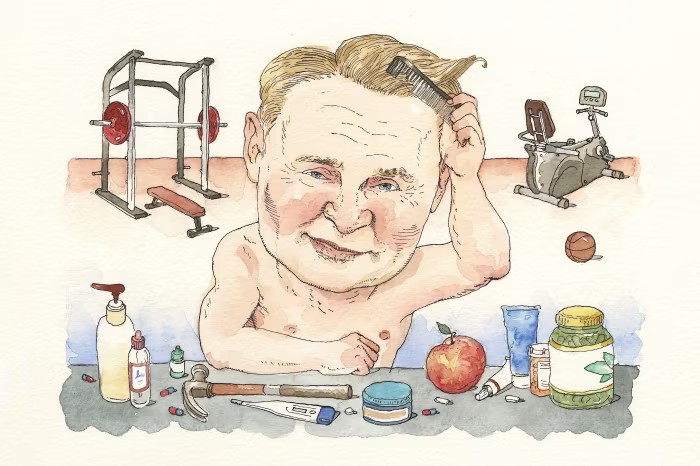
Russian dictator Vladimir Putin, who is now 73 years old, has turned the issue of life extension and the fight against aging into one of the state scientific priorities of Russia. As The Wall Street Journal writes, the Kremlin is promoting a large-scale initiative worth about $26 billion, which is to focus on longevity technologies — from gene therapy to tissue printing and organ cultivation.
According to the publication, this is not just about isolated medical studies, but about a large state program that Putin launched in 2024. It was named “New Health Preservation Technologies” and, according to official Russian logic, is supposed to help extend people’s active lives and allegedly save 175 thousand lives by 2030.
As part of this program, Russian scientists, according to WSJ, are working on several directions at once. One of them is gene therapy, which is intended to affect cellular aging. In April 2026, Deputy Minister of Science of the Russian Federation Denis Sekirinsky said that Russian scientists are developing a drug that is considered one of the promising avenues in the fight against aging.
Another direction is bioprinting, that is, 3D printing of living tissues. According to the publication, Russian state scientists report experiments with printing human cartilage tissue and a mouse’s thyroid gland. In the future, the Kremlin wants to reach technologies for replacing human organs as early as 2030.
The article separately mentions xenotransplantation — growing organs for humans in animal bodies. In the Russian case, it is about mini-pigs, which are being considered as a possible biological platform for future transplants. This topic echoes a conversation between Putin and China’s leader Xi Jinping, which microphones accidentally recorded during a military parade in Beijing in September 2025: at the time they discussed the possibility of life extension through organ replacement.
The key figures in this direction, WSJ names Putin’s eldest daughter Maria Vorontsova and the head of the Kurchatov Institute Mikhail Kovalchuk. According to the publication, they are linked to Russian state programs in the fields of genetics, medicine and longevity technologies. Earlier, Novaya Gazeta, T-Invariant, The Moscow Times and Ukrainian media also wrote about the increase in funding for Russian aging research.
However, there are many questions around these ambitions. WSJ notes that despite loud statements, Russian research has few results confirmed in international peer-reviewed scientific journals. After Russia‘s full-scale invasion of Ukraine, Russian science found itself isolated from a large part of the Western scientific community, which further complicates independent assessment of such projects.
This story looks particularly cynical against the backdrop of the war against Ukraine. While the Kremlin seeks ways to extend the life of its ruler and his circle, the Russian army continues to lose people on the front, and Russia itself faces some of the worst male mortality rates among developed countries. According to official statistics, the average life expectancy for men in the RF is about 68 years — significantly less than in the US and most countries of Western Europe.
Putin’s obsession with his own health is not new. During the COVID-19 pandemic he introduced strict quarantine procedures for visitors, disinfection tunnels and prolonged isolation. And the famous long tables at which the Russian dictator received guests became a symbol not only of political distance, but also of his fear of illness.
In fact, according to WSJ, a new ideological line is forming in the Kremlin: life extension, control over the body and technologies for “repairing” the human are being presented as a strategic direction for the state. But behind the flattering words about “healthy longevity” another motive appears — the fear of the aging Russian elite of their own mortality and their unwillingness to relinquish power.
Earlier we wrote:
- Putin buys cannon fodder by writing off loans: Russians are lured to the front against Ukraine
- Putin and Xi announced unprecedented relations: Russia — supplier of resources, China — responsible consumer
- “Now is not the time”: in Europe they urged not to negotiate with Russia, but to finish it off with sanctions
- Russia uses “Victory Day” to blackmail Ukraine with new strikes
- Putin does not intend to stop the war against Ukraine, US intelligence said