A new sky for attacks: Russia is creating its own Starlink to control drones
Russia is taking the war into orbit: "Rassvet" could become the occupiers' own Starlink


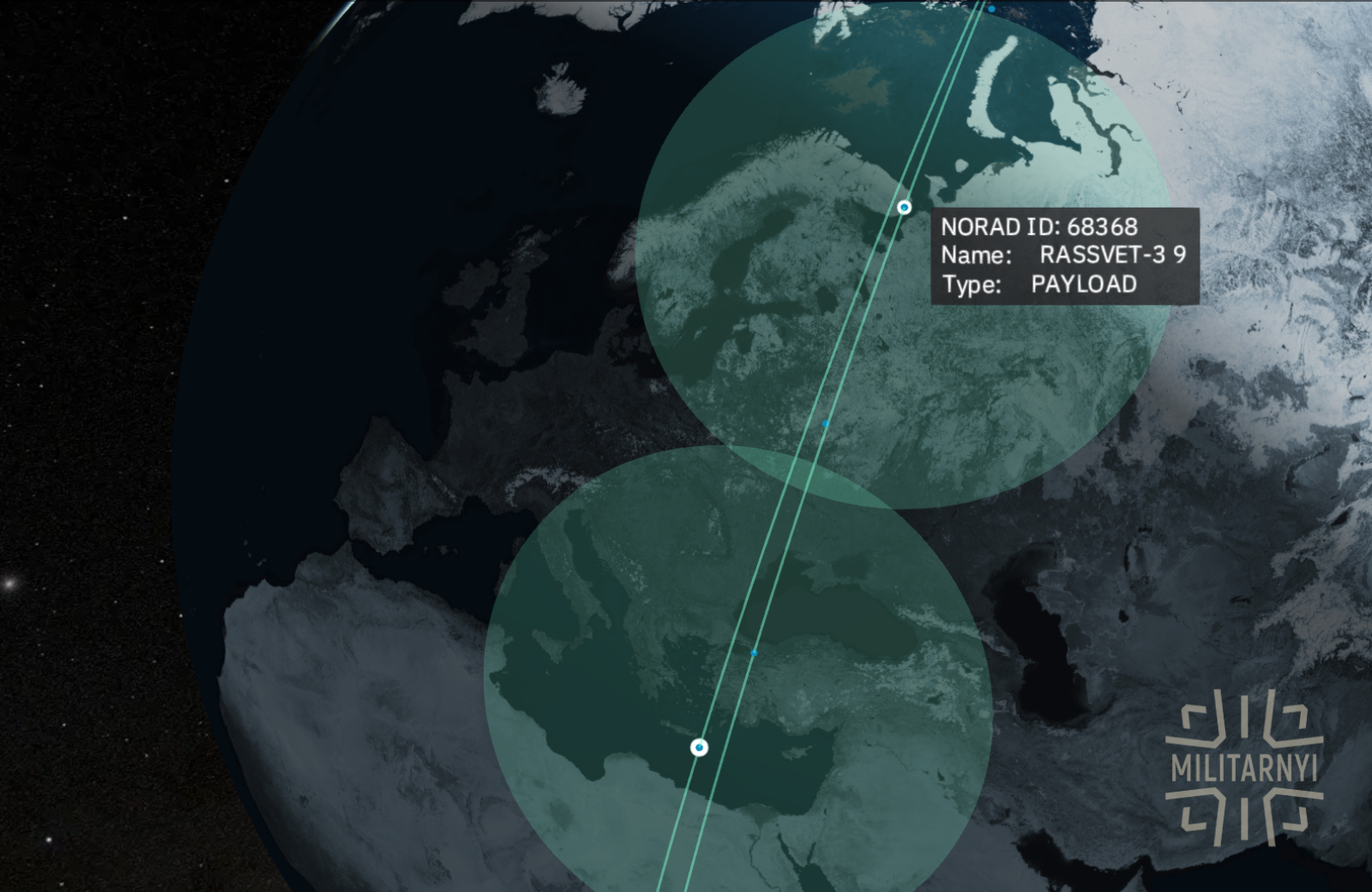
Russia is accelerating the deployment of the low-Earth-orbit satellite system “Rassvet”, which it officially presents as a civilian alternative to Starlink. At the same time, the system could potentially provide secure communications for Russian forces, transmission of intelligence information, and control of unmanned aerial vehicles during the war against Ukraine.
The project is being developed by the Russian company “Bureau 1440”. It launched the first serial group of 16 satellites into orbit on 23 March 2026. The second launch took place on 19 July 2026. The number of spacecraft in the new batch was not officially disclosed, but industry observers estimate it at another 16 satellites. Together with previously launched prototypes, up to 40 spacecraft of the “Rassvet” system may be in orbit.
So far this constellation is not capable of fully replacing Starlink or providing continuous connectivity along the entire front. Defense technology adviser Sergiy Beskrestnov emphasized that for systematic military use Russia would need to place at least several hundred satellites into orbit. Some of the current spacecraft have not yet reached their final positions, and some experimental satellites may already have ceased operating.
However, even the current number of satellites should not be considered entirely harmless. During a preliminary study of the trajectories of three operational prototypes, analysts found that they passed directly over Ukraine about 2-3 times per day. Each such pass created a communication window lasting roughly 15-20 minutes. As the number of satellites increases, such sessions may become more frequent and longer.
This means that even before full coverage appears, Russian forces could theoretically obtain periodic satellite communication channels. They could use them for commanding units, transmitting data, and supporting unmanned systems. At the same time, organizing combat operations that rely only on short satellite passes remains difficult, so a full-fledged Russian Starlink is not currently a reality.
The initial plan envisaged deploying 156 satellites in 2026, 292 – in 2027 and 318 – in 2028. A constellation of several hundred spacecraft is what would allow Russia to move to continuous service for subscribers. At the same time, the schedule has already faced production delays, so the announced timelines may change.
The acceleration of the project comes after Ukraine, together with SpaceX, limited the use by Russian forces of unlawfully activated Starlink terminals. Former defense minister Mykhailo Fedorov called blocking Russian access to the system one of the results of his team’s work.
For Mykolaiv and the southern regions this threat is especially relevant. Russian security services continue to look for Ukrainians who, for money, agree to register Starlink terminals for the occupiers. In July 2026 the SBU detained an agent who, according to the investigation, tried to organize such a registration and was preparing a terrorist attack in Mykolaiv. The enemy planned to use the obtained connection to adjust rocket-bomb, artillery, and drone strikes on the southern front.
Thus, the current “Rassvet” still lags significantly behind Starlink in scale and stability. However, this is no longer just a propagandistic presentation of Russian “import substitution”, but a long-term military risk. If Russia succeeds in launching hundreds of satellites, the occupiers will gain an independent communication channel that will be much harder to restrict by blocking foreign terminals.
Earlier we wrote:
- The SBU detained a Russian agent who tried to carry out a terrorist attack in Mykolaiv
- 22 victories and three shortcomings: Mykhailo Fedorov reported and left the Ministry of Defense
- Starlink for the occupiers for $100: the SBU exposed 8 agents of Russia recruited via Telegram
- Ukraine doubles drone production – the Kremlin faces a hard choice
- Vitaliy Kim assessed the threat of KABs to Mykolaiv and explained what weapons Russia uses to reach the city