No laboratory, no invoice, no results: Kim's claim about MGZ sludge was not confirmed by documents
The Mykolaiv Regional Military Administration does not know where the 50 kg of sludge that its former head Vitaliy Kim talked about went


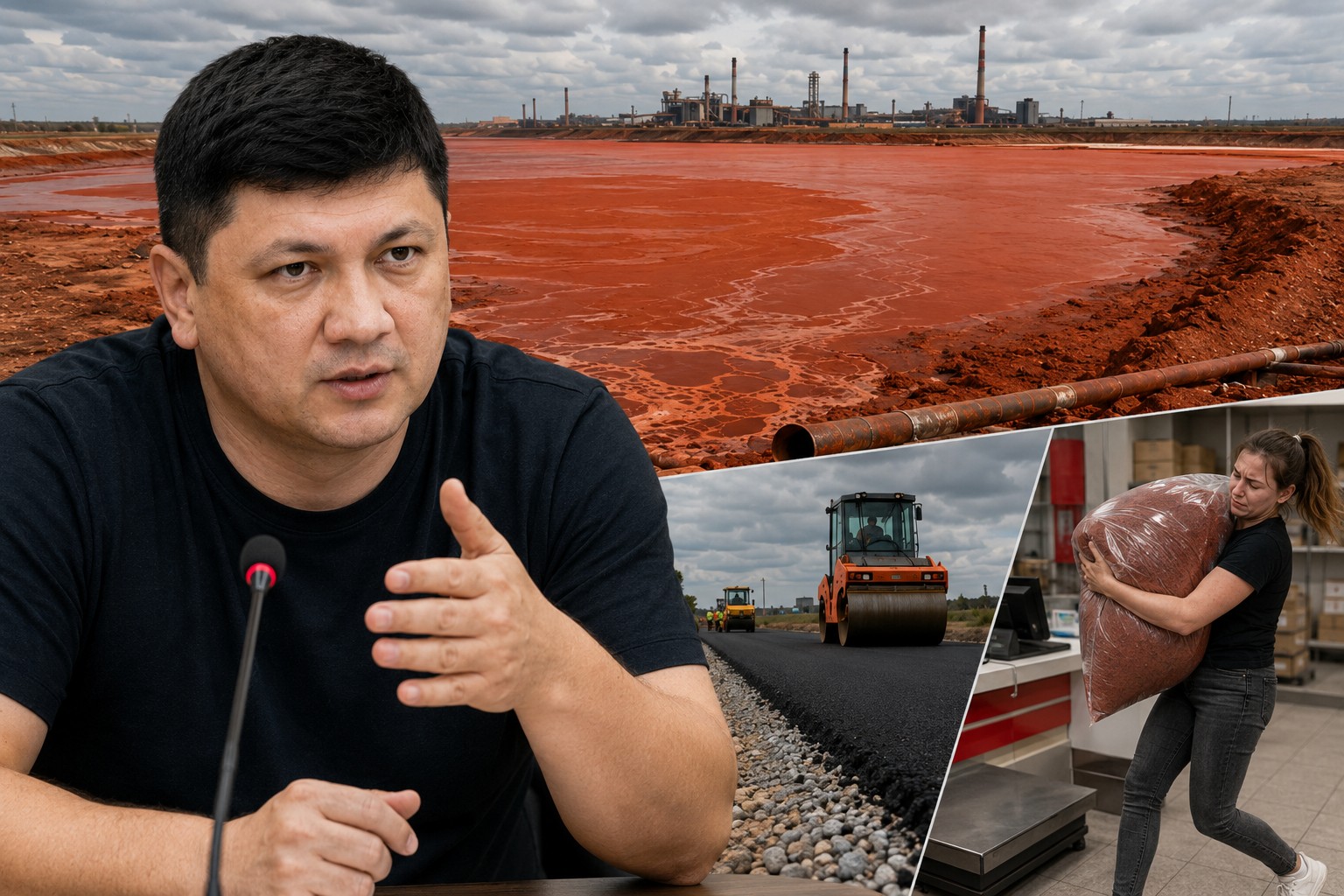
Mykolaiv Regional Military Administration did not provide any document that would confirm the public statement by the former head of the OVA Vitalii Kim about sending to South Korea 50 kg of red sludge from the Mykolaiv Alumina Plant. The administration has no information about the shipment date, the “Nova Poshta” consignment note, customs declaration, recipient, laboratory, testing program, or research results.
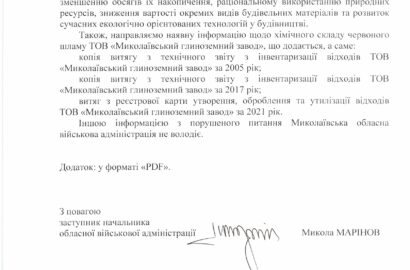
This is stated in the reply of the Mykolaiv OVA to an information request from the editorial office of Korabelov.info. The request was submitted on 19 July 2026 after Vitalii Kim’s final briefing as head of the regional military administration. The reply was signed by the deputy head of the OVA, Mykola Marinov.
The OVA has no information about a parcel with 50 kg of sludge
The editorial office asked the administration more than 40 specific questions about sampling, packaging, shipping and testing of the red sludge from MGZ. Among other things, Korabelov.info requested the “Nova Poshta” consignment note, customs documents, an official request from the Korean side, a sample collection report, the name of the laboratory, the technical assignment and the results of previous studies.
However, after describing general cooperation with the Korean company, the Mykolaiv OVA said that the administration has no other information on the matter.
“The Mykolaiv Regional Military Administration does not possess any other information on the raised issue.”
Thus, the OVA did not confirm with documents any of the key details of Vitalii Kim‘s account about sending the sludge: neither the fact of sending 50 kg of material, nor its recipient, nor that an examination was carried out.
The absence of information in the OVA itself does not prove that the shipment definitely did not take place. At the same time, the administration headed at the time by Vitalii Kim does not have documents on the basis of which his public statement can be verified.
What the Mykolaiv OVA actually confirmed
In its reply the administration confirmed that on 14 December 2023 a memorandum of cooperation on the restoration of the region’s road infrastructure was signed between the Mykolaiv OVA and the South Korean company SG Co., Ltd..
The document envisaged the development of road reconstruction and construction projects, technical cooperation for their modernization and other infrastructure restoration measures. The memorandum description provided by the OVA does not mention transfer of the Mykolaiv Alumina Plant’s red sludge, specific laboratory tests or sending 50 kg of material.
The administration also reported that on 26 May 2026 Vitalii Kim, during a trip to the Republic of Korea, met with representatives of SG Co., Ltd.. The parties discussed prospects for applying the Eco-Steel Ascon technology for restoring roads in Mykolaiv region.
Only on 8 June 2026, after that meeting, did the OVA send a letter to the company president So O Jin proposing to work out the possibility of using SG technologies and materials based on MGZ sludge.
The letter also proposed implementing a demonstration project in Mykolaiv region – to arrange an experimental roadway of about 20 kilometers and to organize an exchange of specialists and scientific-technical materials.
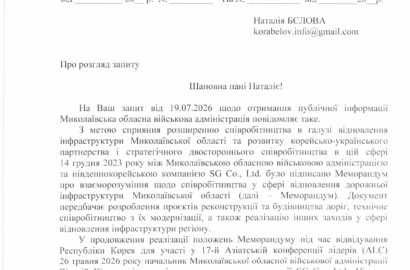
Therefore, as of 8 June 2026 the official matter was only a proposal to work out the possibility of using MGZ red sludge. The OVA’s reply contains no information about an agreed technology, a concluded contract for research, a completed examination, or the start of construction of the demonstration road.
What Kim said at the final briefing
At the final briefing on 18 July 2026 Vitalii Kim stated that the Korean company had already built an experimental section of road near Kyiv in the direction of Brovary. According to him, material from Kryvyi Rih was used during construction, and separately a company in South Korea was allegedly sent 50 kg of red sludge from MGZ.
“They made a piece of road near Kyiv towards Brovary. It withstood the winter no worse, even better, than a standard asphalt covering. They received an expert opinion. This is a different sludge. This is slag from iron ore from Kryvyi Rih. Regardless, they approved their program of activities here for themselves. They requested an analysis of this sludge from us. 50 kg. Viktoriia personally carried it on her back to ‘Nova Poshta’. In other words, it went there for examination in order to adapt the technology.”
The OVA’s reply contains no “Nova Poshta” documents. The administration did not provide the consignment note, payment receipt, description of contents or confirmation of delivery of the cargo to the South Korean company.
Kim spoke about transferring samples back in 2023
Vitalii Kim first publicly reported that sludge samples from MGZ had allegedly been handed over to the Koreans on 26 December 2023. This happened 12 days after signing the memorandum with SG Co., Ltd..
“I’ll put it this way: I have a very small hope, but I have it. One of South Korea’s technologies involves processing sludge for road construction. We have Kryvyi Rih, it’s definitely possible, there’s up to 18% savings while increasing quality. At the meeting with them I handed over samples of our MGZ sludge. If they can use our sludge in road repairs, it will save us,” – said Vitalii Kim.
In response to Korabelov.info’s request, the OVA did not provide documents about this transfer. There is no information about the amount of material, the recipient, the method of transport, research results or the further fate of the samples which, according to Vitalii Kim, were transferred back in 2023.
The administration also did not explain whether the 50 kg that the official mentioned in July 2026 was a new batch, or whether it was a continuation of work with the samples mentioned almost three years earlier.
At first the road was “in Korea”, then – near Kyiv
On 27 May 2026 Vitalii Kim again returned to the topic and said that samples provided by the Ukrainian side had already been used to build an experimental road in South Korea. According to him, the section stood for about a year and showed good results.
“We sent samples of sludge that exist on Ukrainian territory to Korea, and they made an experimental part of the road,” – said Vitalii Kim.
However, on 18 July 2026 the official reported that the road was built not in South Korea but near Kyiv, and that the material used for it was not MGZ red sludge but material from Kryvyi Rih.
At the same time, the OVA’s official reply shows that only on 8 June 2026 did the administration propose to the Korean company to work out the possibility of using materials based on MGZ sludge. In other words, the letter with such a proposal was sent after the claim about the allegedly successful road test.
Slag and sludge mixed into one story again
Korabelov.info earlier checked information about SG’s technology. The Eco-Steel Ascon technology uses steel slag – the metallurgical slag produced during steelmaking.
The red sludge from MGZ is a different type of industrial waste. It is produced during the manufacture of alumina from bauxite and has a different composition and properties.
The experimental section by SG was arranged in the Kyiv region on the road between the villages of Zalissia and Zavorychi. Its length was about 850 meters. Korean reports referred specifically to steelmaking slag, not to MGZ red sludge.
In response to the request the Mykolaiv OVA did not provide a conclusion from the Korean company that the Eco-Steel Ascon technology is suitable specifically for using the red sludge of the Mykolaiv Alumina Plant.
Instead of a new examination – documents from 2005, 2017 and 2021
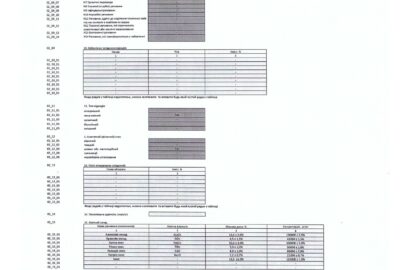
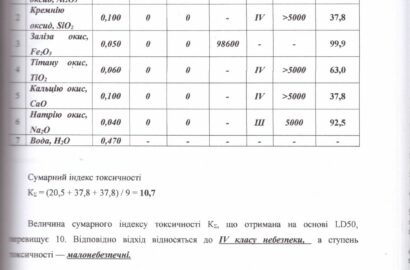
At the request to provide examination results of sent samples, the OVA handed the editorial office three old documents on the composition of MGZ waste:
- an extract from the technical report on waste inventory for 2005;
- an extract from the technical report on waste inventory for 2017;
- an extract from the register card on formation, treatment and disposal of waste for 2021.
The register card for 2021 already contains the chemical composition of the red sludge.
In particular, the sludge content is given as:
- iron oxide – 55%,
- aluminum oxide – 13%,
- calcium oxide – 8%,
- titanium oxide – 5%,
- silicon oxide – 4.5%
- and sodium oxide – 2.2%.
At the same time the OVA did not report which additional tests the Korean specialists are supposed to carry out, how they differ from previous analyses, and why exactly 50 kg of material was required for them.
It is also unknown who and by what method took this sample, from which sludge storage it was taken, and whether it can characterize all the red sludge accumulated on the territory of the MGZ.
Only the proposal is officially confirmed
After receiving the reply, only the memorandum of cooperation with SG Co., Ltd., the meeting of Vitalii Kim with company representatives and the 8 June 2026 letter proposing to work out the possibility of using MGZ sludge remain officially confirmed.
The transfer of samples in 2023, the sending of 50 kg via “Nova Poshta”, carrying out an examination and adapting the Korean technology to MGZ red sludge are not confirmed by documents held by the Mykolaiv OVA.
The administration also did not provide information on a possible completion date for the studies, the construction of an experimental road in Mykolaiv region, or confirmed safety of using red sludge in road surfacing.
Earlier we wrote:
- MGZ sludge fields hung “in the air” for three years: the State Property Fund said it saved the South from disaster
- Equipment for “red sludge”: MGZ receives machines for servicing sludge fields
- Kim confused sludge with slag: the “Korean road” was found not in Korea but near Kyiv
- Roads from MGZ sludge: after tests in Korea Kim wants to move to repairing Mykolaiv roads
- Using MGZ sludge in road construction is possible, – Kim on involving South Korean technologies