Almost 50 million tons of red mud near Mykolaiv: what will happen to MGZ's waste and can it really be recycled?
Not just waste but a "treasure": at MGZ they are seeking gold, metals, and a way to dispose of sludge

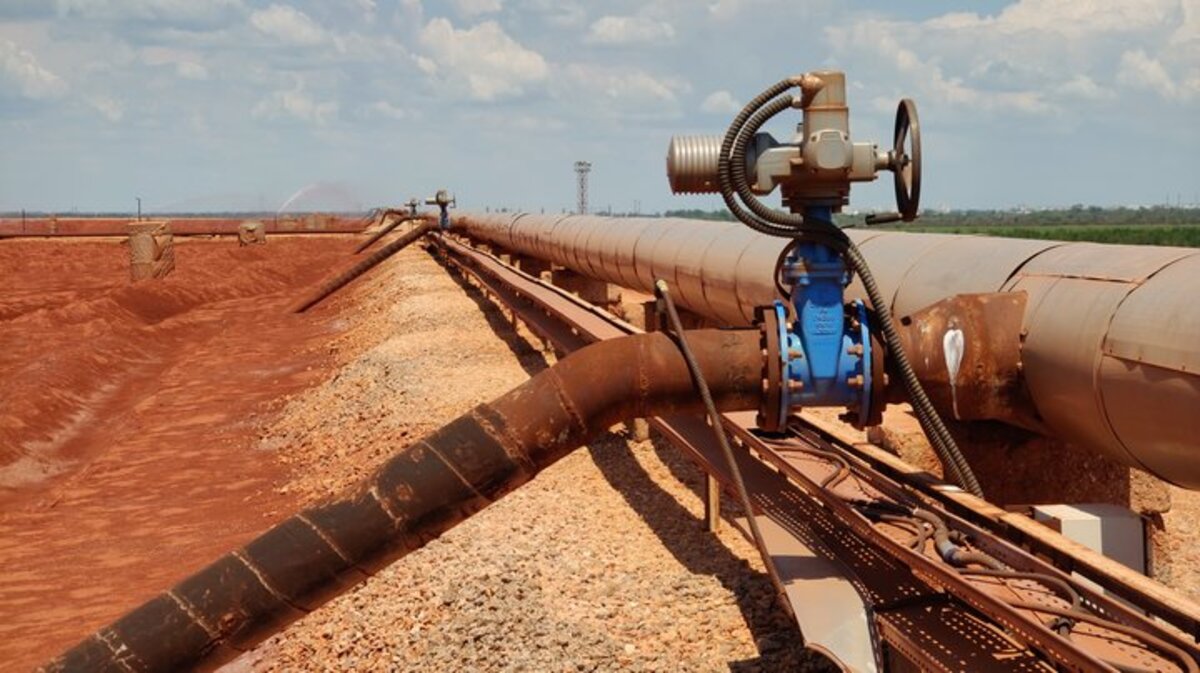
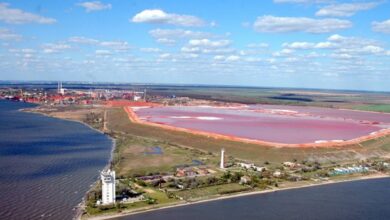
Nearly 50 million tons of red mud have accumulated in two tailings ponds of the Mykolaiv Alumina Plant in the Halytsynivska community. These industrial wastes contain alkali and various metals, including rare-earth and precious elements. The plant itself has not operated since the start of the full-scale war, but the mud has not disappeared — it needs to be stored safely, its dusting contained, and at the same time options for processing or reuse sought.
Reporters from Suspilne looked into possible ways to manage the red mud, its potential value and environmental risks.
According to the acting head of the Mykolaiv Regional Military Administration (OVA), Heorhii Reshetilov, work on possible uses of the red mud began to be developed at the international level while Vitalii Kim was in charge.
“As everyone saw in the information space, Vitalii Kim, while in South Korea, raised these issues; they were being worked on, there are certain developments, and further work is underway regarding the possibility of using it in road construction,” says Heorhii Reshetilov.
The OVA regards the red mud as secondary raw material that can be researched for further use in construction or metallurgy. At the same time, the issue requires technological and economic justification.
The enterprise has not been operational since the start of the full-scale war and has no funds for disposal or processing of the mud, says economist Oleksii Miroshnychenko. After the plant was nationalized in 2023, he says, the problem of the tailings ponds became an issue that concerns not just the enterprise but the region and society as a whole.
“If this could be a potential environmental catastrophe like the one a decade and a half ago in Hungary, when later millions, and now, by our estimates, billions of hryvnias will be spent on eliminating an environmental disaster. In other words, we are now investing funds so as not to spend more in the event of a catastrophe,” says Oleksii Miroshnychenko.
In his view, processing the mud could not only reduce environmental risks but also create jobs and provide budget revenues.
Scientists have been working on the problem of red mud and its dusting for years. The head of the Department of Ecology at the Petro Mohyla Black Sea National University, Doctor of Biological Sciences Liudmyla Hryhorieva, says that the university’s Center for Applied Environmental Research worked with the MAP from 2004–2016 on the problem of dust spread. As a result, part of the first tailings pond was reclaimed — it was covered with artificial soil and vegetation was planted. Researchers studied how to form a humus layer that could become an organic medium for plants, and selected species capable of withstanding local temperature and wind conditions.
“We thought about and evaluated how to create that humus layer to form an organic bed for plants — we found that. In addition, we selected plants: those native to our area, suitable for our temperature regimes and wind conditions,” says Liudmyla Hryhorieva.
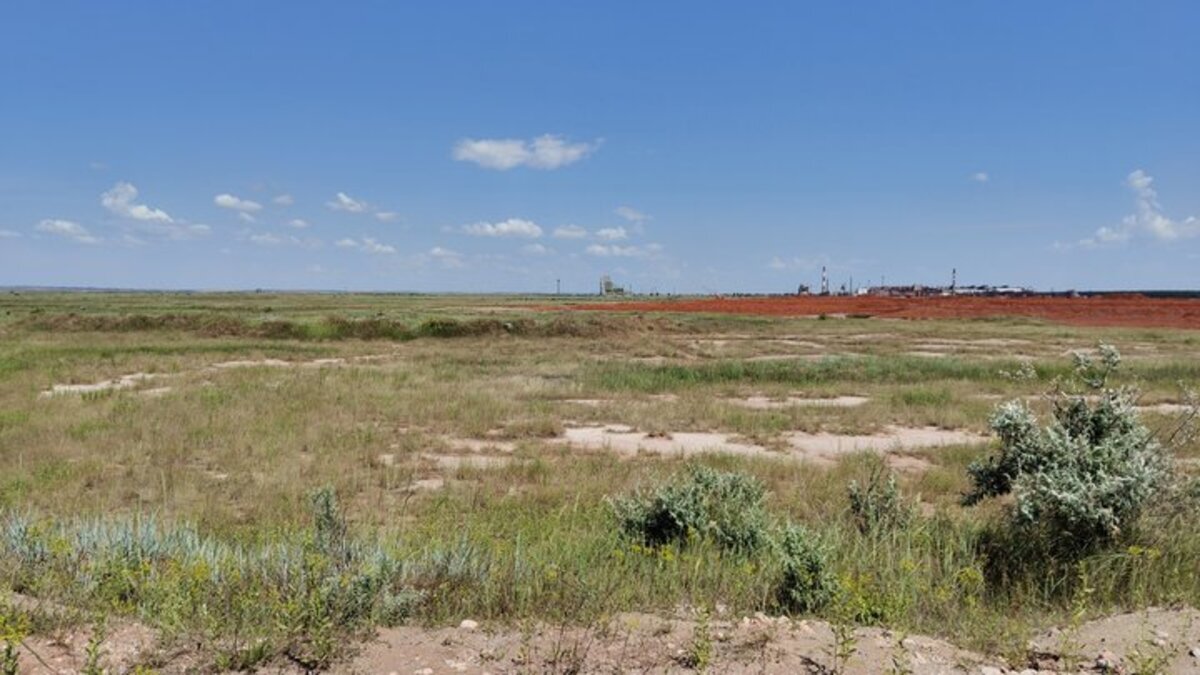
At the same time, the scientist notes that, in addition to toxic substances whose spread reclamation is meant to minimize, the mud also contains valuable elements, including precious metals and even gold.
Director of the Institute of Nanotechnologies and Organic Products Tymur Levda says that together with colleagues he studied various ways to use the red mud, including as a construction material. According to the research results, the most economically feasible use, he says, proved to be using the mud in agriculture after neutralizing harmful substances, primarily the alkali.
“This is the production of ameliorants. And then that ameliorant, when we already researched it. And we obtained good indicators of yield increase, against the background of reduced soil salinity. So it had several uses: both an ameliorant and a fertilizer. In the composition in which we applied it, it renewed the so‑called biota — we tested it on biological microorganisms,” says Tymur Levda.
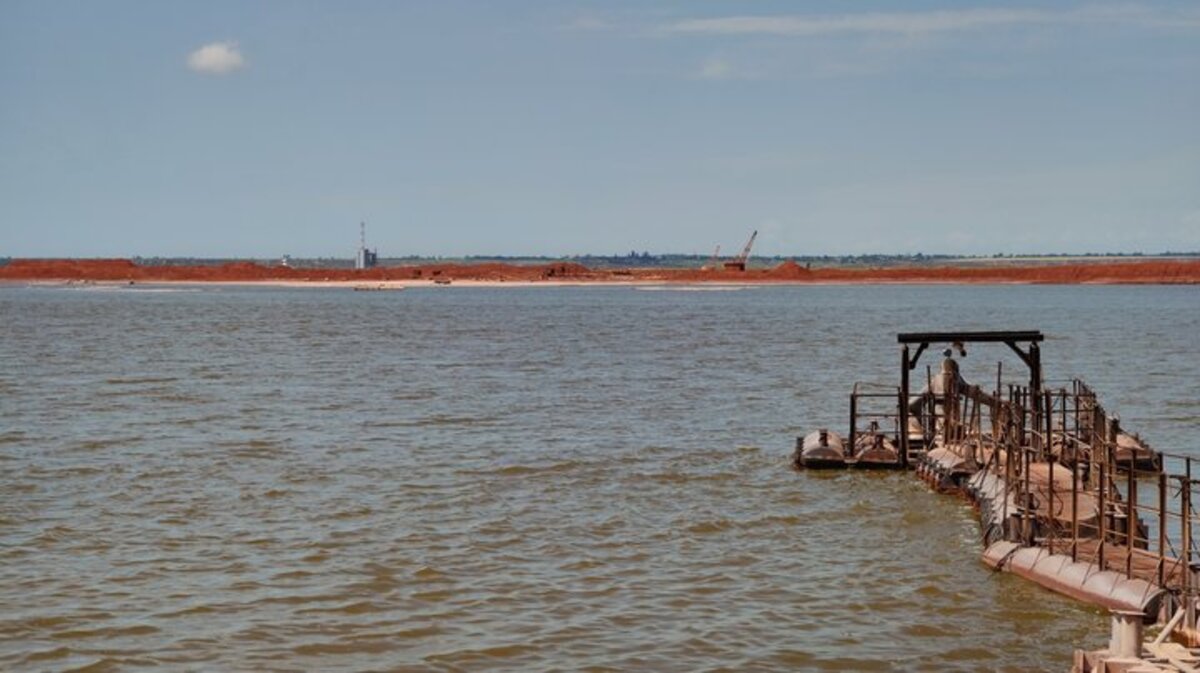
Another direction is extracting metals and other valuable components from the red mud. Chemical engineer and private entrepreneur Oleksandr Vasyuta believes that the capacities of the Mykolaiv Alumina Plant are sufficient to engage in extracting such substances. According to him, the red mud contains up to 40 percent iron oxide, about 10 percent titanium oxide and up to 15 percent aluminum oxide.
“If it is processed into an iron oxide pigment, which is a component of paint and plastic products, its market price is from one and a half to two dollars per kilogram. Multiply 400 kilograms by two — 800 dollars,” says Oleksandr Vasyuta.
He notes that thanks to the content of these components, from one ton of mud it is potentially possible to obtain products worth over one thousand dollars. In addition, the red mud contains rare-earth metals. Their quantity is smaller, but the value of such components can be much higher.
Acting general director of the Mykolaiv Alumina Plant, Oleksii Medvid, says the enterprise is ready to consider a technology for processing the red mud if such a technology is proposed. At the same time, he notes that if implementing the technology requires new capital investments and equipment, that will be a matter for the investor who purchases the enterprise.
The safety of the tailings ponds remains a separate problem. The director general of the regional Center for Disease Control and Prevention, Dmytro Makarov, says specialists periodically conduct monitoring studies of drinking water from wells, soil and air in the Halytsynivska community. According to him, in 2026 they did not find any impact from mud dusting on their quality.
At the same time, earlier studies showed excess concentrations of certain substances in drinking water.
“In 2024, eight samples of drinking water from wells were taken in the town of Lymany — two of them exceeded limits for arsenic. And in the village of Lupareve, 12 water samples were taken — four of them exceeded limits for strontium and arsenic,” says Dmytro Makarov.
According to the director general, this could potentially be related to the impact of the tailings pond on groundwater horizons, but a scientific expert assessment is needed to determine the exact cause.
For residents of nearby villages the problem is not limited to laboratory indicators. Farmer Serhii Tiutiunnyk, who cultivates land in Prybuzke of the Halytsynivska community, says that sometimes the red mud reaches his village.
“Mostly, of course, the wind rose affects Lymany, but when the wind changes — for example now the wind is this way: the day before yesterday there was a red dome there. We breathe all of this — it’s like the entire periodic table, we’re not getting healthier. And there are already enough explosions and everything else, and the mud helps with that,” says the farmer.
He says he does not see the mud being sprayed as it was before.
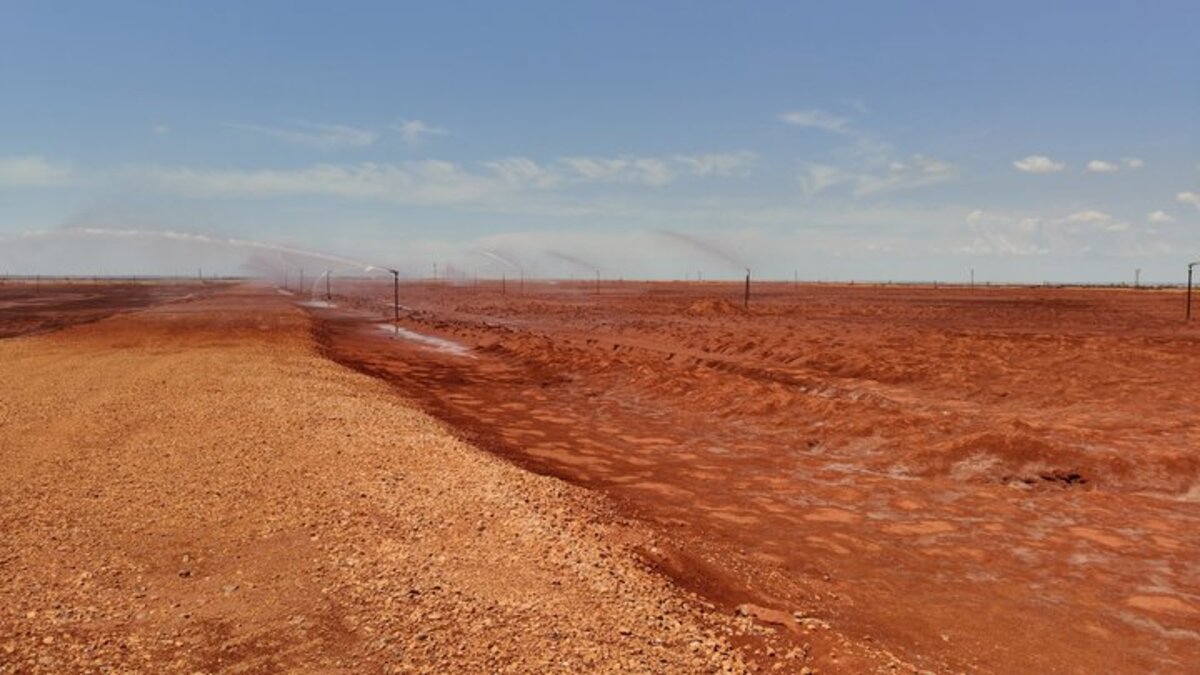
 The plant manager Oleksii Medvid assures that tailings pond No. 2 is watered daily from 09:00 to 18:00, and if necessary — at night as well.
“Red mud itself is, of course, harmful because it contains alkali — that’s what generally causes harm. Everything else is what we have in our soil. But the alkali — it harms if it gets into open eyes, the mouth or nose — yes, there will be a thermal burn. But no one says that during dusting the whole cloud drifts onto one person or one village,” says Medvid.
He adds that the mud is very fine and has a consistency similar to flour.
“We have all worked here for decades — and it’s been fine,” says the manager.
Currently about 400 people work at the plant. About 100 of them are guards; the rest maintain equipment and service the two tailings fields. The first tailings pond was taken out of operation in 2008. According to Oleksii Medvid, it still poses a danger.
“There is approximately 1.2 million cubic meters of alkaline water in basin ‘A’. And basin ‘B’ — it dusts because of the angle of sludge preparation,” he explains.
During the downtime since 2022, the enterprise restored up to 70 percent of the dust suppression means. The system that automatically responded to wind gusts was destroyed by Russian shelling.
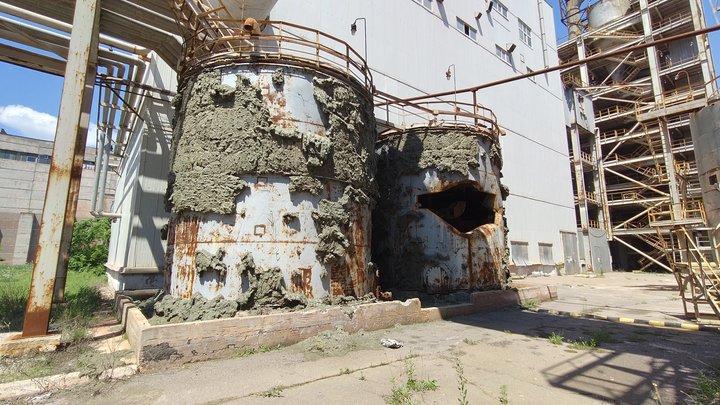
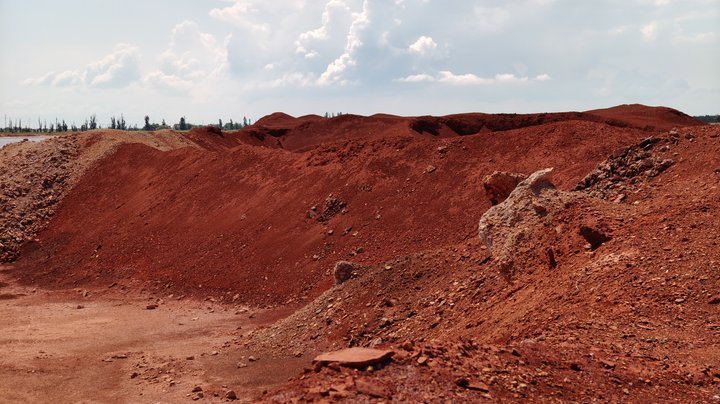
One field has been in operation since 1979, and 28 million tons of mud have accumulated on it. In 2008 the plant switched to a new storage technology. The second field holds about 20 million cubic meters of red mud, and the field area is 140 hectares. According to the manager, the dry storage technology is the most modern and optimal.
“A minimal amount of moisture came in with the red mud from production. Special equipment that processes this field — a rotary screw conveyor — is a machine that during its operation squeezed out moisture, which then went to settling ponds and returned to the production process. The mud was then stored dry,” explains the manager.
In this way the mud was maximally compacted. At the same time, after the top layer dries out, and in the absence of adequate dust suppression, even small wind gusts can lift fine particles into the air.
For Mykolaiv and neighboring communities the issue remains twofold: on the one hand, nearly 50 million tons of industrial waste require constant monitoring and safe storage; on the other hand, the red mud itself is viewed as potential secondary raw material from which metals can be extracted or which can be used in other sectors after appropriate preparation.
At the same time, there is no final decision yet on large-scale processing of the mud. Its possible use requires technological research, safety assessment, identification of funding sources and an investor willing to invest in the necessary equipment.
Earlier we wrote:
- No laboratory, no delivery note, no results: Kim’s claim about MAP mud was not confirmed by documents
- Over 552 thousand tons of MAP raw materials are being prepared for sale: the State Property Fund is looking for buyers
- Equipment for the “red mud”: MAP receives machines to service the tailings fields
- Kim confused mud with slag: the “Korean road” was found not in Korea but near Kyiv
- They want to sell MAP successfully, but first they need to convince the investor not to fear the war