Starlink Alternative for the Military: Obria Needs at Least 100 Satellites
Under favorable conditions, the network is planned to be rolled out within one to two years

For basic continuous satellite coverage of the entire territory of Ukraine, the future Obria network will need at least 100 satellites. This preliminary estimate comes from Ukrainian company HIMERA, which is developing its own communications system together with Denmark’s GomSpace, primarily for the military, government, and other state institutions. HIMERA founder Misha Rudominsky discussed the project’s scale, timeline, and funding in an interview with Oboronka. As reported.
The developers aim to reduce the state’s dependence on the American Starlink system and ensure critical communications regardless of decisions made by foreign companies. At the same time, the team does not intend to immediately replace the service for all its users in Ukraine: the military and state institutions remain the priority.
“The network will belong to a Ukrainian company, governed and operated under the laws of Ukraine,” Misha Rudominsky explained.
Practical testing of the technology is already underway. HIMERA and GomSpace launched the first test satellite, Obria NANO, into orbit on October 1, 2026, as part of SpaceX’s Transporter-18 mission. The companies announced the launch and the planned course of technical testing on October 27, 2026.
The spacecraft, built with Danish partners and weighing 10 kilograms, is a technology demonstrator, not a production satellite for the future network. It will be used to test equipment and develop system operations. The first telemetry was received the day after launch, but it is too early to draw conclusions about the results: the testing program is set to run for 1 year.
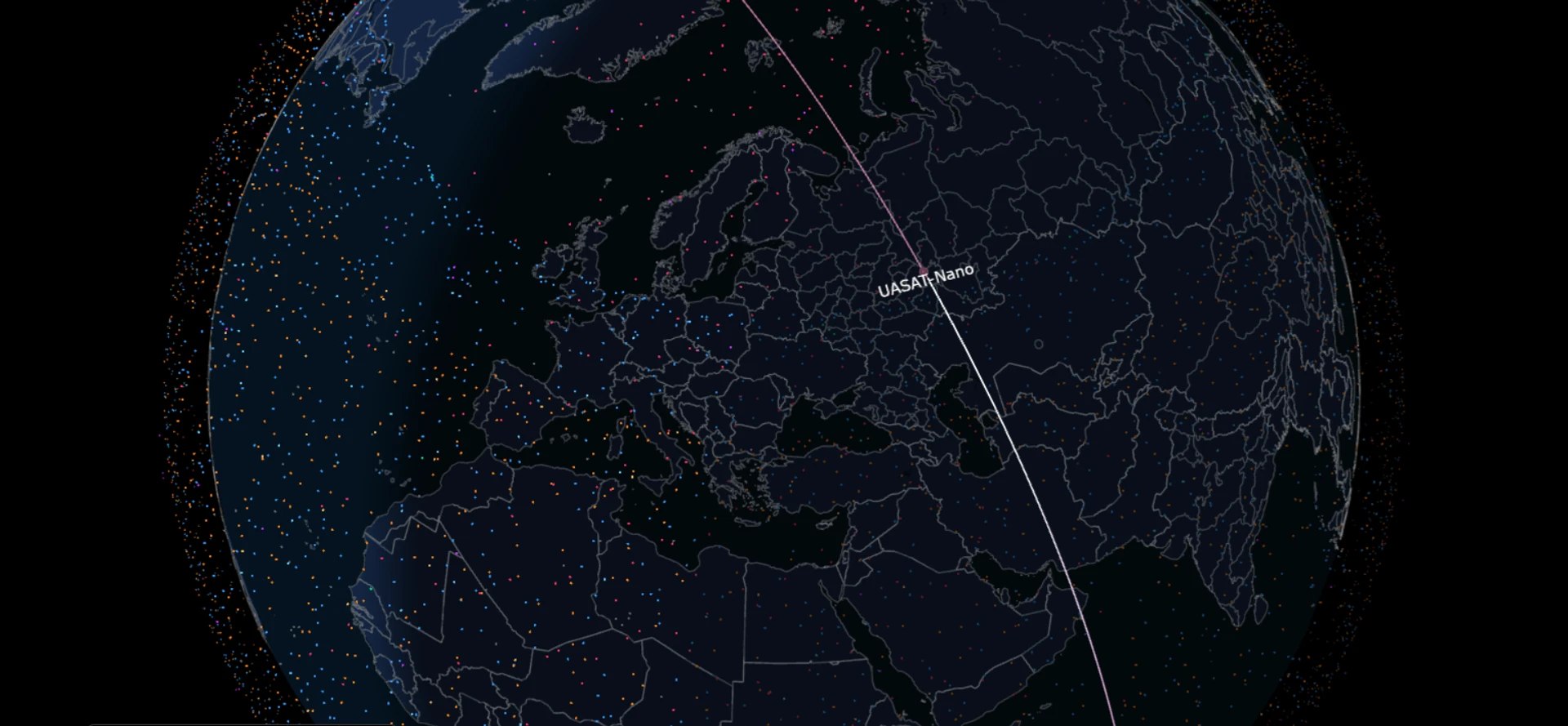
Obria NANO is in a low Earth sun-synchronous orbit and passes over Ukraine once a day. During each pass, the team will be able to establish contact with the spacecraft. According to Misha Rudominsky, the available window for data transmission may last around 6 minutes.
The satellite’s movement can be tracked online. The source article also notes that its trajectory does not pass over Europe.
Production satellites will differ substantially from the current demonstrator: their estimated mass will be 250 kilograms. The plan is to send them into orbit in groups of dozens during a single space mission.
“Our main objective is stable connectivity 24/7,” Misha Rudominsky noted.
The network’s desired capabilities include transmitting video with minimal delay and supporting terminals on moving vehicles. However, it is not yet known whether its speed will match Starlink.
According to the company’s preliminary estimate, full deployment could take 1–2 years under favorable conditions. This is not a guaranteed timeline: it will depend on satellite production, the availability of necessary components, and the ability to launch spacecraft into space.
The initial phase was funded by private members of the consortium, including HIMERA and GomSpace. No government funding was used to launch the test satellite, and the company has not disclosed the cost.
Continuing the work will require significantly greater investment. Misha Rudominsky speaks of tens and hundreds of millions of euros, and potentially even billions of euros. Funding is expected to come from private investors and government programs, including through cooperation between Ukraine and the European Union.
The company’s founder identifies the following key obstacles:
- long waits for rocket launches;
- a limited number of satellite manufacturers;
- delays in component deliveries;
- the complexity of manufacturing communications terminals and the backlogs for ordering them, which can reach several years at some manufacturers.
Due to difficulties sourcing terminals, HIMERA is considering manufacturing the devices itself. In the coming months, the team also intends to learn how to operate satellites independently and determine Ukraine’s priority needs for space communications.
“This project will only work with very close coordination of support from all parties,” Misha Rudominsky emphasized.
According to him, further development of Obria requires coordinated support from:
- Ukrainian customers;
- consortium members;
- European partners.
Restrictions on satellite communications for the Ukrainian military have made the need for its own infrastructure particularly urgent. On the night of October 14, SpaceX restricted the operation of Starlink terminals in Ukraine. The White House denied that the administration of US President Donald Trump was involved in the decision and said it does not control the company. Meanwhile, Axios reported that the US administration intended to ask SpaceX why the restrictions had been imposed.
The Reuters news agency published a different account, citing two American and one Western senior official. According to them, the White House ordered restrictions on Starshield, the satellite system used by the Ukrainian military for frontline communications and to control interceptor drones. The agency’s sources linked this to Donald Trump’s demands that Ukraine stop striking Russian oil refineries.
President of Ukraine Volodymyr Zelenskyy called the reduction in Starlink speeds a planned operation. He also said that the Ukrainian side was continuing to contact SpaceX, but that the company’s representatives had not responded at the time.
On October 21, The Wall Street Journal reported that Elon Musk had ordered the military version of Starlink to be slowed down for Ukraine. According to the publication, this left some Ukrainian strike drones and interceptor drones practically unusable. Meanwhile, Pentagon chief Pete Hegseth denied that the US had ordered restrictions on Starshield in Ukraine.
Separately, the Main Directorate of Intelligence of Ukraine’s Ministry of Defence published information on 49 Russian and Belarusian companies and institutions involved in developing the Rassvet satellite system. Russia plans to use it for military communications and to control troops and unmanned aerial vehicles.
We previously reported:
- Ukraine’s own satellite communications: ICEYE and Nokia to study the project
- Pentagon received White House order to restrict Starshield for Ukraine’s Armed Forces — Reuters
- Restrictions on military Starlink disrupted important Defense Forces missions
- Ukraine is creating its own Starlink alternative — Zelenskyy
- A new sky for attacks: Russia is creating its own Starlink to control drones