Waste sorting in Mykolaiv could pose risks of UAH 238 million per year to the municipal enterprise
Deputy Fedir Panchenko believes that the draft contract could shift the logistics costs and the risks of non-payment onto "Mykolaivkomuntrans"


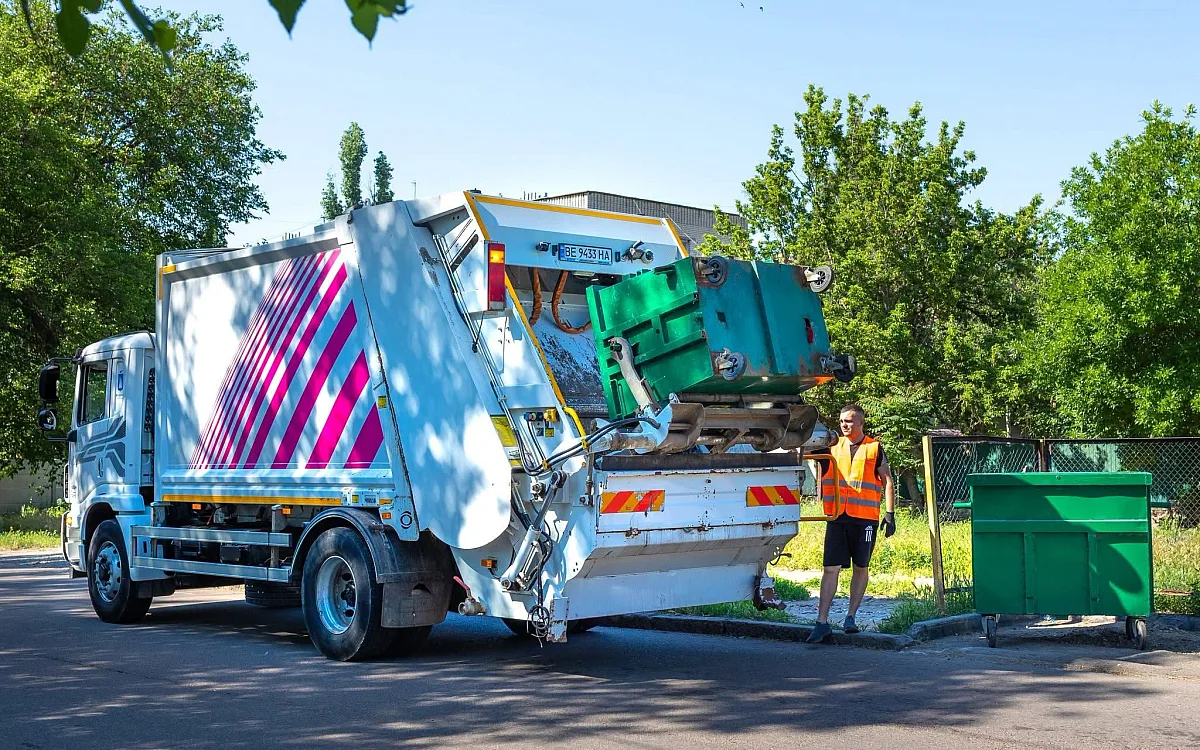
The draft agreement on household waste sorting that the Mykolaiv City Council plans to conclude with a private operator following the results of a tender could increase the financial burden on the city and create problems for the municipal enterprise KP «Mykolaivkomuntrans». This was stated at a meeting of the council’s housing and communal services committee by Mykolaiv City Council deputy Fedir Panchenko.
A tender must be held to determine the company that will sort the waste collected in Mykolaiv. Under the current wording of the contract, after the winner is determined the municipal enterprise will be required to deliver the city’s waste specifically to that company’s sorting line — regardless of where it is located.
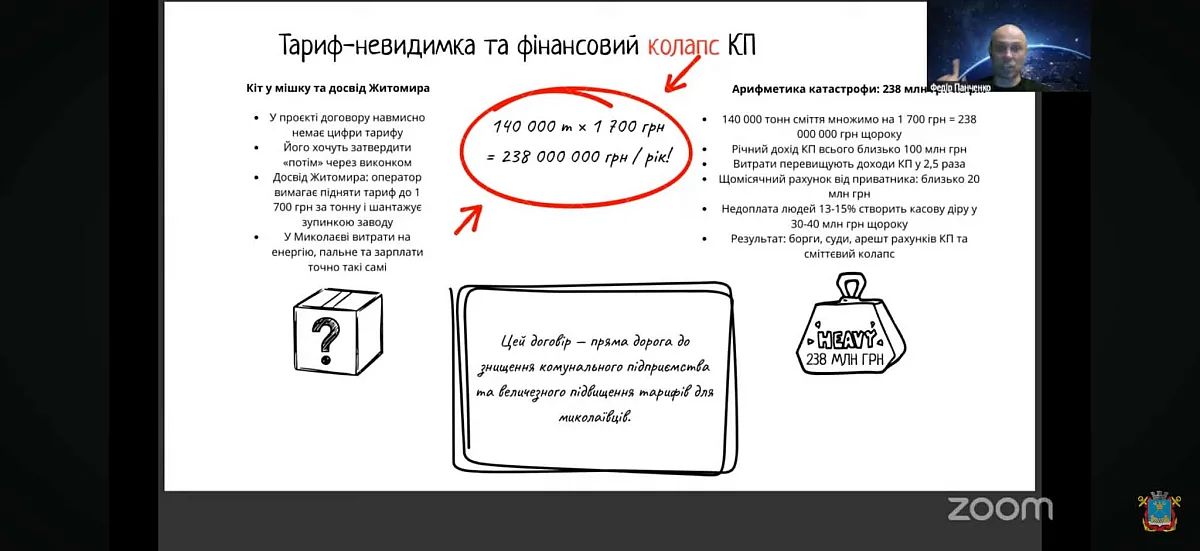
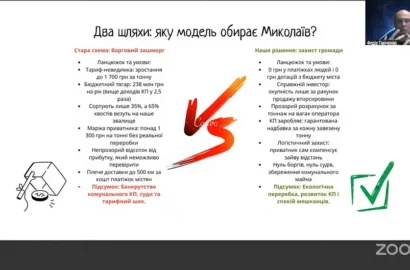
Mykolaiv sends about 140,000 tonnes of waste to the landfill each year. According to Fedir Panchenko, the city must not only bring the waste to the private operator at its own expense, but also pay for its sorting.
“Mykolaiv buries about 140 thousand tonnes of waste in the landfill every year. We will have to deliver the waste to the company at our own expense and also pay for sorting. How much exactly — they are now trying to hide this from us so that we don’t protest in advance,” the deputy said.
As an example, he cited Zhytomyr, where, according to his information, the sorting tariff rose over several years from roughly 150 to 988 hryvnias per tonne. At the same time, the operator, the deputy claims, stated that the current tariff covers only 57% of the service cost.
Based on that experience, Fedir Panchenko suggests that in Mykolaiv the sorting tariff could be about 1,700 hryvnias per tonne. Applying this amount to the entire annual waste volume, potential costs could reach about 238 million hryvnias per year.
A separate risk the deputy sees is that “Mykolaivkomuntrans” could effectively become an intermediary between residents and the private operator. The enterprise would collect payments from subscribers, pass them on to the private company, and at the same time bear responsibility for non-payments.
According to Panchenko, consumer underpayments to the municipal enterprise currently amount to approximately 13%. If, after the introduction of a new tariff, some residents refuse to pay, the lost revenues could turn into a cash shortfall of about 40 million hryvnias. Then the municipal enterprise would have to cover the deficit with its own resources or annually appeal to the city council to replenish its statutory capital. In the long run, the deputy does not rule out court rulings, freezing of accounts and seizure of the enterprise’s assets.
“The municipal enterprise is being asked to collect these funds from citizens and transfer them to the private company, practically performing the role of a collector for free and taking on all the risks of underpayment. With the current underpayment level of about 13%, in the best case the enterprise will fail to collect around 40 million hryvnias. This amount will become a cash shortfall that will have to be covered by who knows what — its own funds or annual replenishment of statutory capital. Later this may lead to court rulings, freezing of accounts and seizure of property,” the deputy reported.
Another weak point of the contract, Fedir Panchenko called the possibility for the municipal enterprise to receive a certain percentage of the proceeds from the sale of secondary raw materials. In his opinion, such a model is complex and opaque, because the operator of the sorting line can influence information about the volumes of sold material, and it will be very difficult to verify these data.
“They propose making the municipal enterprise’s income some mythical percentages of the sale of secondary raw materials. This is a complex and non-transparent scheme that the sorting line operator will be able to manipulate, and control over it will be extremely difficult,” Panchenko said.
The deputy also drew attention to logistical costs. If the sorting line of the tender winner is located outside Mykolaiv, the draft contract, he says, does not clearly define who will pay for the additional transportation.
“What will happen if the winner is a participant who operates, for example, in Zhytomyr? They will tell us: bring the waste here at your own expense. The contract does not regulate this issue. In fact, the enterprise could be obliged to deliver waste to who knows where and pay for it enormous sums,” the deputy said.
According to Panchenko, the document also does not contain sufficiently concrete requirements for handling the residues after sorting — the so‑called “tails.” Using Zhytomyr as an example, he noted that after processing about 60% of the waste, in his information, still ends up at the landfill.
The deputy believes that without a clearly defined sorting depth the operator may receive high payment for the service while sending a significant portion of the waste directly to the landfill. The cost of burial, according to his data, is about 320 hryvnias per tonne, while the sorting tariff may be at the level of 1,500–1,700 hryvnias. The difference could be around 1,300 hryvnias per tonne.
“The operator receives waste at a tariff of 1,500–1,700 hryvnias per tonne, after which they can take it to the landfill and pay about 320 hryvnias for burial, leaving the difference for themselves. If the abuse is even greater, the trucks can go straight to the landfill while the documents state that they visited the sorting line. This is a kind of waste arbitrage. A contract with such gaps should not be allowed,” Panchenko said.
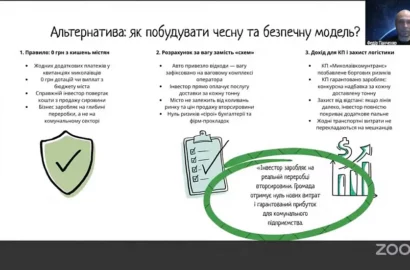
To change the proposed approach, the deputy suggested holding the tender not for the right to receive payment for sorting, but for the right to accept waste from the municipal enterprise taking delivery costs into account.
Under his model, the private investor should pay Mykolaivkomuntrans for transporting waste to its own sorting line. For example, if the line is located not at 50 but at 51 kilometers, the tender participant should pay the enterprise extra for the additional distance. Competition is proposed to be ensured by a bonus surcharge to the delivery payment:
- one participant can offer to pay for the delivery itself;
- another — to pay for delivery plus an additional 10%;
- a third — to pay for delivery plus an additional 20%.
In Fedir Panchenko‘s view, under this scheme no subsidies will be needed for the municipal enterprise, since delivery will be paid by the investor and the enterprise may even earn a small profit. Also, the deputy believes, there will be no need to introduce a new high sorting tariff for the population, and the operator will not be able to manipulate data on the sale of secondary raw materials.
In the proposed model, the investor’s business should be based on sorting and selling materials, not on receiving funds from the city, the budget and residents simply for accepting waste. Corresponding proposals were submitted to the draft decision on amendments to the regulation and to the draft contract that will be concluded as a result of the tender.
Members of the council committee supported this draft.
At the same time, introducing sorting will in any case require additional payment — regardless of who provides the service. Therefore, the waste collection tariff for the population will still increase.
Earlier it was reported that Mykolaiv plans to sharply raise waste collection tariffs: some services may become more than twice as expensive. A sorting line for household waste in the city should be created in accordance with legislative requirements, and the tariff will change in any case. The city council has already adopted a decision on the sorting line and the need to supply it with waste.
Previously we wrote:
- In Mykolaiv, municipal workers urge residents to collect plastic separately and throw it into mesh containers
- “Transparent” tender without open documentation: Mykolaiv again enters a waste story
- The same waste, but prices rise: residents of Korabelnyi are being prepared for a new tariff “surprise”
- Mykolaiv may be left without a functioning landfill for waste: authorities urgently take up sorting
- Same waste, different price: the executive committee raised the waste collection tariff for Korabelnyi