korabelov.info launches a monthly AI forecast on the internal state of the RF: first issue devoted to the fuel crisis, the budget, oil revenues, debts and the risk of regional destabilization
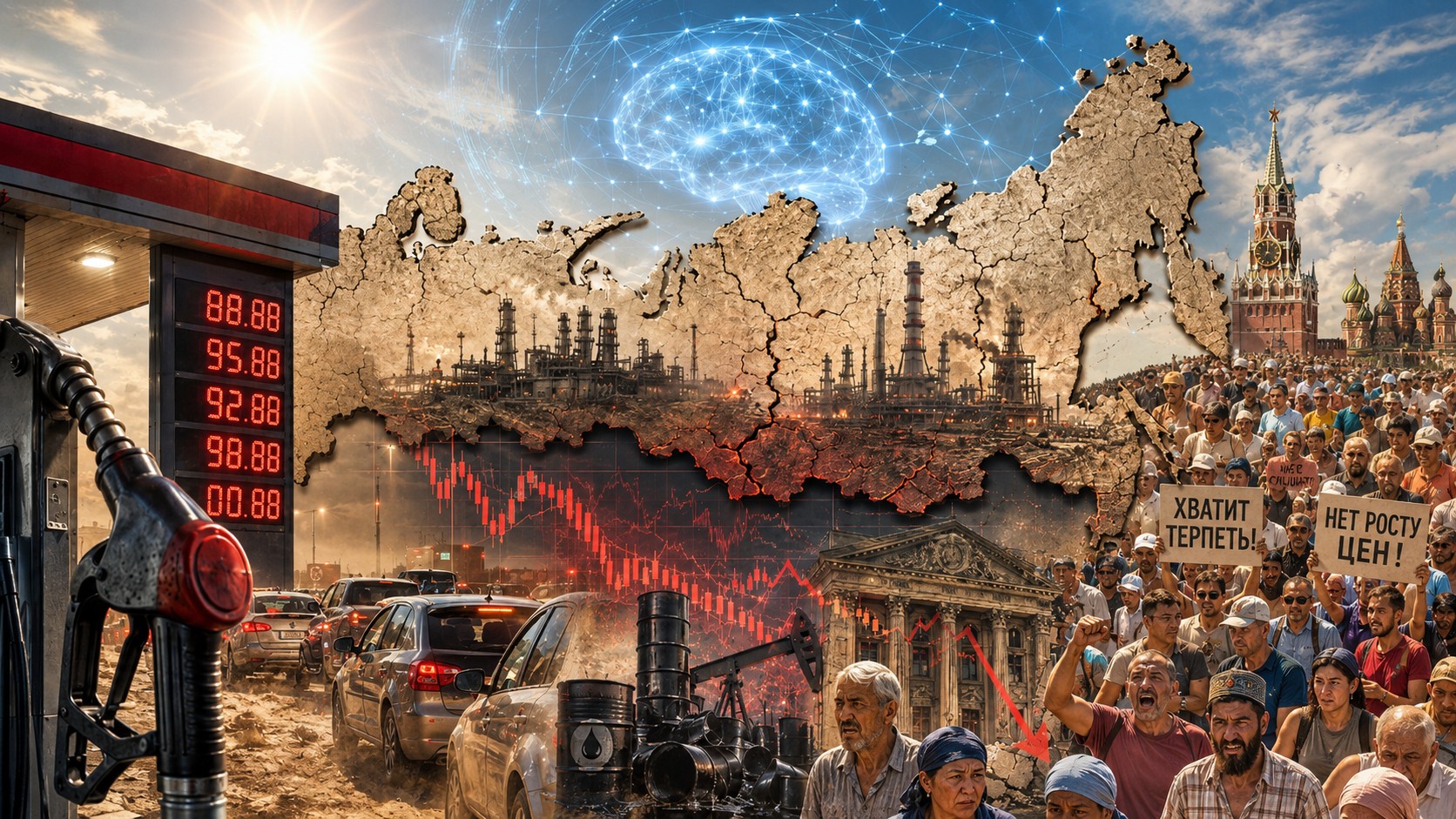
The first issue as of July 2026 is devoted to what may become Russia’s main vulnerabilities in the coming years: the fuel crisis, falling oil revenues, the budget deficit, hidden statistics, debts, inflation, war fatigue and rising tensions between Moscow and the regions.
The main conclusion of this forecast: do not expect a rapid territorial collapse of Russia in 2026. But the system is already entering a period of accumulating crises, and the most dangerous window for a major political rupture may open in 2027–2030.
This is not prophecy, but a forecast
This piece is not “prophecy” and does not give a precise date for the collapse of Russia. It is an analytical forecast that assesses open data, economic trends, weak points of the Russian system and events that are already occurring.
Each month korabelov.info will return to this forecast and check whether previous assessments are coming true: whether the fuel crisis is worsening, whether budgetary pressure is growing, whether oil revenues are falling, whether problems are building up in banks, and whether dissatisfaction in the regions is becoming more visible.
Main forecast for July 2026
The AI assesses that the most realistic scenario for Russia is not an instant collapse but gradual exhaustion across several directions simultaneously.
This concerns the fuel crisis, strikes on refineries, oil depots and logistics, falling oil revenues, rising budget deficits, problems with debt and the banking system, concealment of real statistics and rising irritation in the regions over the war, prices and inequality with Moscow.
The main idea of the first forecast: Russia may begin to crack not in the TV picture, but in the fuel tank.
Timeline: 2026–2030
According to the AI’s estimate, in 2026 a territorial collapse of Russia should not be expected. The most likely scenario for this year is a further deterioration of the situation: problems with the budget, fuel, inflation, war losses, public fatigue and hidden pressure on the economy.
But the center still holds the security apparatus. It remains the main safeguard against a rapid system collapse.
The most likely first serious window of political crisis is 2027–2028. That does not necessarily mean state disintegration, but abrupt personnel reshuffles may begin, the search for “those to blame”, conflicts between elite groups, attempts to freeze the war or, conversely, a new wave of mobilization.
The period 2028–2030 could become even more dangerous for Russia if the war does not end favorably for the Kremlin and the economy fails to restore its resource base. In that case a post-Putin scenario is possible, or a situation in which Vladimir Putin formally remains in power but is no longer the undisputed arbiter for the elites, security forces and regions.
After 2030 a territorial collapse of Russia becomes more realistic, but only under one key condition: if the center falls apart beforehand. Regions are unlikely to be the first to openly secede en masse. They will begin to withdraw when they realize that Moscow no longer guarantees money, force or protection.
Short takeaway of the timeline: in 2026 do not expect a quick “collapse of Russia“. Expect a buildup of crisis. The most realistic window for a major rupture is 2027–2030. And territorial disintegration may become a consequence, not a cause, of a central government crisis.
Fuel: why petrol for Russia is more than a fill-up
For Russia fuel is not just about cars. For a country so large in territory, petrol and diesel are the basis of logistics, transport, agriculture, the army, goods delivery and the daily life of the population.
When fuel shortages begin, almost everything becomes more expensive: food, transportation, factory operations, the agricultural sector, military logistics and the very survival of remote regions.
According to Reuters, the fuel crisis in Russia has already pushed prices at some independent filling stations above 100 rubles per liter. At some stations fuel was sold for 120–140 rubles per liter. Large chains tried to hold prices down, but as a result fuel ran out faster and some stations temporarily closed.
Separately, Reuters reported that in temporarily occupied Sevastopol petrol prices rose by 30% in a week. Against the backdrop of the shortage, the local occupation authorities restricted access to fuel for private drivers and also cut business and public transport services.
Ukrainian strikes on refineries: the war returns to the Russian economy
One of the key causes of the fuel crisis has been Ukrainian strikes on Russian refineries, oil depots and logistics. This is no longer only military pressure. It is a strike on the system that supplies both Russia’s civilian economy and its military machine.
Reuters wrote that on the night of 28 June 2026 Ukraine attacked two Russian refineries – in the Krasnodar and Yaroslavl regions. According to the agency, the strikes were part of Kyiv’s campaign to disrupt Russia’s fuel supply and weaken its military capabilities.
The same strikes were reported by korabelov.info: they concerned damage to the Slavyansky refinery in the Krasnodar region and a plant in the Yaroslavl region, one of which is located approximately 700 kilometers from the Ukrainian border.
For the Kremlin this is painful not only because fuel production decreases. It also destroys the main propaganda myth: that the war is far away, and everything inside Russia is under control.
Oil and the budget: the main source of money weakens
Oil and gas have for decades been the main financial foundation of Russia. It was from these revenues that the Kremlin financed the army, security forces, regions, propaganda and the appearance of “stability”.
But now that foundation is weakening. Reuters reported that oil and gas revenues to the Russian budget for the first 5 months of 2026 amounted to almost 3 trillion rubles, roughly 30% less than for the same period in 2025.
At the same time Russia’s budget deficit for the first 5 months of 2026 already stood at 2.6% of GDP against an annual target of 1.6%. The Russian central bank, in the face of these risks, on 19 June 2026 lowered the key rate only to 14.25%, meaning the economy remains under serious pressure.
For a country conducting a large-scale war against Ukraine, this is a dangerous combination: the war requires ever more money, while the main revenue source no longer provides the former cushion.
OPEC+, oil prices and a trap for the Kremlin
A separate risk for Russia is the situation on the global oil market. Reuters reported that OPEC+ may again raise its production targets from August 2026, by roughly 188 thousand barrels per day. This continues the trend of gradually returning some supply to the market.
For Moscow this is a bad signal. If there is more oil on the market and demand does not grow at the same pace, prices come under additional pressure. For Russia, which depends on oil revenues and simultaneously spends huge resources on the war, even a moderate drop in revenues can hit the budget, the regions and military spending.
So the problem is not only Ukrainian strikes on refineries. The problem is that Russia is facing several blows at once: damaged refining, domestic fuel shortages, a budget deficit and a less comfortable situation on the global oil market.
Debts and banks: a hidden weakness of the system
Another important direction is debt. Russia can show “stability” on television for years, but the banking system and budgetary spending are already feeling the strain.
Reuters reported that VTB, Russia’s second-largest bank, is preparing to increase reserves in the second half of 2026 due to inflationary pressure, rising fuel prices and borrower problems.
Reuters also reported that Sberbank lowered its expectations for corporate lending due to a rise in non-performing loans and the deterioration of borrowers’ financial condition. Some clients are increasingly requesting loan restructurings.
This means the fuel crisis is already hitting not only drivers and farmers. Through inflation, loans and expenses it is beginning to pressure businesses, banks and the budget.
Closed statistics: if everything is fine, why hide the numbers?
A separate alarming signal is data concealment. When the state is truly confident in its economy, it does not need to massively close statistics, change publicity rules and hide the real state of affairs.
Reuters reported that Russian authorities gained the ability to change plans on debts and expenditures without public hearings. New rules allow the government to borrow beyond budget-set limits, and changes to debts and expenditures no longer have to be public.
For the AI this is one of the important markers: the more Moscow hides financial and economic indicators, the more likely it is that the official picture does not match reality.
Closed statistics do not create stability. They only give the Kremlin time to hide problems from the population, businesses and the regions.
Regions: where the most dangerous crack may begin
The most dangerous factor for the Kremlin is not poverty itself. Russians can endure a falling standard of living for a long time. But something else is more dangerous: different regions pay different prices for the war.
Some regions send more people to the front. Others face fuel shortages. Others see money flowing to Moscow, the army and security forces while local infrastructure collapses.
It is here that territorial and national dissatisfaction may gradually grow. In Russia many regions have long lived with a sense of injustice toward Moscow. While there were enough funds, fear and cheap fuel, this was muted. But when the economy worsens, the question “why should we pay for the Kremlin’s war?” becomes increasingly dangerous.
Reuters, citing Gallup surveys, reported that economic pessimism among Russians reached its highest level in at least 20 years: 60% of respondents believe economic conditions in their locality are worsening, and 56% report a decline in living standards.
Why regions will not go first
The AI does not predict that regions will start to separate en masse first. For that they need not only dissatisfaction and a distinct identity, but also an understanding that the center can no longer punish, finance and control them.
Therefore territorial disintegration of Russia looks like a consequence, not the beginning, of the process. First the center must weaken: through an elite crisis, the loss of Putin’s role as arbiter, budget problems, defeats or an unfavorable end to the war, conflicts among security forces and a decline in Moscow’s ability to guarantee regions money and force.
Only after that may regions begin to act more boldly.
What this means for Ukraine
For Ukraine this forecast is important not as an “expectation of a miracle” but as an assessment of the enemy’s weak points.
Ukrainian strikes on Russian oil, fuel and logistics infrastructure have not only a military effect. They reduce the resources that feed the war against Ukraine and at the same time make Russians feel the real cost of aggression.
The war for Russia increasingly becomes not only the front, but queues at gas stations, more expensive fuel, transport problems, pressure on farmers, falling trust and growing dissatisfaction in the regions.
AI’s conclusion
As of July 2026 the forecast remains restrained but alarming for Russia: a rapid collapse this year is not expected, yet the system is entering a period of accumulating crises.
Fuel, the budget, debts, inflation, falling oil revenues, hidden statistics, war fatigue and rising tensions between Moscow and the regions are gradually undermining the aggressor state’s foundation.
The most likely window for a major political rupture is 2027–2030. That is when the crisis may move from the economic plane into elite struggles, a reassessment of Putin’s role, a search for those to blame for the war and the center’s loss of ability to guarantee regions money and force.
Territorial disintegration of Russia does not look like the first stage. It may become a consequence if the central government collapses beforehand. And korabelov.info will monitor this in the following monthly AI forecasts.
Previously we wrote:
- 700 kilometers did not save: Zelensky announced strikes on two refineries in Russia
- A plant for “Iskanders”, the “Dubna” center and the port “Kavkaz”: the Armed Forces struck a series of hits on Russian sites
- Occupiers’ logistics are collapsing: Crimea was left without petrol, power and ferries
- Long-range sanctions without warning: occupiers lose radars and “Pantsir”
- Moscow in smoke: drones struck refineries in Kapotnya, airports halted operations