A swarm of naval drones against "Shaheds": Denmark prepares a €12m defense for Odesa
Shoot down drones 20 km off the coast: Odesa to be sealed off with a maritime shield


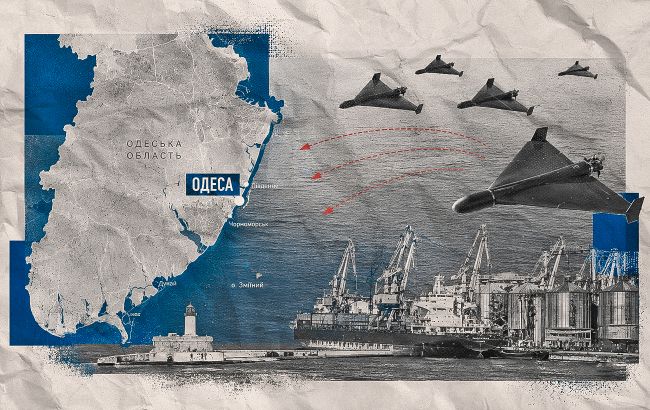
Danish startup BlueShadow is developing the Blue Dragon system, which is intended to intercept Russian strike drones over the Black Sea before they approach Odesa and the coastal infrastructure. It involves a swarm of autonomous unmanned boats capable of operating at a distance of approximately 10-20 kilometers from the shore.
The founder and CEO of BlueShadow, Charles Maher, spoke about the features of the development in an interview with RBC-Ukraine, published on 3 July 2026 after the final event of the Defence Builder defense accelerator. According to the company’s plan, the first squadron of maritime drones could appear off the Ukrainian coast in spring 2027, but before that the system must undergo further testing, obtain certification from the Ukrainian Ministry of Defense and be integrated into Ukrainian defense platforms. The protection system envisions deploying squadrons of 12 unmanned surface vessels. Approximately 10 boats will be constantly at sea, while another 2 will be undergoing maintenance, refueling and rearming. One such group, the developers estimate, can be controlled by only 5 people from a shore command center.
Each unmanned boat is planned to be equipped with interchangeable combat modules. Depending on the mission, it may carry interceptor quadcopters, missiles, machine guns, and later — electronic warfare means or other effectors. The swarm is intended to operate as a single network. The boats will exchange data in real time, receive information from their own sensors and Ukrainian command systems, after which the software will determine which platforms should move to intercept an aerial target. Describing his professional experience and the primary purpose of Blue Dragon, BlueShadow founder Charles Maher noted that the system is being created primarily to protect the coastal regions of Ukraine:
“By education I am a submarine officer of the U.S. Navy, I have extensive experience at sea and a passion for maritime security. Our technology is designed to protect people in the coastal regions of Ukraine — primarily Odesa, which regularly suffers strikes by Shaheds from the sea, where air defense capabilities are limited. We protect cities, infrastructure, and, importantly, trade. By protecting these key aspects of Ukraine’s coastal zone, we give the freedom to withstand pressure from Russia and also to recover even after combat in a hybrid warfare situation,” — BlueShadow founder Charles Maher.
The core of the complex will be a C4ISR-class platform that will combine command, communications, computing, intelligence, surveillance and target detection. The developers plan to exchange information with the Ukrainian systems Delta, “Kropiva” and SkyMap: the swarm will receive from them data on the air situation and transmit its own sensor information.
A BlueShadow Edge module is also planned to be installed on each unmanned vessel. It is meant to link individual boats into a single squadron with a shared operational picture. If Shaheds are detected, the system will be able to direct a single boat, several platforms or the entire swarm into the danger zone.
Explaining the system’s structure and the target allocation algorithm, Charles Maher said:
“The technology itself consists of two parts. The first is the C4ISR technology platform that connects swarms of unmanned vessels operating at sea with higher-level command and control systems such as Delta, Kropiva and SkyMap. We receive information from those systems and at the same time transmit to them data obtained from our sensors. The second part is the BlueShadow Edge technology, an autonomy module installed on each unmanned surface vessel. This allows the vessels to operate as a squadron unified by a common operational picture and to make autonomous decisions to optimize combat engagements. If the system detects Shaheds approaching from a certain direction, it can redirect individual vessels or the entire swarm there. The system is optimized specifically for interception. Each vessel that establishes contact with a target estimates the probability of destroying it, and the swarm decides which vessels will participate in the engagement. Then there is detection, tracking, target classification and damage assessment — to understand whether re-engagement is required,” — Maher.
At the same time, Blue Dragon is not yet a ready and deployed combat system. The main software platform is already operating in internal testing mode, but the artificial intelligence models are still being trained. A full launch of the BlueShadow Edge module was only being prepared at the time of the interview.
Speaking about the current development status, Charles Maher emphasized the system’s testing:
“We are currently at the development stage. The main platform already works, and we are using it for internal beta testing — it has been demonstrated and functions. At the same time there is an artificial intelligence aspect: we are now training models to improve their performance and ensure stable reliability. For the BlueShadow Edge module we are using an existing hardware platform and integrating partner software into it. We combine all these components and create the top layer — autonomous mission management. This process is still ongoing. We have not yet put BlueShadow Edge into full operation, but we expect to do so within the next month or two,” — the founder of Blue Dragon.
The developers claim that the swarm’s software will be able to process virtually an unlimited number of aerial targets simultaneously. The actual number of drones shot down will depend on the number of maritime platforms, the ammunition and the interceptors installed on the boats.
Answering a question about the potential number of destroyed targets, Charles Maher noted:
“Theoretically — unlimited. Each vessel will carry several interceptors, and the vessels themselves are designed to be modular: they can be equipped with blocks of quadcopter drones, missiles, machine guns, and in the future — EW means or other energetic interceptors. The real limitation, in my view, is the number of vessels and interceptors on them. As for the number of targets the software can handle — it is practically unlimited thanks to distributed sensing and powerful computing at the BlueShadow Edge level,” — Charles.
BlueShadow names the main advantage of the system as the ability to control a significant maritime and coastal area with a small number of operators. Instead of individually controlling each drone, a person will control the tasks of the entire squadron, while the platforms will distribute targets and movement directions among themselves.
Explaining the advantage of swarm technology over individual drones, Charles Maher said:
“This is a step forward in technological development. If you view this as an evolution — from individual drone operators to operators with access to information who can coordinate actions and strike individual targets — the next step we are taking is the use of distributed sensors and distributed effectors under the control of a small number of people to provide security over a large area. This provides scalability: the ability to protect large areas with fewer personnel is far more efficient, as all combat engagements are managed comprehensively across the entire battlefield using swarm technology.”
BlueShadow acknowledges that once the maritime platforms begin combat operations they will themselves become priority targets for Russian drones and missiles. To preserve the system, the boats must first intercept the targets that directly threaten the swarm. Even if one vessel is destroyed, other platforms should automatically redistribute its tasks and continue the mission. The company calls this property the swarm’s self-healing, but its effectiveness in real combat conditions still needs to be proven.
“We fully understand: once we demonstrate effectiveness, we ourselves become a target. But we already account for this in the system’s design. Our approach is target prioritization: if our platforms are attacked, we first intercept the drones that threaten us to ensure the mission’s survival. But even if we are hit — and that is possible in battle — the swarm has a self-healing property. If we lose one vessel, the remaining vessels continue the mission independently, which provides resilience on the battlefield over time,” — Charles Maher said evaluating the system’s survivability during potential Russian attacks. The system must operate around the clock — 24 hours a day, 7 days a week and 365 days a year. For this, the boats are planned to return to shore in turn for maintenance, refueling and loading of new effectors.
Describing the squadron’s operation and the required personnel, Charles Maher explained:
“We plan to deploy the system in squadrons of 12 vessels. About 10 vessels will be at sea at the same time, two will be in maintenance, and those at sea will operate continuously, 24/7, 365 days a year. A shore team will control such a squadron. We believe that five people can handle it. Replenishment will occur in rotation: one vessel is taken out of the sea, refueled, restocked with interceptors and returned — and so on in turn. This provides continuous defense with minimal personnel requirements.”
The final cost of the system has not yet been determined. According to BlueShadow’s preliminary estimate, the first squadron of 12 vessels, a shore command center, spare parts and integration into the Ukrainian defense network could cost approximately €10-12 million.
Commenting on the price of the first complex, Charles Maher said:
“We are still determining this, as early-stage research and development require certain efforts. But we believe the first squadron will cost roughly €10-12 million per squadron, including a shore command-and-control center and integration into the national platform. That is, it is a complete package, including spare parts for technical support.”
BlueShadow expects to undergo the certification procedure with the Ukrainian Ministry of Defense and deploy the first squadron in spring 2027. Thus, for now this is not a system that already protects Odesa, but a prospective defense project at the stage of development, testing and seeking opportunities for full combat deployment.
Previously we wrote:
- Air defense neutralized 132 enemy targets: in Kyiv the warhead of a missile fell near a house
- “Shahed” and FPV drones attacked the Mykolaiv region: a warehouse, buildings and a private house were damaged
- 20 alerts a day are no longer surprising: Vitaliy Kim called Kyiv more alarmed than Mykolaiv
- Even 90% of shot down targets do not guarantee safety: Kim explained the risks for civilians
- Kim announced municipal production of drones to shoot down “Shaheds”