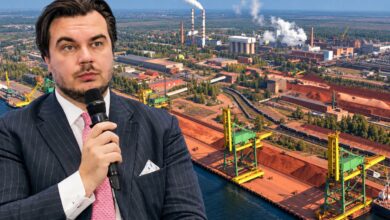
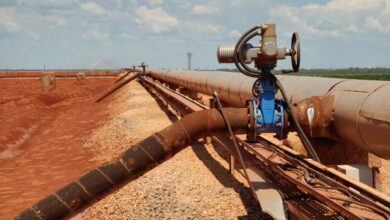
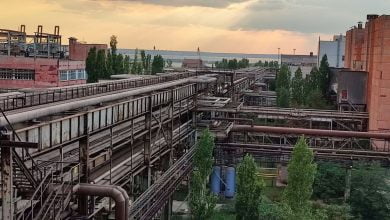
Kyiv officials came to admire the MGZ: the plant — an asset, the sludge — almost a bonus
MGZ are being prepared for privatization, but alongside discussions about investors the authorities say almost nothing about the main issue: who will be responsible for the tailings ponds


Mykolaiv Alumina Plant is once again being presented as a promising strategic asset that Ukraine plans to prepare for large-scale privatization in 2026. But behind the polished talk about investors, European supply chains and a quick restart of the enterprise remains a question far more important to residents of Mykolaiv than the starting sale price: who will be responsible for the sludge fields, the “Mars Field” and the millions of tons of red sludge after privatization?
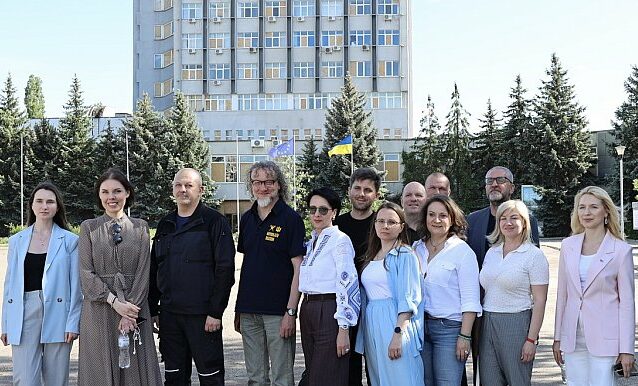
The preparation of the enterprise for sale was reported by the Deputy Minister of Economy, Environment and Agriculture of Ukraine, Darina Marchak, who visited MGZ as part of a working trip to sites being prepared for privatization. At the official level the plant is presented as an asset with great potential that can be brought back into full operation and integrated into new production chains.
Formally, the logic is clear: the state does not want to keep the plant as dead weight, but to put it up for privatization, find a buyer, restart production and show investors that even complex industrial assets in Ukraine can work again. Moreover, it was previously reported that the Mykolaiv Alumina Plant was valued at approximately USD 86 million, and its sale was planned for the fourth quarter of 2026.
But in the case of MGZ we are not just talking about a plant, pipes, workshops, warehouses and possible profit. Alongside the enterprise there is a huge environmental problem — the sludge fields locally long known as the “Mars Field”. It is there that millions of tons of red sludge have accumulated, and this problem will not disappear once the plant changes owner.
Furthermore, earlier pieces by korabelov.info already raised the issue of almost 50 million tons of red sludge near Mykolaiv. And this is not an abstract problem for reports or presentations. It is dust, risks to air, soil, water, people’s health and a responsibility that officials can very easily shift from one pair of hands to another.
During the visit to MGZ, ministry representatives and plant management discussed the technical condition of production facilities, prospects for restoring full plant operation, preparation for privatization and environmental issues. Special attention was paid to the sludge fields. But the very formulation that these sites could be of interest to investors sounds at least worrying to local residents.
Because the sludge fields are not a “bonus” to a privatization package or an attractive area for an investment presentation. They are a potential environmental bomb that has accumulated for years next to Mykolaiv. And if Kyiv officials really view it as part of the asset’s attractiveness, they must honestly tell people: what exactly do they plan to do with the sludge, who will pay for it and what guarantees will the community receive.
This topic looks especially acute against the background of the fact that the red sludge has already caused problems for adjacent territories. Environmentalists previously warned about the danger of dust from the MGZ sludge storage sites, and local residents have seen red dust again appear in the air over nearby villages.
Against this backdrop, statements about a rapid plant restart look strange. Technologically, MGZ may be attractive to a potential buyer: it is a large industrial site that operated for decades in the alumina production chain. But the question is different: is the government now trying to turn the enterprise into an investment “candy” without raising the most unpleasant questions that residents of Mykolaiv and the region may be left to deal with after the sale?
After all, historically MGZ was tied not so much to the European market as to the production chains of the Russian aluminium business associated with Oleg Deripaska. That is why claims about integration into European supply chains require very concrete explanations: who exactly is ready to buy MGZ alumina, does its quality and fraction meet the requirements of new consumers, who will provide raw materials, and will the environmental problem not simply become an appendage to a pretty privatization story.
Darina Marchak said during the visit that the plant has significant potential for Ukraine after the restoration of full operation.
“For Ukraine MGZ is an asset with great potential for integration into European supply chains after restoration of full operation,” – said Darina Marchak.
But behind that quote lie a number of awkward questions. If the plant can really be restarted quickly, is the state ready to resolve the sludge field issue just as fast? Will the privatization agreement contain strict environmental obligations? Will there be independent monitoring of dust emissions, dam conditions and environmental impact? Or will it again come down to presentations promising “great potential” while people nearby are left with red dust?
Trust is not helped by how local authorities communicate the issue of MGZ waste. The head of the Mykolaiv OVA, Vitaliy Kim, recently touched on the topic publicly, but in fact confused sludge with slag. To some this may seem a minor linguistic mistake. But when it comes to industrial waste, ecology and possible use of materials in construction, the difference between sludge and slag is fundamental.
Slag and red sludge are not the same thing. And if officials confuse even basic terms, a natural question arises: how deeply do they really understand the environmental risks they are trying to incorporate into a privatization story about a “promising asset”?
Earlier Vitaliy Kim also voiced plans to restart MGZ and the possible construction of an aluminium plant. Korabelov.info already wrote about this in early May 2026. But even here the main question does not go away: any production restart must begin not with PR, but with honest answers about the environment.
It is also worth noting separately that MGZ has already attracted the attention of potential investors. In particular, it was reported that the plant interested companies connected with the aluminium industry and stock markets. But investor interest does not automatically mean the problem is solved for people. An investor looks at profit, logistics, assets and prospects. Residents look at air, dust, water, their children’s health and whether they will be left alone with the consequences of old production.
The Ministry of Economy expects that high-quality preparation of the enterprise for privatization will attract investors and ensure further development of the production complex. But in the case of MGZ high-quality preparation is not only an assessment of equipment, capacities, workshops and the future price. It is above all an environmental audit, public commitments, a concrete plan for handling the sludge and a clear responsibility of the future owner.
Darina Marchak also stressed that the state wants to manage assets more efficiently.
“There are still many state and communal assets in Ukraine that could operate much more efficiently. Our goal is for Ukraine to become a truly effective owner of its assets,” – emphasized the deputy minister.
In the case of the Mykolaiv Alumina Plant, efficiency cannot be measured only by the sale price or the speed of a restart. For Mykolaiv, real efficiency is when after privatization the city and surrounding villages are not left with dust, dams, sludge and empty promises.
For now the situation looks as if the authorities are trying very hard to turn MGZ into an investment “candy”. But inside that “candy” are the sludge fields, environmental risks, undefined responsibility and a very bitter aftertaste for the people who live nearby.
Previously we wrote:
- Kim confused sludge with slag: the “Korean road” turned out not to be in Korea but near Kyiv
- Mykolaiv Alumina Plant attracted a company from the New York Stock Exchange
- Investors are already taking a look: Kim announced plans to restart MGZ and build an aluminium plant
- An episode sharpened the problem: an ecologist warned about the danger of dust from the MGZ sludge storage sites
- They want to sell MGZ successfully, but first they must convince the investor not to fear the war
- While MGZ sludge fields are without water and without money, Vitaliy Kim talks about the plant’s future
- An environmental “bomb” of delayed action: what are the chances for the Mykolaiv Alumina Plant after nationalization