Ukrainians have become more cautious about regulation of online content
Support for content-removal rules has fallen to 56%: Ukrainians fear abuse and censorship


More than half of respondents are ready to support rules for removing illegal and terrorist content provided they comply with European standards. At the same time, support for such regulation has noticeably declined over the past two months.
Rules for removing illegal and terrorist content on the Internet would be supported by 56.1% of surveyed Ukrainians if they meet European standards. In particular, 24.2% answered “yes”, and another 31.9% — “rather yes”.
At the same time, in May support for such regulation was 67.2%. Thus, in just two months it fell by 11.1 percentage points. The share of those who are against or rather against such rules, on the contrary, grew from 16.6% to 27.2%. Another 16.7% of respondents could not decide.
Among the main risks of possible regulation, Ukrainians name interference with privacy — 50.5%, the possibility of abuses — 50.3%, and corruption risks — 48.9%.
The emergence of censorship is feared by 36.9% of respondents, erroneous removal of lawful content — 32.2%, and possible pressure on the opposition — 30.4%.
The survey results also indicate that society is not prepared to unconditionally trade freedom for security. Maximum or greater freedom was chosen by a total of 48% of study participants. Maximum or greater security was preferred by 40.5%.
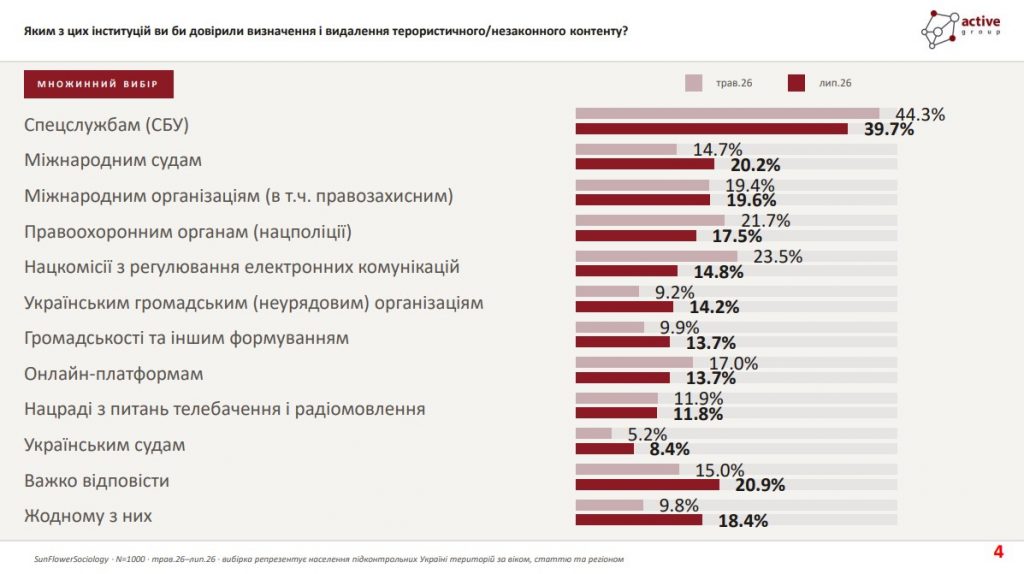
Most respondents would entrust the identification and removal of illegal content to the security services, including the SBU, — 39.7%. At the same time, even this indicator decreased compared to May, when it was 44.3%.
Such a function would be entrusted to international courts by 20.2%, to international and human rights organizations — 19.6%, to the National Police — 17.5%. Ukrainian courts are trusted by only 8.4% of respondents.
At the same time, 18.4% of respondents would not entrust the removal of content to any of the proposed institutions, and another 20.9% could not answer this question.
More than half of respondents encountered disinformation on the Internet over the past year — 58%, as well as fraud or phishing — 56.1%. They encountered hate speech — 45.9%, the dissemination of personal data without consent — 22%, and calls for violence — 21%.
At the same time, only 37.7% of respondents feel completely or rather protected from dangerous and terrorist content. 53.9% of respondents consider themselves unprotected.
“Today Ukrainians are effectively telling the state: we are ready for a tougher fight against dangerous content, but not at the cost of our own rights and freedoms. This is a very important signal for legislators. The research shows that society supports a European approach to regulating the digital environment, but expects maximum transparency in decisions and independent oversight of their implementation. Only under such conditions will mechanisms to combat illegal or terrorist content have a sufficient level of public trust,” said Active Group director Oleksandr Pozniy.
The survey was conducted by Active Group using the SunFlower Sociology online panel. It included 1,000 adult respondents; the sample represents the population of territories controlled by Ukraine by age, gender and region.