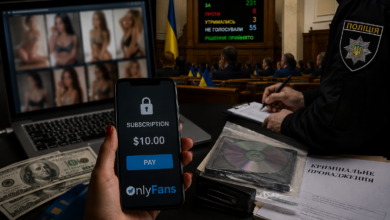
Law enforcement is going after adult content while serious sexual crimes remain a problem
While the country is at war, law enforcement continues to spend resources on cases involving intimate content between consenting adults, and courts are punishing people en masse for private photos, chats, and webcam content



In Ukraine the debate around Article 301 of the Criminal Code of Ukraine has flared up again, under which people can be punished for producing, storing, or distributing pornographic materials. Formally this concerns “public morality”, but in practice criminal cases often target intimate content between adults, private correspondences, webcam streams or photos sent in messengers, – writes texty.org.ua
According to the provided data, even exchanging intimate photos between consenting adults can be interpreted by law enforcement as “the production, storage and distribution of pornographic materials”. The penalty under Article 301 of the Criminal Code of Ukraine can include a fine from 34,000 to 85,000 hryvnias, restriction or deprivation of liberty for up to 5 years. Most often such cases appear in the context of private messages on Telegram and Viber.
The topic became prominent again after May 20, 2026 when law enforcement detained 4 heads of the main directorates of the National Police of Ukraine and their deputies on suspicion of “protecting” the porn business. After that, talks about decriminalizing adult voluntary porn intensified with renewed force.
But already on May 28, 2026 the Verkhovna Rada of Ukraine failed to pass the bill on decriminalizing pornography. Only 207 deputies voted “for”. 5 voted against, 3 abstained, and another 60 deputies simply did not vote. The factions “European Solidarity” and BYuT, according to the data, did not give a single vote “for”.
Before that, on May 27, 2026, korabelov.info had already reported that the Ministry of Internal Affairs of Ukraine had approved the text of the corresponding bill almost without comments, and Minister Ihor Klymenko effectively shifted further responsibility to parliament: the document was already in the Verkhovna Rada of Ukraine.
Overall, the authors of the study analyzed about 3,500 cases in the court register brought under Article 301 of the Criminal Code of Ukraine. They concluded that the old Soviet logic of fighting pornography still creates space for absurd convictions, corruption risks, and the diversion of law enforcement from truly serious crimes.
Over 20 years, starting from 2006, the court register found 3,473 cases related to pornography. Of these, 2,293 ended with convictions concerning adult pornography. That is, approximately 66% of such cases result in guilty verdicts.
Separately, 1,505 court sentences were analyzed. Among them 1,084 cases concerned the sale of pornographic content in the form of photos, videos or online chats, and another 30 — online broadcasts. Most often such content was sent via Telegram or Viber.
The most cases under Article 301 of the Criminal Code of Ukraine were recorded in Dnipropetrovsk Oblast — 331, Kharkiv Oblast — 247, as well as in Kyiv — 245. The fewest such cases were found in Chernihiv, Kyiv Oblast and Volyn Oblast.
The problem is that the law enforcement system often substitutes real efforts to combat violence with the persecution of adults for voluntary intimate content. The provided analysis explicitly states: serious sexual crimes, including violence or child exploitation, are investigated less effectively than publicly available adult pornography.
Separate criticism concerns investigation methods. To prove the “crime” in private chats or on online platforms, law enforcement conduct controlled purchases with public funds, review materials, seize phones and computers and order examinations. Then courts often conclude cases with fines, suspended sentences, or recognition of guilt by the accused.
In effect the state spends the time of investigators, prosecutors, experts and courts on content created consensually by adults. And this happens during a full-scale war, when the resources of the law enforcement system should be maximally focused on crimes against state security, war crimes, violence, human trafficking and child exploitation.
Critics of the current approach emphasize: criminal liability should remain where real harm exists — coercion, blackmail, distribution without consent, exploitation, violence, child pornography, human trafficking. But adult voluntary content between consenting adults should not automatically turn into a criminal case.
Herein lies the main absurdity: the state simultaneously talks about taxes, the digital economy and filling the budget, but continues to criminalize a sphere that already effectively exists. Earlier Danylo Hetmantsev stated that about 8,000 Ukrainians in 2023 together earned 5 billion hryvnias of income from OnlyFans, and potential tax revenues could amount to about 1 billion hryvnias per year.
Another telling point is public reaction. A petition to decriminalize pornography gathered more than 25,000 signatures, after which President of Ukraine Volodymyr Zelensky replied that the final decision lies within the powers of the Verkhovna Rada of Ukraine.
After the failed vote on May 28, 2026 the issue remains open. And now the responsibility lies not with abstract “morality” but with specific deputies who either did not support it or simply did not press the button.
Because while adults are prosecuted for intimate content, the state risks losing not only tax revenue. It loses citizens’ trust, law enforcement resources, and common sense in an area that long ago needed a clear separation: where there is a crime and where there is the private life of consenting adults.
Previously we wrote:
- Naked photos from a mother’s iPhone: a girl received a criminal record for a message
- 40 million in taxes, but sex is banned: what Zelensky told OnlyFans models
- Don’t stick your nose in underwear! A petition about intimate freedom is already halfway to the President
- A naked thank you: a mother of six “thanked” her godfather with intimate photos and received a sentence
- Porn business for 750 hryvnias: a Mykolaiv municipal cleaner became a figure in a high-profile case