Parcels, sole proprietors (FOPs) and the military levy: what Ukraine must change to secure €90 billion from the EU
The EU gives a loan, but the check isn't without "small print"


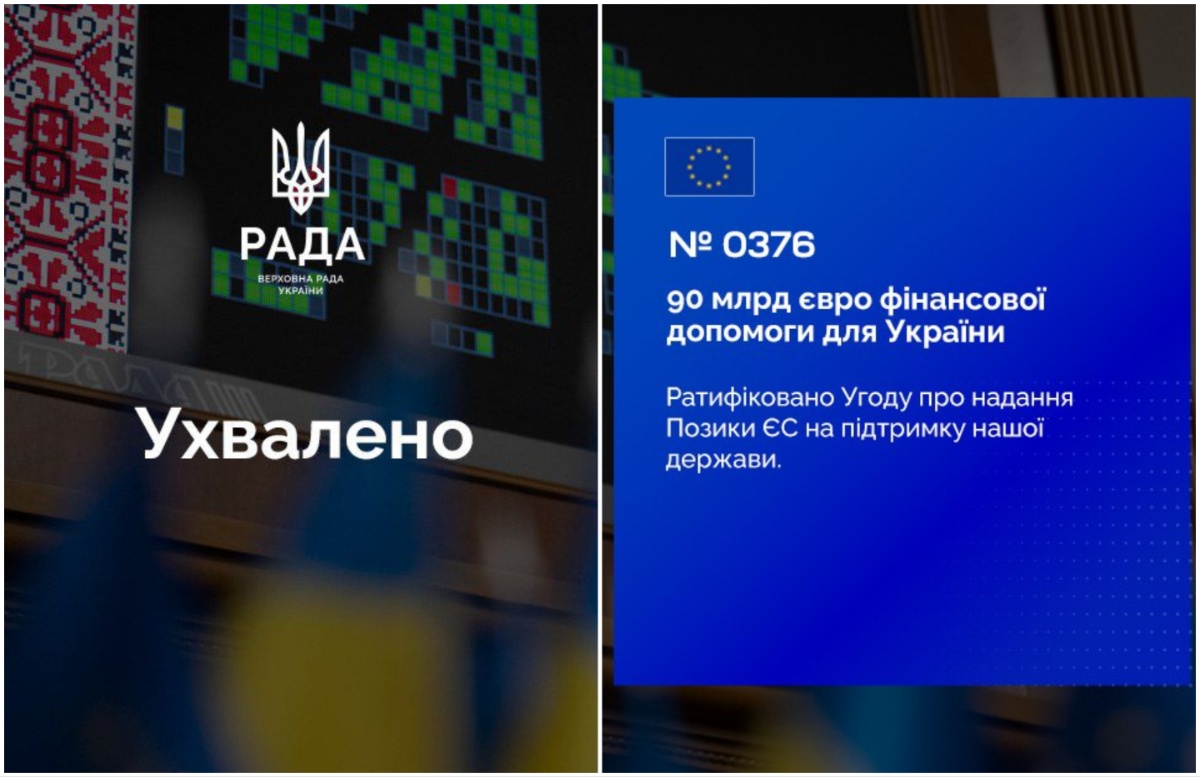
The Verkhovna Rada of Ukraine ratified the Loan Agreement to support Ukraine with the European Union. For the corresponding bill No.0376, 298 members of parliament voted in favor.
The document opens the possibility to attract financial assistance from the EU in a total amount of up to €90 billion in 2026–2027. It concerns funds to cover the state budget deficit, support macroeconomic stability, and strengthen the country’s defense-industrial potential.
On the parliament’s website, bill No.0376 is registered on 28 May 2026 as a draft law on the ratification of the Loan Agreement to support Ukraine between Ukraine as the borrower, the National Bank of Ukraine as the borrower’s agent, and the European Union, represented by the European Commission, as the lender. The document also concerns the Memorandum of Understanding on receiving macro-financial assistance.
Under the terms of this mechanism, repayment of the loan principal is to be carried out not at the expense of Ukrainian taxpayers, but from future reparations from the Russian Federation. Interest on the loan is to be covered by the EU budget.
At the same time, together with the financing, Ukraine undertakes obligations to implement reforms in the tax, customs and budgetary spheres. Among the most sensitive issues for citizens and businesses are the elimination of tax benefits for some international parcels, new rules for income from digital platforms, changes for FOPs and the continuation of the military tax.
In particular, in the tax package that the government promoted as part of agreements with international partners, there was talk of taxing international parcels, income from digital platforms and a new model of the military tax. According to specialized publications, for individuals the military tax is to remain at 5%, while for FOPs of the third group a rate of 1% of income was envisaged.
A separate part of the changes concerns digital platforms and online services. The legislative initiatives envisaged international automatic exchange of information on income received via digital platforms, in accordance with OECD standards and the EU DAC7 directive. For individuals receiving such income, a tax rate of 5% was proposed instead of the current 18%.
Another painful point — international parcels. Previously there was talk of taxing purchases from abroad valued up to €150, while small non-commercial shipments up to €45 were to remain without VAT. This issue has already provoked serious discussion, as it directly affects Ukrainians who order goods from abroad.
Also in focus is the reform of the simplified taxation system. Authorities and international partners insist on combating schemes of artificial fragmentation of businesses, when large companies formally split activities into a network of FOPs to reduce the tax burden.
In fact, ratification of the loan agreement does not mean the automatic introduction of all tax changes immediately. But it cements the course toward fulfilling agreements with the EU and other international partners on which the country’s budget financing during the full-scale war depends.
For Ukraine, which continues to defend itself from Russian aggression, this €90 billion is a critically important financial resource. But for Ukrainians and small businesses the price of such a resource may manifest in new tax rules, stricter income control and the reduction of some benefits.
Previously we wrote:
- Parliament approved in the first reading the taxation of income from digital platforms
- Sold a sofa — pay taxes: the state targets OLX and taxis
- The IMF approved a 4-year financing program for Ukraine for $8.1 billion
- €100 billion for Ukraine — but after 2028. For now — a hole in the budget
- The mayor of Mykolaiv urgently “freezes” budget expenditures: the city lacks money even for salaries