"The truth will rise and the country will live again": a mural to Mykola Arkas unveiled in Mykolaiv
The artists worked on the artwork for about 20 days


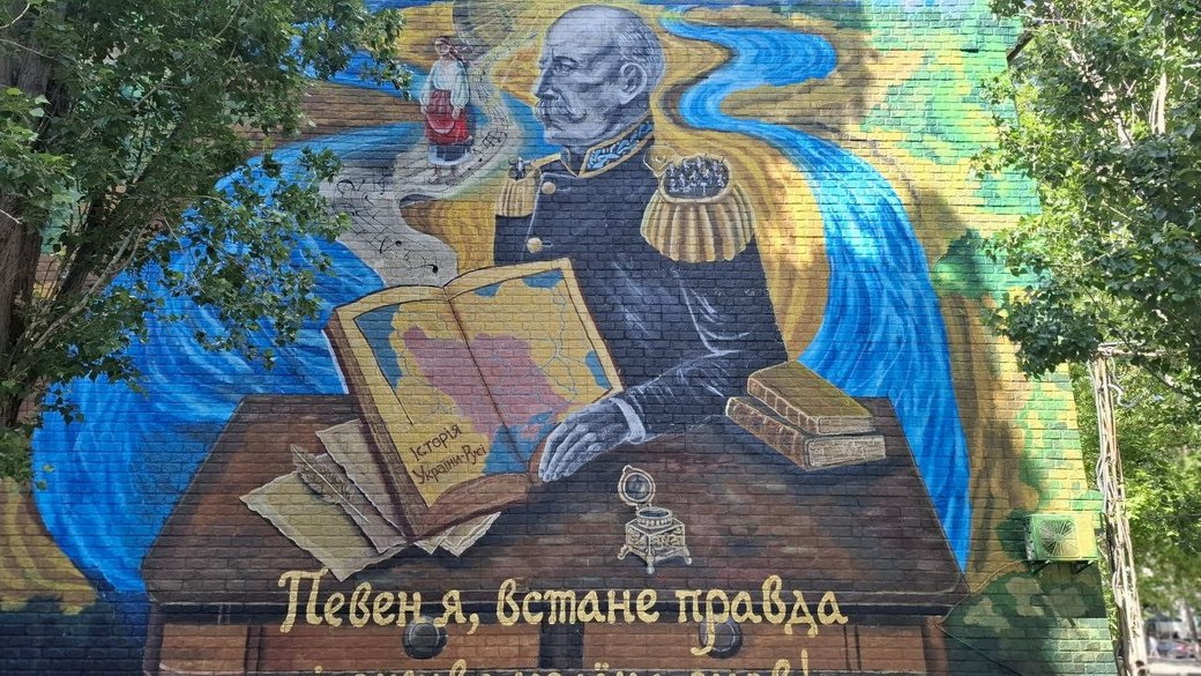
A new large-scale mural dedicated to the prominent Ukrainian composer, historian, writer and enlightener Mykola Arkas has been unveiled in the center of Mykolaiv.
The initiative to create the mural came from the city’s chief architect Yevhen Polyakov. The project was realized thanks to financial support from private patrons and the work of Mykolaiv artists.
About the concept, symbols and the process of creating the mural, Yevhen Polyakov and the sketch author Valeria Kucher told correspondents of Suspilne.
The choice of Mykola Arkas for the new city mural was deliberate. He was born in Mykolaiv, became one of the most prominent figures of the Ukrainian cultural and educational movement, and consciously supported Ukrainian identity during the Russian Empire.
The city’s chief architect Yevhen Polyakov called Mykola Arkas one of the key figures of Ukrainian nation-building.
“Mykola Arkas is not only an honorary citizen of Mykolaiv, but also an outstanding Ukrainian. During the Russian Empire he consciously promoted Ukrainian culture: he spoke the Ukrainian language, supported Ukrainian writers, built a Ukrainian school, collected our folklore, wrote the first Ukrainian opera and “History of Ukraine-Rus’”. He can safely be called one of the key figures of Ukrainian nation-building.”
According to Yevhen Polyakov, the figure of the enlightener is especially important today, when Ukraine is again forced to defend its statehood, language, history and culture from Russian aggression.
The architect emphasized the Ukrainian history and future of the city.
“Mykolaiv is a Ukrainian city. Ukrainians lived in it, live in it and will live in it.”
In addition to Mykola Arkas’s portrait, the mural features his words: “I am sure the truth will rise and the country will live again.”
For the inscription the authors did not use an ordinary modern font. It was specially adapted from the sample of the first printed edition of Mykola Arkas’s book to preserve the historical link with the enlightener’s work.
Chief architect Yevhen Polyakov explained why they chose this short quote for the composition.
“We took the first printed edition and adapted the font for this inscription. We wanted to keep a short but very powerful quote that sounds especially relevant today.”
Private patrons contributed to the project’s financing. One of them, named Yevhen, expressed the hope that the mural will make passersby not only admire the bright composition but also reflect on Mykola Arkas’s contribution to preserving the Ukrainian nation.
The patron stressed that the mural should become not just a decorative object for the townspeople, but a meaningful message.
“I would like people, passing by, not only to see a beautiful picture but also to think about its meaning. It is thanks to such people that our nation has been preserved and has deep roots.”
The sketch for the mural was created by artist Valeria Kucher. According to her concept, the composition was intended to tell much more about Mykola Arkas than an ordinary portrait.
Therefore, alongside the enlightener’s figure appeared surreal and symbolic images: a kobza with the sun, an orchestra on the shoulders, a musical-note path and Kateryna — the heroine of the composer’s eponymous opera.
Artist Valeria Kucher explained which images she used to convey Mykola Arkas’s creative world.
“I wanted to create not just a portrait but to show what resonated with me in this person’s character. Thus surreal images appeared in the composition: the sun in the kobza, an orchestra on the shoulders, and Kateryna who walks a path of notes over the master’s shoulder.”
The kobza symbolizes Mykola Arkas’s contribution to the development of Ukrainian music. The path made of notes reflects his journey as a composer, and the image of Kateryna recalls the opera he created based on Taras Shevchenko’s poem of the same name.
The sun inside the kobza is interpreted by the author as a symbol of Ukraine’s cultural enlightenment.
During the preparation of the sketch, the team studied historical materials, the biography and the creative output of Mykola Arkas. According to the artist, without such research it is impossible to work responsibly on the image of a person so important for the city.
Valeria Kucher explained that during the work she often spoke with passersby and told them about the hero of the future mural.
“Ignorance would have put me in an awkward position before the people of Mykolaiv. The process of creating a mural always arouses curiosity among passersby, so I often tell people about the subject of the work, his contribution and his significance for the city and culture.”
The mural was created by artists Valeria Kucher, Dmitro Voloshyn and Olena Martynova. Relatives and friends of team members also joined in to complete certain tasks.
Work on the mural lasted about 20 working days. For Valeria Kucher, this mural became the largest project in her professional practice.
The artist said that the scale of the work and the responsibility for the image of Mykola Arkas were a serious test.
“This is the largest mural in my practice, so it was a real challenge and a test of courage. Courage was needed in everything: both because of the scale of the object and because of the responsibility of working in the city center on the image of such an important person. It was a very valuable professional and personal experience.”
During the creation of the mural the artists received many positive responses from passersby and social media users.
The authors hope that the mural will become a new cultural highlight of Soborna Street and at the same time help residents and guests of Mykolaiv learn more about the Ukrainian history of the city.
Previously we wrote:
- Legend of the Korabelnyi District: a mural featuring the well-known greening expert Serdtsev will appear on a school wall
- Flowers grew from the ruins: artists turned a broken building in Mykolaiv into a work of art
- Mykolaiv chooses a hero for a mural: a student proposes creating an art symbol of the city
- “Happiness is peace”: French artists left murals about hope in Mykolaiv
- Destroyed cultural memory of Mykolaiv: 77 historical sites have been destroyed — will there be restoration?