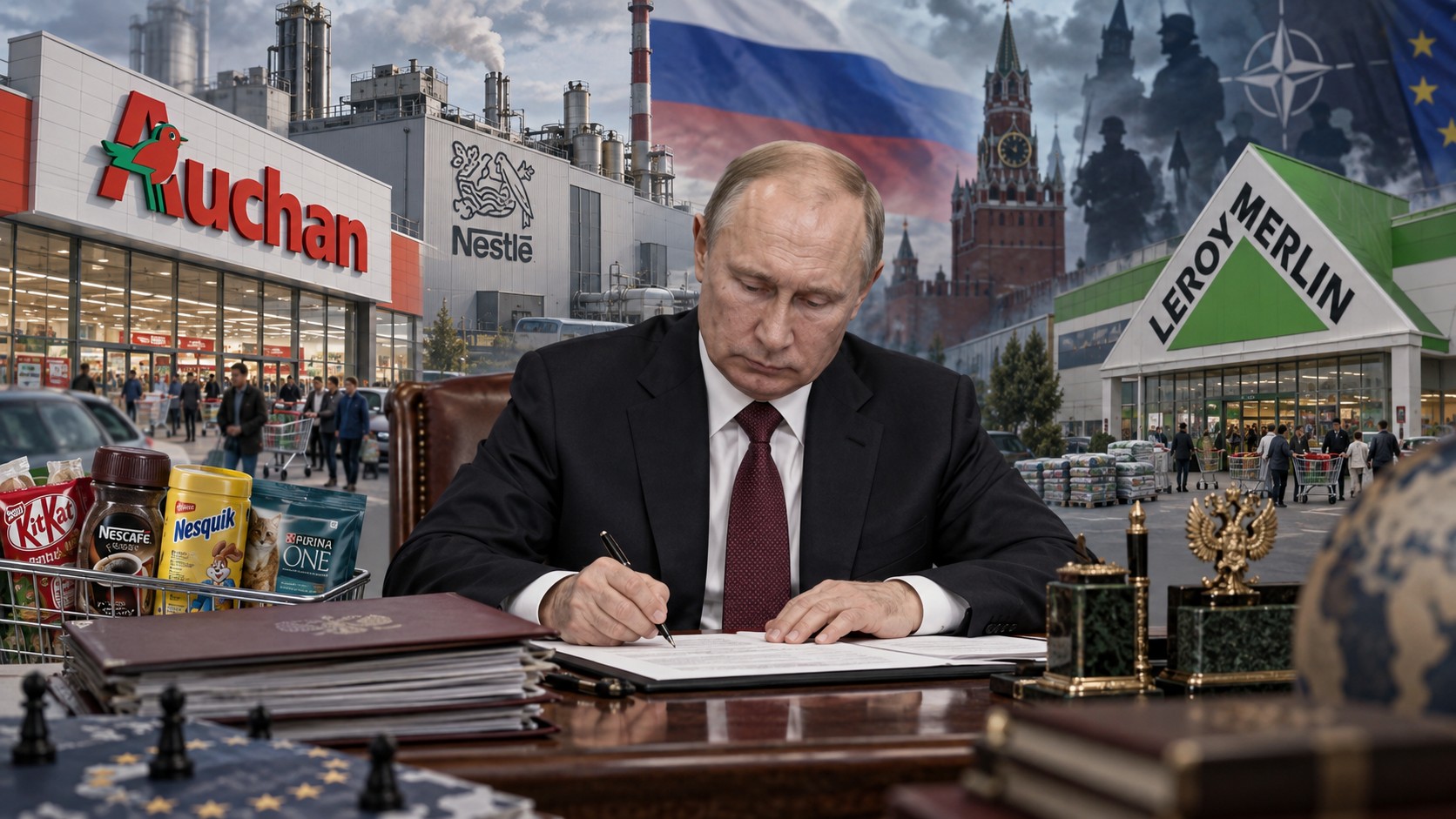
Russian President Vladimir Putin 17 September 2026 signed decree No. 661, by which Russian assets of the French retailer Auchan, the Swiss company Nestlé, the former Leroy Merlin network and a number of logistics companies were transferred to the so‑called “temporary management” of the Russian entity JSC “L.E.V. Management”. The decision took effect immediately after official publication.
Some Ukrainian media called this decision a confiscation or nationalization. At the same time, legally the decree itself speaks specifically of “temporary management”: ownership rights are not formally declared terminated, but foreign owners effectively lose the ability to independently manage the Russian assets. Reuters notes that in previous similar cases in Russia such a mechanism often preceded actual dispossession, forced sale or transfer of businesses to structures connected with the Russian authorities.
What exactly the Kremlin took under management
In the case of Auchan, JSC “L.E.V. Management” takes control of virtually 100% of the Russian LLC “AUCHAN”: 99.99858% belonged to the French Sogepar, and another 0.00142% to Meelacker B.V.
With respect to Nestlé the decree covers two entities. In LLC “Nestlé Russia” the management was transferred for 84.082% that belonged to the Swiss Société des Produits Nestlé S.A., and 15.918% to the German Nestlé Deutschland AG. That is, it concerns the entire 100% of the company.
Similarly, virtually 100% of LLC “Nestlé Kuban” moves under external management: 67.44% belonging to the Swiss company and 32.56% to the German one.
The decree also includes LLC “Le Monlid” – the legal entity of the “Lemana PRO” network, which previously operated under the Leroy Merlin brand. JSC “L.E.V. Management” was granted management of 99.993% held by Scenari Holding LP registered in the UAE, and another 0.007% by the French Groupe Adeo. Thus, the decree covers the entire 100% of the company.
Aside from major retail chains and Nestlé, the decree concerns Russian assets of logistics groups FM Logistic and Batilogistic, in particular “FM Logistic Vostok”, “FM Logistic Customs”, “FM Logistic Rus”, as well as a number of regional Batilogistic entities.
The company with a 15 thousand ruble capital received a multi‑billion business
Particularly notable is the structure to which Vladimir Putin entrusted management of these assets. JSC “L.E.V. Management” was registered in Moscow only in October 2024.
Its authorized capital is only 15 thousand rubles. For the results of 2025 the company reported a loss of about 15 thousand rubles, and its main activity is listed as consulting on commercial activities and management. Information about shareholders is not disclosed. From 10 September 2026, that is only 7 days before the decree, the company’s CEO became Andriy Krayushkin.
For comparison, the authorized capital of the Russian LLC “AUCHAN” as of 17 September 2026 was about 16.7 billion rubles, and LLC “Nestlé Russia” – 880 million rubles.
Nestlé has operated in Russia since 1994 and has 6 plants there. According to Reuters, about 7,000 people work in the company’s Russian business. In 2021, the last year for which Nestlé published full figures, sales in Russia amounted to about 2 billion Swiss francs, or roughly $2.4 billion. After the start of the full‑scale invasion, the company reduced its presence, and analysts estimate Russia’s current share at roughly 1% of Nestlé’s global sales.
According to Reuters, Auchan has about 230 stores and roughly 30,000 employees in Russia. The company did not leave the market after the start of Russia’s full‑scale invasion of Ukraine.
After the decree appeared, Nestlé said it is assessing the situation and possible steps to protect its rights and continue operating. Auchan stated that as of the morning of 18 September its stores continue to operate as usual, and the company has sent a request to the Russian authorities seeking clarification of the decree’s consequences.
The decree appeared a day after the US sanctions vote
Vladimir Putin’s decision came amid a sharp escalation of sanctions pressure from the United States.
As early as 7 August 2026 the US Senate approved the Lindsey O. Graham Sanctioning Russia and Iran Act of 2026 by a vote of 86 to 11. And on 16 September, a day before Putin’s decree, the House of Representatives supported the measure by 262 to 159 and sent it to US President Donald Trump.
Important detail: as of 18 September 2026 the document is still awaiting Donald Trump’s signature, so legally the new sanctions have not yet come into force.
The package provides for new restrictions on Russia’s financial, defense and energy sectors, companies and vessels that help evade sanctions, including Russia’s so‑called “shadow fleet”.
A separate mechanism allows the US President to impose additional tariffs of up to 100% on goods from countries that are among the largest purchasers of Russian oil and gas or help to circumvent energy sanctions. At the same time, 100% is the maximum rate, not an automatic tariff that takes effect immediately upon signing the law.
Thus, the sequence of events looks illustrative: on 16 September the US House of Representatives completed the passage of the sanctions package through Congress, and already on 17 September Vladimir Putin signed a decree to transfer large foreign assets under the control of a Russian manager. However, there is currently no confirmation from the Kremlin or other reliable sources that decree No. 661 was adopted specifically as a direct response to the US vote.
The legal basis for such actions has existed in the Russian Federation since 25 April 2023, when Vladimir Putin signed decree No. 302 on “temporary management” of foreign assets. The Russian authorities then presented this mechanism as a response to the freezing and possible seizure of Russian property abroad. Previously, under this scheme, assets of Danone and Carlsberg were already brought under the control of the Russian authorities.
Previously we wrote:
- US “hellish sanctions” will complicate the search for peace — Peskov
- The EU may present the largest package of sanctions against Russia this autumn since the start of the full‑scale war
- Almost half of Russia’s oil refining is halted: Ukrainian drones inflicted $13.5 billion in losses on the industry
- The European Commission proposes banning entry to the EU for all Russian military personnel
- Russia counts closed wells and banks: Zelenskyy published new intelligence data