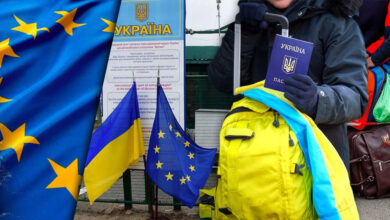
«Reserve+» will now be needed not only in Ukraine: the EU has changed temporary protection rules for men
New rules from August 5: which Ukrainians the EU may refuse temporary protection to



The Council of the European Union extended the application of temporary protection for people who left Ukraine due to the full-scale Russian aggression until 4 March 2028. At the same time, for Ukrainians who will be applying for this status for the first time, a new condition was introduced: they must confirm fulfillment of military obligations, exemption from them, or the legality of departure from Ukraine.
This concerns the Implementing decision of the EU Council 2026/1912, adopted on 30 July 2026 and published in the Official Journal of the European Union 4 August. The document came into force the next day – 5 August 2026.
At the same time, the claim that the European Union allegedly completely stopped providing temporary protection to all Ukrainian citizens subject to conscription is inaccurate. The new rule is not an automatic ban for all Ukrainian men of mobilization age.
In the decision the criterion is related not only to a person’s sex or age, but to the presence of military obligations under Ukrainian law. The restrictions will apply to new applicants who cannot prove that they have fulfilled the relevant requirements, are exempt from them, or have received permission from Ukrainian authorities for lawful departure.
Confirmation can be a Ukrainian international passport with a stamp indicating crossing the state border, which attests to lawful departure. One may also submit a paper or electronic document on the fulfilment of military obligations, a deferral, exemption from them, or another legal ground for departure.
For example, the migration service Finland reported that in the absence of a passport stamp the applicant may provide an official document, including an electronic military registration document in the application “Reserve+”. The specific list of evidence and procedures for their verification may be clarified by the authorities of each EU country.
The new requirements do not apply to Ukrainians who are already using temporary protection in EU countries. They do not lose their status simply because of the adoption of the decision and do not have to reprove the legality of departure to retain the protection already granted.
Article 2, which establishes the new conditions for applicants with military obligations, applies from 5 August 2026. This is the date indicated in the corrigendum to the decision published in the Official Journal of the EU.
Meanwhile, the extension of the overall period of temporary protection to 4 March 2028 will begin to apply from 5 March 2027. Until then, the previously adopted extension of the status to 4 March 2027 remains in effect.
The decision concerns specifically the simplified temporary protection mechanism. It does not mean automatic deportation of a person to Ukraine, a blanket ban on staying in the European Union under any circumstances, or deprivation of the right to seek international protection.
A Ukrainian who does not meet the new temporary protection requirements can apply for another residence permit, for example on the basis of work, study, or family circumstances. The right to apply for international protection is also preserved, but such applications are considered individually in accordance with the legislation of the specific country.
Temporary protection gives people the right to reside in an EU country, to work, receive medical and social assistance, use housing, and for children – to attend school. Unlike the regular asylum procedure, this mechanism was introduced after the start of Russia’s full-scale invasion to provide rapid collective protection for millions of people.
As of 31 May 2026, about 4.38 million people who left Ukraine because of the war were using temporary protection in EU states. The Council of the European Union explained the changes by the need to simultaneously protect displaced Ukrainians and to take into account Ukraine’s need to defend itself against Russian aggression.
Thus, the new rules do not strip the status of those who already live in the European Union under temporary protection, and do not establish a blanket ban for all persons subject to military obligations. They primarily concern new applicants, who will now need to provide documentary evidence of the legality of their departure from Ukraine or of the fulfilment or absence of the relevant military obligations.
Earlier we wrote:
- The EU extended protection for Ukrainians until 2028, but changed rules for men
- The EU plans to limit temporary protection for Ukrainians who are subject to mobilization
- Hungary will grant asylum to Ukrainian men, – Prime Minister Péter Madiar
- The EU may limit temporary protection for Ukrainian men of conscription age