The Baltics instead of Ukraine? How a war with NATO could become Putin's attempt to go all-in
An invasion that until recently seemed like madness: if NATO does not respond - it will collapse

A possible Russian invasion of the Baltic states, which until recently seemed almost unthinkable, could, in the logic of the Russian leadership, turn out to be the next step in escalation of the war. This scenario was examined in detail on 29 September 2026 by Vladimir Pastukhov and host Boris Pastukhov in the 160th episode of the program “Pastukhov’s Kitchen”.
At the same time, this is not information about a Kremlin plan for an invasion that has already been approved, but an analytical scenario. In the conversation Vladimir Pastukhov emphasizes that until recently he considered an open war between Russia and Europe unlikely for two reasons: the self-preservation instinct of the Russian leadership and the obvious lack of resources for another front, when the Russian army even in Ukraine is unable to quickly achieve its set goals.
“Casino”: lost — double the bet
It is Boris Pastukhov who, in response, explains why, in his view, an invasion of the Baltics could paradoxically fit into the Kremlin’s logic.
He compares the situation to a roulette player. If they bet on black and lose, one way to recoup the previous loss is to double the next bet. The problem with such a strategy is that after several losses resources quickly run out.
According to Boris Pastukhov, the Kremlin may view the war in a similar way: if the bet on Ukraine did not bring the desired result in the confrontation with the West, there is a temptation not to retreat but to make the next bet much larger.
Not a “second war”, but another sector of the same front
A key element of this logic is how, according to Boris Pastukhov‘s assumption, Vladimir Putin himself may perceive the current war.
In such a worldview the Kremlin is already fighting not only with Ukraine. Ukraine is seen as the territory of confrontation between Russia and Europe and the West in general.
Therefore a potential entry of Russian troops into Estonia, Latvia or Lithuania, according to this logic, would not necessarily be perceived in the Kremlin as the beginning of a fundamentally new war or even the opening of a second front. It could look like a redeployment of forces to another sector of a single large front.
What the Kremlin could gain if NATO does not respond
The first scenario considered by Boris Pastukhov is that Russia conducts a military operation against one of the Baltic countries, but the allies do not dare to fully intervene.
Boris Pastukhov believes that in such a case the very idea of NATO collective defense would be under attack. The consequences, in his version, would be felt not only by the Baltic states but by other Alliance countries as well: they would begin to doubt whether they would receive real military protection in the event of a Russian attack.
He formulates this part of his argument as categorically as possible:
“If NATO does not respond, NATO collapses.”
“Little green men” and roads clogged with refugees
After that, the interlocutors turn to the question of how such an invasion could practically begin.
Boris Pastukhov refers to a previously published scenario, whose reliability he immediately questions himself, but considers it useful for modeling possible actions.
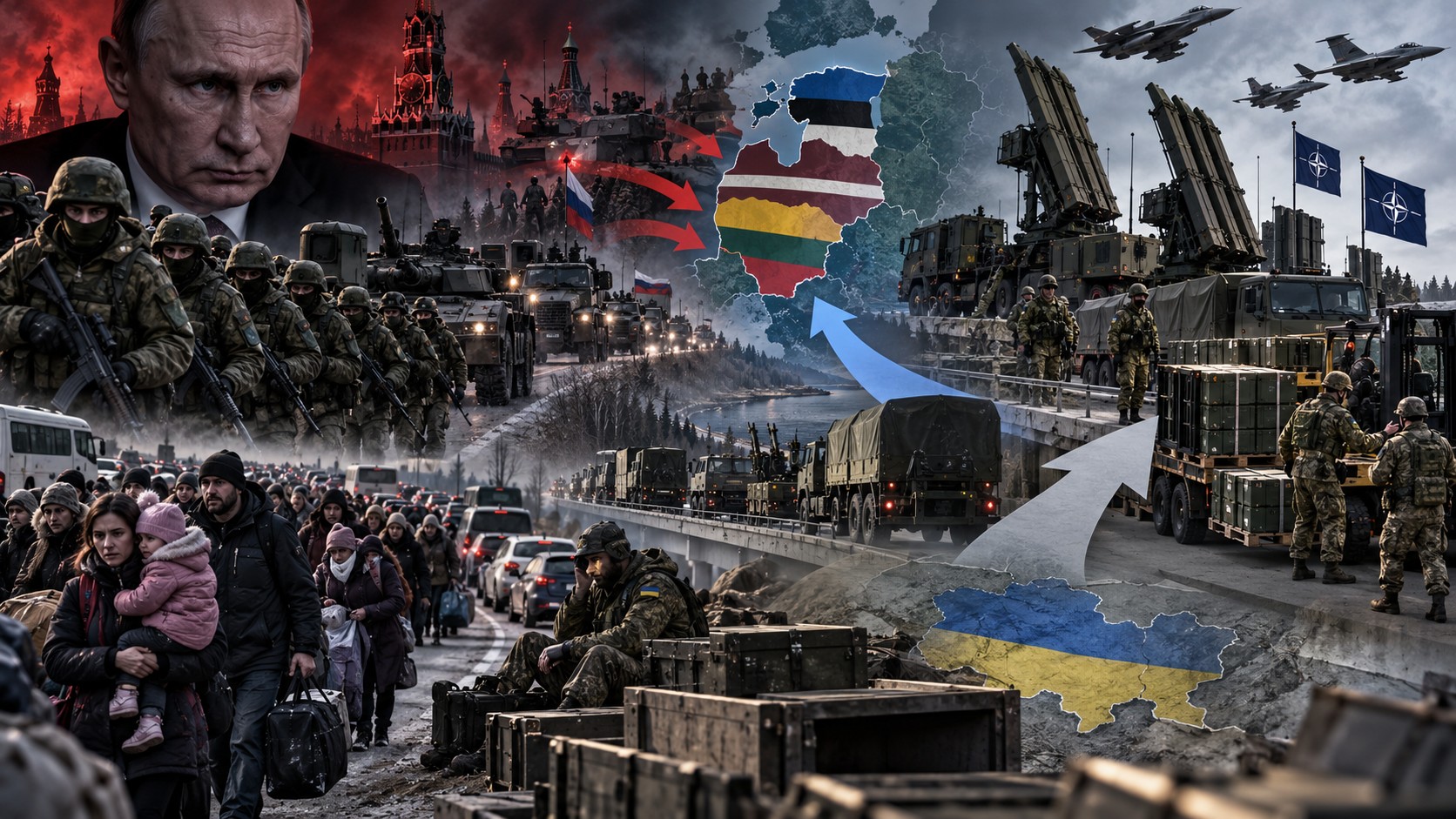
According to this scenario, a large number of so-called “little green men” appear in Estonia at first, whose affiliation is hard to determine right away. Amid the panic, the civilian population begins to leave the country en masse through Latvia and Lithuania.
Roads fill with cars carrying civilians, after which Russian troops begin to advance along the same routes.
Then NATO aviation faces an extremely difficult problem: strikes on the convoys can only be carried out with a huge risk of killing civilians who are moving on those same roads. It is this kind of situation, according to the presented scenario, that calculations may be based on.
But an invasion requires troops
Vladimir Pastukhov points to the obvious weak spot of such a scenario: even a covert or hybrid start to an operation will sooner or later require a significant military grouping.
He recalls that even before the full-scale invasion of Ukraine in 2022, Russia had concentrated about 150–200 thousand troops along the Ukrainian borders.
In response, the conversation notes the buildup of forces and arrival of new equipment on Russia’s northern and northwestern directions. Officially, this is explained as a need to defend Russia’s northwest after Finland’s accession to NATO.
Why Russia may not want to wait another 2–3 years
Another argument is the factor of time.
The conversation suggests that the Russian General Staff is capable of calculating the long-term trajectory of the war. If the current situation continues without a sharp escalation, in 2–3 years the scale of European production of drones and other strike means could significantly increase.
The discussants assume that the Kremlin may view prolonging the war as dangerous for itself and therefore have an additional incentive to raise the stakes earlier. This is an assumption of the participants in the discussion, not an established forecast about the balance of military resources in 2–3 years.
Option No. 1: NATO does not intervene
The first outcome of a potential invasion that Boris and Vladimir Pastukhov consider is politically advantageous for the Kremlin: if the allies effectively leave Estonia, Latvia or Lithuania to face Russia alone, trust in NATO would suffer a severe blow.
Then Moscow, according to this logic, would gain the ability to pressure other European states as well, demonstrating to them that military guarantees may not work.
Option No. 2: NATO enters a conventional war
The second scenario is that the Alliance still intervenes, but the conflict remains conventional, without the use of nuclear weapons.
Troops from other countries, ammunition, missiles, air defense systems and other equipment would then have to be redeployed to the Baltic countries.
Here the authors put forward one of the most important arguments for Ukraine: a large portion of these resources are currently being used to help Ukraine or come from the same stocks and production capacities.
According to Boris Pastukhov, the opening of a new front could force European states to prioritize their own defense, which would sharply complicate further support for Ukraine. This is the discussants’ projection, not a determined consequence of a possible NATO–Russia war.
Option No. 3: nuclear escalation
The third scenario is the confrontation reaching a nuclear level.
In the conversation it is described through the well-known Kremlin formula about Russia’s readiness to perish together with others. It is precisely the possibility of uncontrolled escalation, according to the interlocutors’ logic, that the Kremlin could use as the main tool to intimidate Western states.
Thus, in the model built by Boris Pastukhov, the Kremlin might consider 2 out of 3 outcomes acceptable: either NATO does not respond and its authority is destroyed, or NATO responds and is forced to divert significant resources to its own defense. The third outcome — nuclear war — can no longer be considered a rational “victory,” but fear of it can be part of the calculation to deter the West.
Why Vladimir Pastukhov stopped dismissing this scenario
For Vladimir Pastukhov, the central problem remains the question of rationality.
He explains that for a long time he rejected certain scenarios precisely because they seemed so destructive and illogical that a normal political actor supposedly could not resort to them.
In the conversation he recalls his own experience analyzing the Magnitsky case and reaches a broader conclusion: the formula “this cannot be” is no longer, in his view, a reliable tool when analyzing the behavior of the Russian authorities.
Later Vladimir Pastukhov also recalls 2022: even when Russian troops were already positioned near the Ukrainian borders, for a long time it remained psychologically hard to believe that Vladimir Putin would actually give the order for a full-scale invasion. According to him, certainty about the inevitability of war appeared only about 3 weeks before the invasion began.
“Great ideas” instead of pragmatism
The interlocutors separately examine the Kremlin mindset.
In their version, the Russian leadership increasingly perceives itself in terms of a global historical confrontation with the West. Under such an approach, arguments about the lack of soldiers, equipment or high risks may prove less important than the conviction that Russia is supposedly engaged in a historical struggle to change the world order.
Vladimir Pastukhov draws a parallel with the danger described by the philosopher Isaiah Berlin of eras of “great ideas,” when politics is subordinated to sweeping historical concepts and pragmatic constraints begin to be ignored.
From the point of view of resources — madness. From the point of view of their logic — possible
This is the main contradiction of the whole discussion.
If one counts Russian troops, ammunition, equipment and compares Russia’s potential with that of all Europe, an attack on NATO looks extremely risky.
But if one tries to look at the situation through the eyes of the Kremlin leadership, which believes it is already in a global conflict with the West and is losing it without further escalation, the logic may be different.
This is precisely where Vladimir Pastukhov is gradually coming to: stretching the front within such a worldview may seem logical, especially if the Kremlin believes that without a sharp increase in the stakes the strategic situation will only worsen.
And what instead of an invasion?
The conversation also considers a less radical alternative — continuation of sabotage and hybrid warfare in Europe.
However, Boris Pastukhov believes that explosions at enterprises, problems at airports, sabotage on railways and other similar operations can cause harm but are unlikely to fundamentally stop assistance to Ukraine.
Moreover, in his assumption, overly large-scale Russian sabotage could have the opposite political effect and turn even those European forces that are currently more sympathetic to Russia against Moscow.
“Madness” is no longer an argument
At the end of the first part of the conversation Vladimir Pastukhov returns to the question with which everything began.
Previously he considered a possible Russian invasion of the Baltics madness and for that reason judged such a scenario to be extremely unlikely.
After Boris Pastukhov‘s arguments that certainty was shaken. Vladimir Pastukhov explains: the number of decisions that previously seemed so illogical that they were impossible to imagine has become too large for “madness” itself to serve as proof that the Kremlin will not take the next step.
At the same time, the interlocutors do not claim that a decision to attack has already been made or that an invasion is inevitable. They analyze why such a step ceases to seem impossible if the situation is assessed not from the standpoint of ordinary military rationality but from the standpoint of the worldview they attribute to the Russian leadership.
This nuance is important in light of previously published data. On 29 August 2026 Korabelov.info wrote, citing Bloomberg, that European officials at that time saw no evidence that Russia was preparing an attack on NATO or separately on the Baltic countries. At the same time, over recent months the topic of possible provocations and testing of the Alliance’s eastern flank repeatedly appeared in reports by Western media and officials.
Earlier we wrote:
- Putin may “back down”: Two Kremlin scenarios after almost five years of war
- NATO fighters shot down a drone for the first time over Lithuania
- European officials see no evidence that Russia is preparing an attack on NATO
- CIA chief in Moscow warned Russia against attacks on NATO countries
- NATO has developed a plan for ground combat operations in the event of a large-scale attack by Russia