"Demographic catastrophe": only 243 thousand first-graders in Ukraine - the number of children in schools has halved
From 455 to 243 thousand: first-grade figures revealed the scale of Ukraine's demographic problem


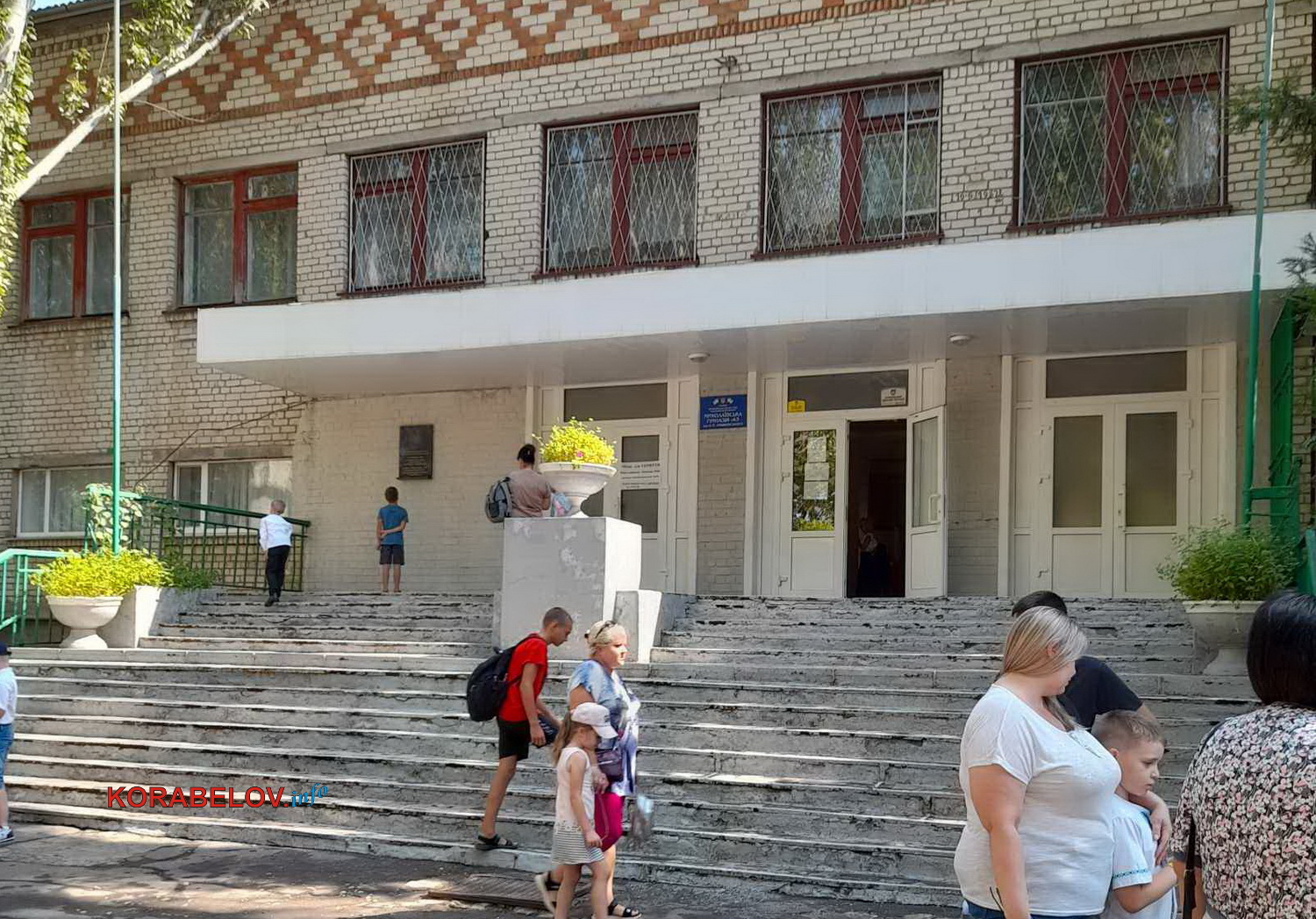
In the 2026/2027 school year, in Ukraine 243 398 children entered first grade – this is the lowest figure in at least the last 12 years. For comparison, in the 2018/2019 school year there were 454,9 thousand first-graders. That means the current intake is only a little more than half of that level.
According to the Ministry of Education and Science, overall on 1 September 2026 the school year began for more than 3,5 million pupils in 11 940 schools, and the educational process is provided by over 366 thousand teachers. Another roughly 315 thousand Ukrainian children are currently studying outside the country.
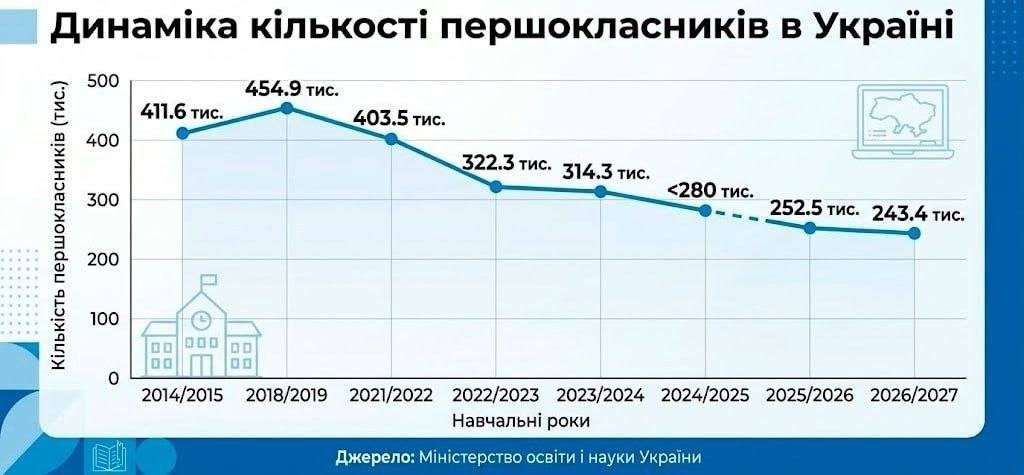
The trend in the number of first-graders over recent years shows a prolonged decline:
- 2014/2015 – 411,6 thousand;
- 2018/2019 – 454,9 thousand;
- 2021/2022 – 403,5 thousand;
- 2022/2023 – 322,3 thousand;
- 2023/2024 – 314,3 thousand;
- 2024/2025 – less than 280 thousand;
- 2025/2026 – 252,5 thousand;
- 2026/2027 – 243,4 thousand.
The largest number of first-graders during this period was in the 2018/2019 school year. Analysts note that the number of children entering school largely mirrors the demographic situation from about six years earlier. For example, in 2012, when one of the demographic peaks was recorded, 520,7 thousand children were born in Ukraine.
The current statistics are simultaneously affected by falling birth rates and the full-scale war, due to which a significant number of Ukrainian families with children left abroad or ended up in temporarily occupied territories. As of 1 January 2026, 315 061 students were outside Ukraine, the Ministry of Education and Science’s monitoring report indicates.
Economist Oleksiy Kusch drew attention to the sharp reduction in the number of children. He compared the current situation with the 2013/2014 school year, when, according to his data, more than 434 thousand children entered first grades of Ukrainian schools. The economist also pointed to the total fertility rate. In 2013 it was indeed about 1,51 children per woman, as confirmed by State Statistics. Under the full-scale war the indicator fell to a historically low level of about 0,9. The UN Population Fund cites a similar level.
According to Oleksiy Kusch‘s model, if one were to project the demographic indicators of the 2013/2014 years over a 30-year period, the country would obtain a new generation numbering about 13 million people. Approximately 6.5 million of them would be women, who at a fertility rate of about 1.5 could give birth to over 10 million children. Population decline under such a scenario, in his view, would still continue but much more slowly.
For current indicators the economist obtains a much darker picture. By his calculations, over the next 30 years a hypothetical generation could number about 7 million people, of whom roughly 3.5 million would be women. At the current fertility rate, in his model they would give birth to fewer than 3 million children. The next generation in such a hypothetical progression would be even smaller: from 3 million children about 1.5 million would be women, and the number of births of the following generation could shrink to slightly more than 1 million.
In Oleksiy Kusch‘s view, if such parameters persist the country’s demographic base could shrink radically within just two generations, that is, roughly within 50 years. He believes demographic policy is one of the issues Ukrainian political elites should prioritize.
At the same time it is important to distinguish between statistics and forecasts: the calculation presented by Oleksiy Kusch is his conditional model, not an official forecast of Ukraine‘s population in 30–50 years. Actual demographics will be affected by the duration of the war, the return of Ukrainians from abroad, migration, mortality, economic conditions, and how birth rates change.
There are fewer children in Mykolaiv region as well
A similar trend is already clearly visible in the Mykolaiv region. In the 2026/2027 school year schools in the region expected about 88,5 thousand pupils, whereas the previous year there were 94,3 thousand. Thus, in just one year the number of schoolchildren decreased by roughly 5,8 thousand.
As of 5 August 2026 parents had submitted 5 782 applications in Mykolaiv region for enrollment of children in first grade. The director of the Education and Science Department of the Mykolaiv Regional Military Administration, Alla Velikhovska, then emphasized that the figure was preliminary and could change by the start of the school year. Among the future first-graders there were many displaced children, including from the Kherson region.
So the nationwide demographic trend already has a concrete dimension for the Mykolaiv region: fewer children means fewer pupils in schools, changes in the load on the education network, and, in the long term, significantly fewer young people entering the labor market.
Earlier we wrote:
- Almost 6,000 fewer in a year: how many children will attend school in Mykolaiv region
- In Mykolaiv 45 schools will operate in-person, another 12 remotely
- Without long speeches under the sun: schools are advised to forgo assemblies on September 1
- Fines for Russian in school chats: the ombudswoman reminded parents and teachers of the rules