First she paid for likes, then 75,000 was taken: a resident of the Mykolaiv region fell into a fraudsters' trap
She transferred 500, they returned 600 - and then took thousands: how the new "easy money" trap works


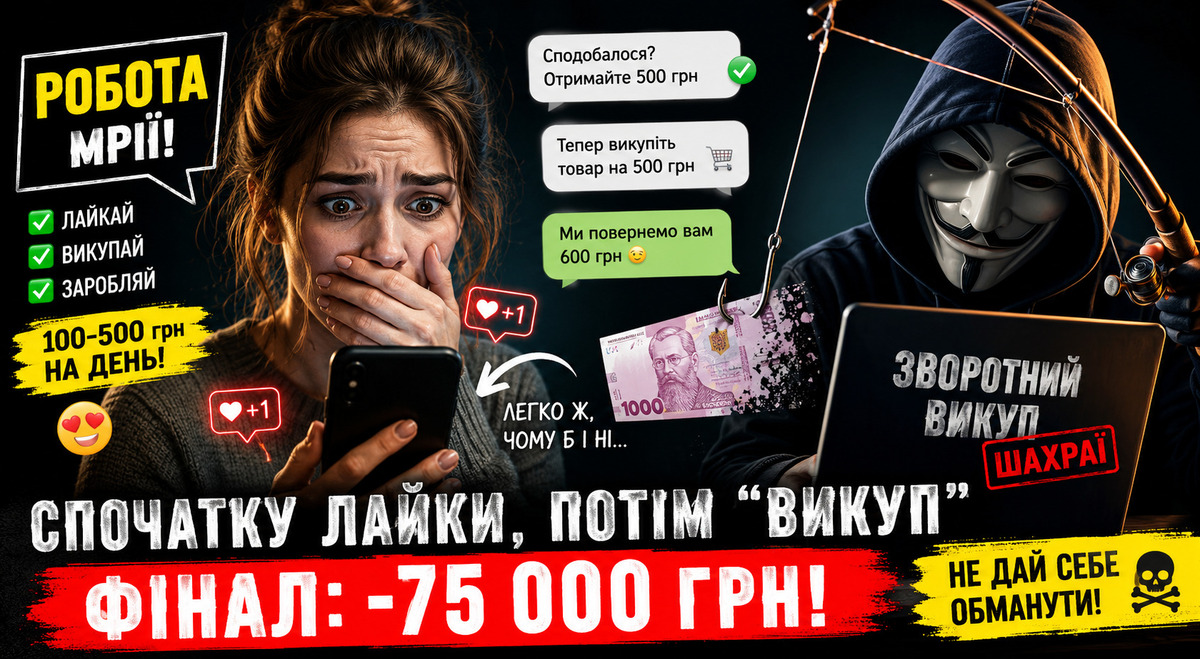
A resident of Mykolaiv region lost about 75 thousand hryvnias after believing an advertisement about simple remote part-time work allegedly from a well-known retail chain. At first the woman was offered to like products, and then – “repurchase” them with her own money with a promise to refund the money and add a reward. When the amounts grew to tens of thousands, the money was not returned, the correspondence was deleted, and the “employers” disappeared.
The cyber police explained that this is a widespread fraudulent scheme known as “reverse buyback” or “task fraud”. It is disguised as remote work related to promoting goods on marketplaces. This mechanism has already been officially described by the Cyber Police Department of Ukraine: at first a person is given simple tasks and may even receive a small payment, after which they are persuaded to invest their own funds.
In August 2026 the woman saw an ad in a job-search group about alleged remote part-time work from one of the well-known retail chains. The terms looked simple: she was to like products and perform other uncomplicated tasks. In return they promised quick rewards without formal employment or special skills.
The next stage was purchasing or the so-called “buyback” of products with her own money. The potential worker was promised to be refunded the full amount spent and to receive an additional reward. The woman agreed and began transferring money to bank accounts that unknown persons provided. The amounts gradually increased. In total the victim transferred about 75 thousand hryvnias. When it became clear that the promised payment would not be made, the criminals deleted the correspondence and stopped responding.
The danger of this scheme is that in the first stage fraudsters do not always immediately take money. A person may be offered to like products and promised about 100–500 hryvnias a day. The first small payments are sometimes actually made by scammers – not out of honesty, but to build trust and convince the victim that the scheme works. After that begins the stage when the victim is asked to invest their own funds. For example, a person may be asked to transfer 500 hryvnias to “repurchase a product”, after which they are promised to be returned 600 hryvnias. Seeing a real profit, the victim agrees to the next operation for a larger amount. Thus the “buyback” can gradually grow from several hundred to tens of thousands of hryvnias.
The Cyber Police Department previously explained that to participate in the scheme victims may also be redirected to websites controlled by scammers, where they are required to top up an alleged personal balance by transferring real money to the cards of private individuals. When a significant amount appears on the account or in the fake personal cabinet, the victim tries to withdraw it. This is where the next trap appears.
The payout is allegedly blocked, after which the person is asked to make another transfer. Reasons may vary: “account unblocking”, “tax”, “commission”, “technical error” or the need to complete one more task. After each new payment a new reason to pay arises. This process can continue until the victim realizes that no one is going to return the money, or until they simply run out of funds.
The cyber police of Mykolaiv region also drew attention to other common schemes in which full or partial prepayment plays a key role.
In particular, scammers may offer:
- generators, smartphones, branded clothing and other popular goods at suspiciously low prices;
- goods through fake social media pages with inflated followers, likes and positive reviews;
- purchase or delivery of a car from abroad with a mandatory prepayment for “reservation”;
- firewood, fuel briquettes and fuel coupons at an attractive price;
- products in fake online stores where the price may be 30–50% lower than the market under the pretext of “clearing out stock”, “urgent sale” or a promotion.
The fact of prepayment itself does not yet mean fraud. However, a demand to urgently transfer money to an unfamiliar seller, especially to a private individual’s card, combined with an offer that looks too good to be true should prompt further checks.
Law enforcement officers recommend, when possible, using cash on delivery and paying for the goods after receiving and inspecting them. If a purchase is made through a well-known marketplace, it is better to use only the platform’s built-in payment and buyer protection systems.
It is especially dangerous when a seller asks to move from the marketplace to an external messenger and sends a separate “payment link” there. Such pages can turn out to be phishing sites used to steal bank card details.
Before buying, it is also worth checking:
- when the seller’s page was created;
- when the first posts appeared;
- whether the reviews look genuine;
- whether identical comments are repeated;
- whether the price corresponds to the market average;
- whether the buyer is being forced to pay “right now”.
If an account was created recently but already has hundreds of raving reviews, thousands of followers and dozens of stories about “satisfied customers”, this may be a sign of an artificially created fraudulent page. The cyber police name an overly low price and constant pressure from the seller as characteristic signals of possible deception.
To raise Ukrainians’ awareness in the field of digital security, the “Cyber Gate” platform operates. It collects materials on phishing, fraud, account protection, safe use of social networks and other cyber threats. The project was created to provide users with practical knowledge and tools for safe behavior in the digital space. Among its tasks are countering fraud, disinformation and other online dangers.
For Mykolaiv region the “easy earnings” scheme is not new. As early as 1 January 2026 Korabelov.info wrote about a case in Pervomaisk, where a minor girl believed in earnings from watching videos and likes, and as a result her mother lost funds from her bank account.
Previously we wrote:
- Almost 1.6 million UAH from one client: police suspect the organizer of Money 24/7 in a large fraud
- Asked to check “Privat24” — lost 6,400 UAH: in Mykolaiv a man received a sentence for fraud
- Pretended to be representatives of UNITED24 and UNICEF: police exposed a large-scale fraud scheme
- A link to aid from a partner country turned into a series of debits of 82,000 UAH for a Mykolaiv resident
- Half a year of siphoning money into “investments”: scammers left a Mykolaiv resident without savings