Koblevo is being fortified against amphibious landings: concrete and wire on the beach, anti-tank mines in the sea; access to the sea is closed
Engineers of the 123rd Territorial Defense Brigade are modernizing barriers: mine-explosive fields are being installed in water and on sand


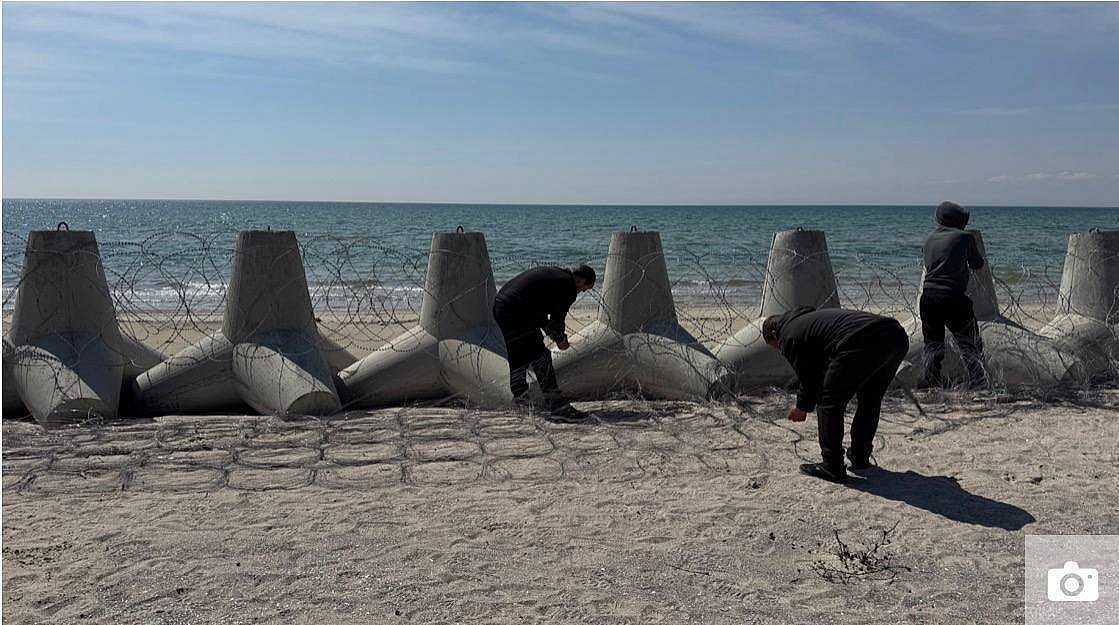
On the coast of Koblevo, engineers of the 123rd Territorial Defense Brigade are upgrading and strengthening coastal obstacles to prevent a landing; access to the sea here remains closed.
As reported by Suspilne, concrete and wire fences are being combined with minefields on the beach, creating a multi-layered system of obstacles on land and in the coastal waters.
The brigade’s chief engineer, Serhiy Khomenko, explained how this defense along the shore is arranged.
We combine this with mine-explosive obstacles. In the water we have anti-tank and anti-landing mine obstacles. And also in the sand in front of the tetrahedrons — anti-personnel minefields.
According to him, engineering units are restoring and modernizing existing obstacles, specifically integrating concrete and wire structures with minefields along various sections of the coast so as not to leave the enemy any “gaps” for maneuver.
The military urge people not to approach any fences and warning signs on the beach — the mine danger remains, and entering the sea is officially prohibited.
The restriction on access to the sea in Koblevo has been in effect since the beginning of the full-scale invasion. Last year, village residents temporarily blocked the road demanding to “open the sea”
Earlier we wrote:
- Another mine washed ashore in the Mykolaiv region — it detonated uncontrollably
- Stormy seas washed naval mines ashore on the coasts of Mykolaiv and Odesa regions
- Some exploded: after the Kakhovka HPP blast nine mines washed up on the shores of Odesa and Mykolaiv regions
- After the storm, the mine danger on the Black Sea coast increased