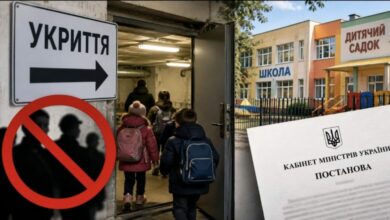
Children "on top of each other's heads": Finally, Sienkevych ordered school shelters to be inspected after parents' complaints
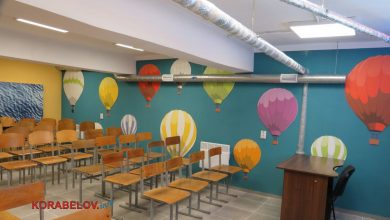
Heat, noise and overcrowded basements: what parents saw in Mykolaiv school shelters


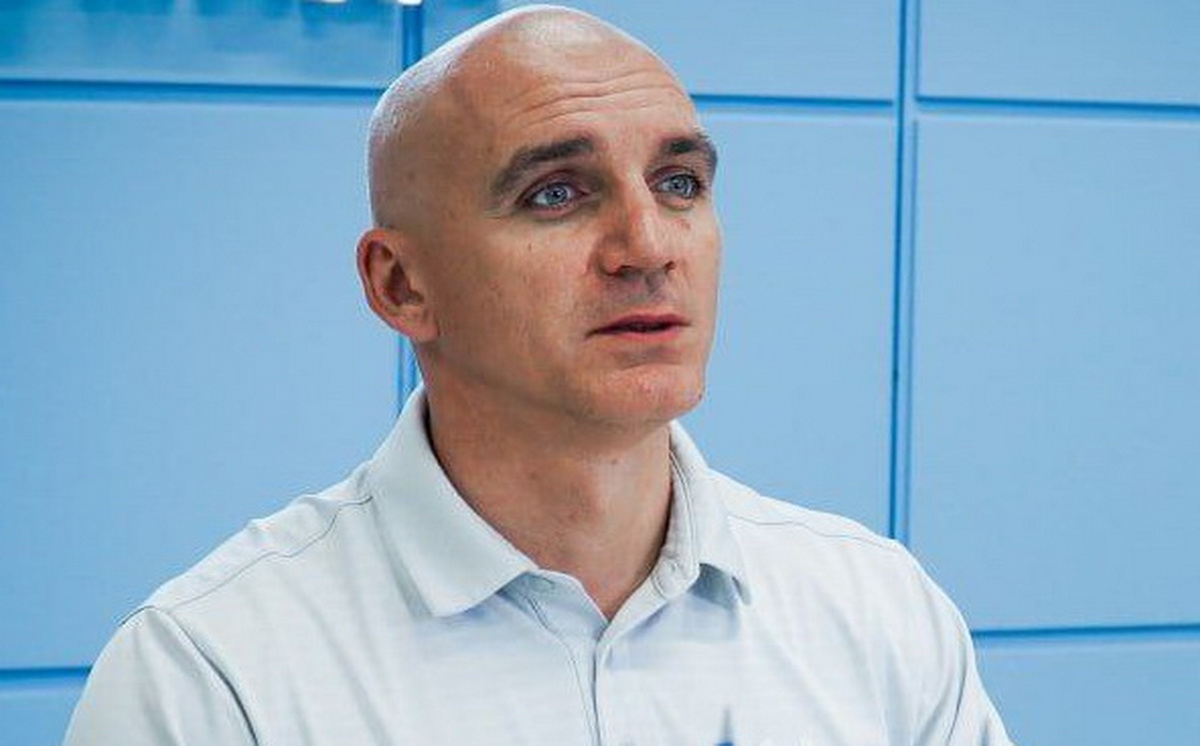
In Mykolaiv, after complaints from parents, authorities will check the conditions in which schoolchildren and kindergarten pupils stay in shelters during prolonged air raid alerts. Special attention should be paid to the proper and continuous operation of ventilation, air temperature, and whether the number of children corresponds to the actual capacity of the shelters. In some schools parents report overcrowded rooms, noise, and the impossibility of conducting lessons normally.
The relevant instruction was given by the mayor, Oleksandr Senkevych, during an official meeting on September 7, 2026. The city council called the first week of the school year an adaptation period: schools have already adjusted student distribution and schedules taking into account shelter capacity. Currently 45 schools in Mykolaiv are operating in person, 12 – remotely, and moving all institutions to single-shift learning is still impossible because of the specifics of the protective facilities.
Mayor Oleksandr Senkevych explained that due to the increase in the number and duration of air raid alerts, children spend significantly more time in shelters, and he receives information about the real conditions there not only from officials but also directly from residents.
“Because the number of alerts and their duration have increased here, the amount of time children spend in shelters has also increased. I receive information about the situation there not only from city officials, but also from parents and residents of the city,” — said Oleksandr Senkevych.
Among the complaints received by the mayor are reports of intermittent operation of ventilation systems. According to Oleksandr Senkevych, in one institution the exhaust is periodically switched off, although children may remain in the shelter for a long time.
“In one of the schools the exhaust ventilation does not operate continuously: it is turned on, turned off, and turned on again. This makes it uncomfortable for the children. Yes, the ventilation creates noise, but that noise is far less harmful to health than poor air,” – explained Oleksandr Senkevych.
The mayor also noted that some systems were designed without calculating for a situation in which, due to prolonged Russian attacks, ventilation would have to operate almost continuously for many hours. He separately criticized possible attempts to save electricity by switching off equipment.
“In some shelters it was not anticipated that the exhaust fans would have to run virtually all day. So they are simply turned off. Sometimes school principals save electricity, but that must not be done. Do not save electricity at the expense of our children’s health. They will get sick later, and we will spend other resources. Why did we do all this? Not for the sake of an exhaust fan or electricity — we did it for the sake of education,” – emphasized the mayor.
After that, Oleksandr Senkevych instructed the education department together with the State Emergency Service to inspect the schools and kindergartens of Mykolaiv where in-person learning is organized. They must check for the presence of ventilation, its technical condition, and the possibility of continuous operation while children are in the protective premises. Earlier the mayor’s office had already confirmed that the capacity and features of shelters remain one of the main constraints for organizing in-person learning.
Head of the Mykolaiv City Council education department Hanna Lychko stated that school leaders were initially urged to use shelter ventilation systems continuously.
“I immediately stressed to all leaders: you cannot skimp on ventilation use. It must be turned on,” – said Hanna Lychko.
At the same time, according to Hanna Lychko, another problem arose in the first days of the school year — heat. Ventilation systems take air directly from the street, so at high outside temperatures it does not make the shelter noticeably cooler.
“The only problem now is that the ventilation draws air from outside, and it is hot outside. Currently the maintenance organization is visiting educational institutions and inspecting the ventilation systems. We are working to make children more comfortable,” – explained the head of the education department.
Particular attention was drawn to the situation at Gymnasium No. 24 in Matviivka. Parents of pupils complained that during air raid alerts too many children were in the shelter at the same time, the room was hot, and the ventilation, according to them, did not provide comfortable conditions. According to the head of the education department, the shelter at Gymnasium No. 24 does have ventilation. She linked the problem primarily to the high external temperature: in the first days of September the air the system supplied to the shelter was heated to over 30 degrees Celsius. Hanna Lychko assured that all simple shelters that have been officially accepted and are already used in Mykolaiv’s educational institutions have ventilation. At the same time, there is one renovated room in the city that has not yet been accepted for operation precisely because of the absence of the required ventilation system. Donors are to install the equipment by December 1, 2026. According to the official, that institution already has another functioning shelter with ventilation and the corresponding readiness certificate. Students are using that one now.
Parents name not only the air but also overcrowding of shelters as a separate problem. During a long alert pupils from many classes can go down to a single room at the same time. Because of the noise and the number of children, it can be difficult to organize a full lesson there.
Reader Tetiana Sanzharevska, commenting on conditions at Gymnasium No. 52, stated that children from different classes are simultaneously together in a shared basement room.
“At Gymnasium 52 the basement-shelter is just packed. All classes together, on top of each other. Noise, racket. My head is spinning,” – she wrote.
Another resident of Mykolaiv, Iryna Tkach, questioned the possibility of full-fledged learning in such conditions, especially given the constant threat of Russian attacks on the frontline city.
“Speechless… in how many schools do the ‘shelters’ allow lessons to be held? Frontline area, children in basements more often than in classrooms,” – reads her comment.
About the situation at School No. 13 wrote Nataliya Drohina. According to her, during alerts the children stay in the shelter together, but full lessons are not held there.
“At School 13 everyone sits together on chairs and no lessons are held! Why aren’t shelters equipped with classrooms? They sit in the basement all day, what’s the point of opening and enrolling children in such schools?!” – she wrote.
The education department calls two-shift schooling one of the practical ways to reduce the number of children in shelters. However, it is impossible to organize it uniformly for all classes. According to Hanna Lychko, it is easiest to move primary grades to two shifts, where most lessons are taught by a single teacher. In middle and high school the schedule depends on a large number of teachers, classrooms, subjects, and the actual area of the shelter. Gymnasium No. 24 already switched to this format after the first week.
Head of the education department Hanna Lychko confirmed that the decision on two-shift schooling at Gymnasium No. 24 was made after assessing the situation in the first days of the school year.
“The head, based on the results of the first week of classes, saw that indeed it was necessary to study in two shifts. Today they are studying in two shifts,” — said Hanna Lychko.
According to official city council data, currently 19,308 students study in person in Mykolaiv schools, another 5,187 attend in person with the use of remote learning technologies, and 8,060 children remain fully remote. Over the year the number of pupils in the city decreased by 2,465, and the number of classes by 67.
Despite shelter problems, Oleksandr Senkevych said the city must preserve in-person learning wherever it can be organized safely. He considers a complete transition of students to remote learning a poor alternative.
Mayor Oleksandr Senkevych, referring also to his own experience of children’s schooling during the COVID-19 pandemic, said that in his view the remote format does not provide a full educational process.
“I personally do not believe in online learning for school-age children. I don’t believe that children who study remotely can gain proper knowledge. I have two children, and I was convinced of this during COVID. Children do not study: they play, do their own things, and at the same time communicate with someone. There is no full-fledged educational process. And I understand that today there are risks to children’s safety, but in shelters they are much smaller,” — said the mayor.
In August the executive committee of the Mykolaiv City Council approved the organization of learning for the 2026/2027 school year with a direct link of each school’s format to the security situation, capacity and condition of shelters. Before the start of the school year, institutions with shelters also had to pass separate commission readiness checks.
Remember, we wrote about this two years ago;
Earlier we wrote:
- Over 8 thousand children remained remote: how Mykolaiv schools operate
- In Mykolaiv a school has already installed structures of a radiation-protection shelter
- Without long speeches under the sun: schools are advised to do without assemblies on September 1
- 600 million budget hryvnias: what was found in tenders for school shelters
- In Mykolaiv 45 schools will operate in person, another 12 – remotely