"A 3,000 fine for photos of empty shelves": a new Russian fake exposed amid food supply disruptions
Photographing the shelves is allowed: the Russians made up a fake, but were exposed by AI


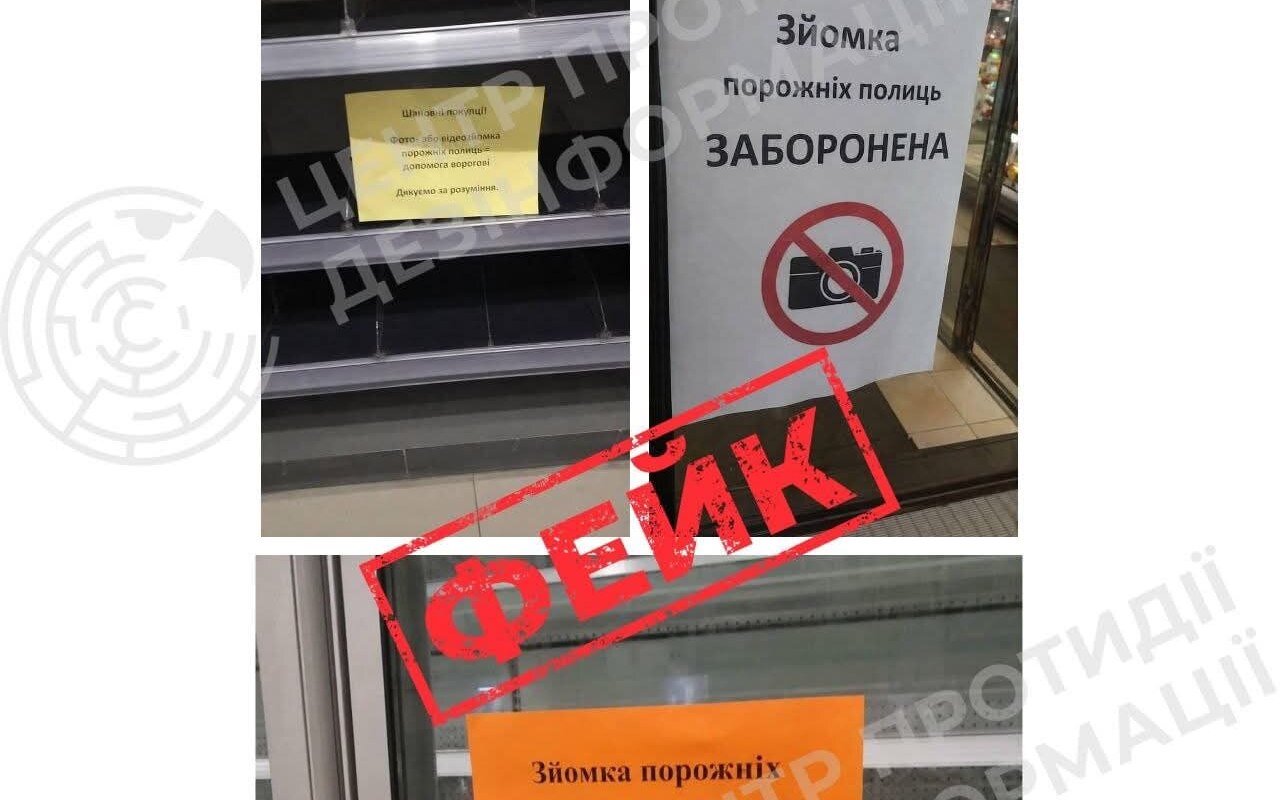
Against the backdrop of partially empty shelves and delays in food deliveries in shops in Ukraine, Russian propaganda has launched a new fake. On social media, photographs are being spread allegedly from Ukrainian supermarkets, where shoppers are supposedly warned against photographing empty shelves and even threatened with a 3,000 hryvnias fine. The Center for Countering Disinformation (CCD) stated that such images are forged.
The CCD reported the latest Russian information operation on 3 September 2026. According to the Center, images began to be actively circulated online allegedly showing notices installed in stores banning the photographing of empty shelves.
The Center for Countering Disinformation described which messages Russian outlets are trying to pass off as genuine announcements from Ukrainian supermarkets.
“Russian propaganda is spreading fake photos allegedly banning the photographing of empty shelves in Ukrainian stores. Images are being circulated online supposedly from Ukrainian supermarkets where notices call on people not to photograph empty shelves, warn against filming or even threaten a 3,000 hryvnias fine for such photos,” — the CCD said.
The Center checked the circulated photos and concluded that they are not photographs of real in-store notices. According to the CCD, the images were created using artificial intelligence and were initially distributed by Russian propaganda Telegram channels. The CCD emphasized that the Russians used real temporary logistics problems that arose after Russian strikes on warehouses and logistics centers as the basis for their information campaign.
“They were generated using artificial intelligence, which is confirmed by checks from specialized content analysis services. The primary sources of these images were Russian propaganda Telegram channels. This disinformation campaign by the enemy was deployed against the backdrop of temporary difficulties with food supplies to stores caused by Russian strikes on warehouses and logistics centers,” – The CCD explained that the aim of such a campaign is to demoralize Ukrainians and spread fear about the country’s food security.
What’s with the shelves in Mykolaiv
At the same time, the actual difficulties with the supply of certain categories of goods in Mykolaiv are indeed being observed. A NikLife correspondent checked a number of city supermarkets and reported that he did not find any such signs banning the photographing of shelves or threatening fines. At the same time, in some retail outlets shelves for certain products remained partially empty.
For example, in one ATB store, juices and Pepsi were placed in the vacated spots instead of porridges and grains. Other products were partially used to fill spaces where sugar, flour and salt are usually sold. Water and other products were also placed on egg shelves. Journalists also recorded shortages of certain porridges and grains in Velmart.
Earlier ATB explained that problems with the availability of certain goods and the introduced restrictions were related to the consequences of Russian strikes, pressure on logistics, as well as mass purchases of goods by some shoppers and resellers. From 28 August 2026 the chain temporarily limited the sale of a number of socially important products to 6 units or kilograms per receipt. The list of goods subject to the restrictions included, in particular, cereals, pasta, salt, sugar, oil, canned goods and chicken eggs. At the same time, ATB emphasized that the introduction of limits in itself does not mean a general shortage of products.
The situation worsened after a series of Russian attacks on civilian and logistics infrastructure. In particular, on 29 August 2026 a Russian Shahed strike drone attacked a warehouse of a food industry enterprise near Mykolaiv, where a large-scale fire broke out.
Thus, Russian propaganda used real interruptions in the supply of certain goods as the basis for the fake, adding fabricated “bans” on photographing and “fines” for shoppers.
Earlier we wrote:
- “I wanted a kilogram of sugar and a packet of salt — I couldn’t buy them”: who emptied the shelves at ATB
- Russian attack destroyed a Roshen warehouse and damaged Comfy, “Avrora” and “House of Toys” centers in the Kyiv region
- Russian forces struck the Sandora warehouse near Mykolaiv with a Shahed drone
- “Shahed” and “Banderol” struck Mykolaiv: the enemy attacked the port, energy infrastructure and a food enterprise
- ATB explained the reason for restrictions on the sale of groceries and eggs