Everything into the furnace! In Mykolaiv they want to heat boiler houses with pellets made from city trees
Pellet independence for 2.5 million UAH: a production line has been launched in steppe Mykolaiv — but where will the raw materials come from?


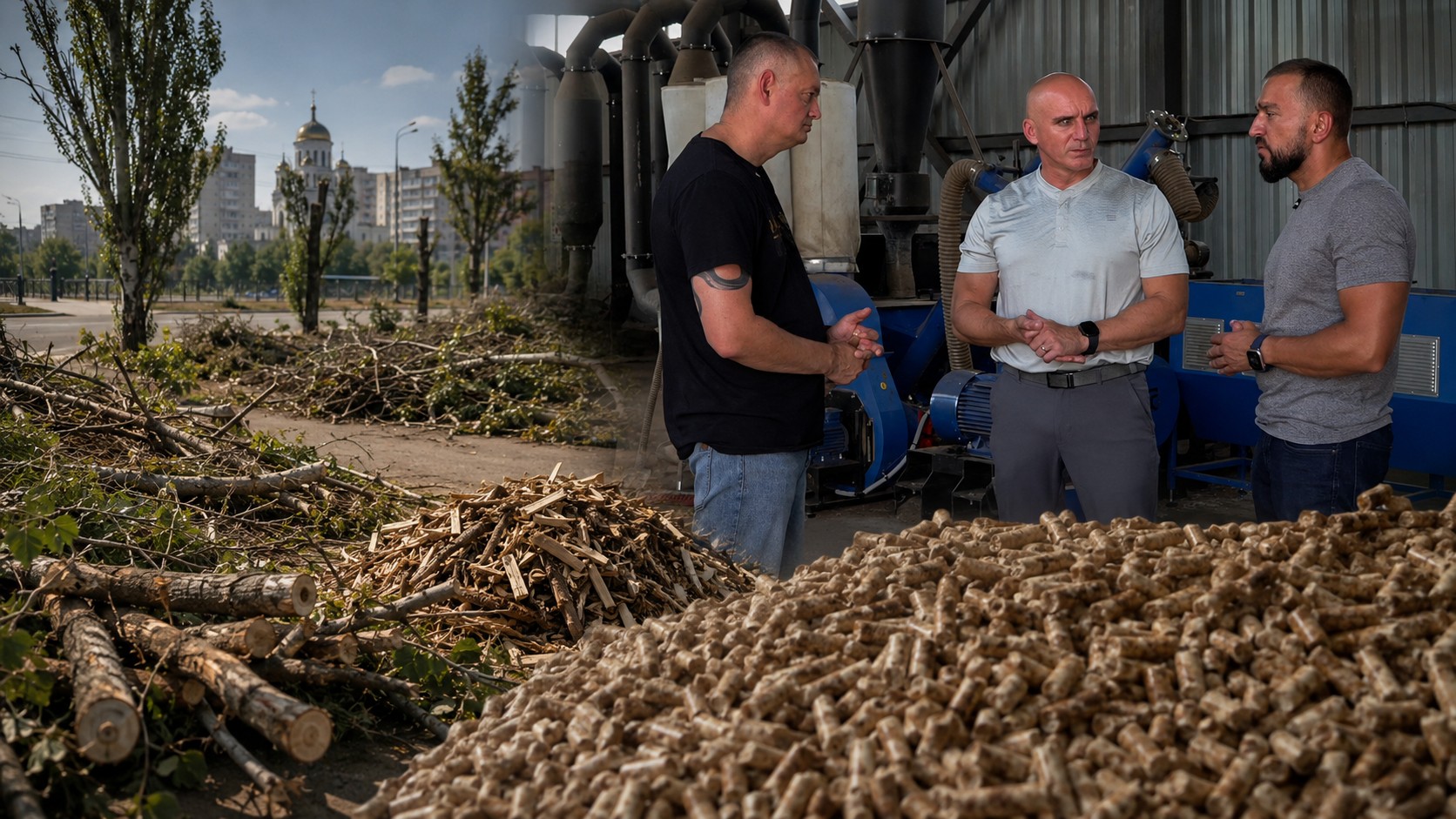
The municipal enterprise “Mykolaivoblteploenergo” reported that in Mykolaiv its own fuel pellet production line is already operating. The company calls this a step toward energy efficiency, savings and energy independence: instead of buying ready-made pellets the heating utility wants to produce them itself from wood and chips after pruning the city’s trees.
However, behind the attractive scheme “branches – pellets – heat” a number of questions remain. The most important of them: whether the wooded raw material in the steppe city of Mykolaiv will be sufficient for the expensive equipment to operate regularly rather than stand idle? Especially since in the video accompanying the company’s announcement a representative of the heating utility LOGVINOV Mykola Yuriyovych explains that the raw material is planned to be obtained from KP “Mykolaiv Parks”, but there is currently no legal mechanism for such a transfer.
The line exists, but there’s no mechanism yet to transfer raw material
“Mykolaivoblteploenergo” reports that the raw material for production should be wood and chips generated after pruning trees by KP “Mykolaiv Parks”. The waste that could be removed the company wants to turn into fuel for boiler houses.
But in practice an unusual sequence emerges: the production equipment has already been purchased, installed and launched, while the legal issue of transferring the main declared raw material from one municipal enterprise to another is not yet resolved.
That is why the first public question to “Mykolaivoblteploenergo” is quite simple: what guaranteed volume of raw material did you count on when deciding to purchase the line?
The line itself cost almost 2.5 million UAH
The cost of the equipment can already be seen in open procurement data. The municipal enterprise “Mykolaivoblteploenergo” conducted a procurement for a “Pellet granulation line” with identifier UA-2025-01-11-000448-a. The amount of the completed procurement is 2 484 522 UAH.
The procurement was created on 11 January 2025 and completed on 4 February 2025. The supplier of the equipment was LLC “TMS-TRADING”.
So this is not just an experiment crushing a few truckloads of branches. This is a separate production line costing almost 2.5 million UAH, whose economic efficiency directly depends on its utilization, the amount of raw material and the production cost of each tonne.
Why did they decide to produce pellets themselves at all?
As early as 2 December 2025 the director of the municipal enterprise “Mykolaivoblteploenergo” Mykola Logvinov explained that the company had received pellet-fired boilerhouses from international partners. Such facilities exist in Mykolaiv and Snihurivka, in particular a pellet boiler is used to heat a hospital.
According to Mykola Logvinov, the market price of pellets at that time had risen to roughly 15,000 UAH per tonne, while a year earlier it cost about 7,000–8,000 UAH per tonne. The increase in the price of ready fuel was named by the head of the enterprise as the reason for switching to in-house production.
The logic is clear: if pellets become more expensive, and wood residues can be obtained for free or at minimal cost, in-house production could potentially yield savings. But the word “potentially” is key here, because savings depend not on the price of store-bought pellets but on the full production cost of in-house pellets.
How much did the company previously spend on ready-made pellets?
Open procurements allow at least a partial estimate of the scale of expenses.
For example, in 2025 “Mykolaivoblteploenergo” purchased 22 tonnes of wood pellets for delivery to Snihurivka. The price was 8,000 UAH per tonne, the total cost – 176,000 UAH.
Another purchase of fuel pellets in 2025 amounted to 588,456 UAH. According to “Anticorruption Vymir” this concerned 66 tonnes of pellets at 8,916 UAH per tonne.
In addition, on 14 February 2025 open data shows another completed procurement by “Mykolaivoblteploenergo” – fuel pellets from wood for 1,187,208 UAH.
Thus, just from these three identified procurements in 2025 we have:
- 588,456 UAH;
- 1,187,208 UAH;
- 176,000 UAH.
Together – 1,951,664 UAH.
At the same time it should be emphasized that these 1.95 million UAH cannot automatically be called the company’s full annual pellet consumption. These are only the procurements that could be identified in open data, and they may concern different boilerhouses and different periods.
The line costs more than 1 year of the found pellet purchases
If one simply compares the cost of the line – 2,484,522 UAH – with the sum of these three pellet purchases – 1,951,664 UAH, the equipment costs approximately 1.27 times more.
But this does not mean that the line can pay for itself in 1.27 years. That calculation would only be possible in a fantastic situation where in-house pellets cost nothing: no wages, electricity, repairs, transport, drying and raw material preparation.
In reality, from the price of pellets that the company no longer buys on the market one must subtract all the costs of producing them in-house. And that figure – the full cost of one tonne – is not provided in the company’s public announcement.
At least two workers – already over 400 thousand UAH per year
Additional insight into fixed costs comes from the company’s vacancies.
The municipal enterprise “Mykolaivoblteploenergo” was looking for an operator of the fuel pellet production line with a salary of 17,150 UAH and a fitter-repairman for the fuel pellet production sector with the same salary – 17,150 UAH.
Both vacancies are full-time. If we take only the stated salaries in the vacancies, without any bonuses, allowances or other staff, we get:
17,150 UAH × 2 = 34,300 UAH per month.
34,300 UAH × 12 months = 411,600 UAH per year.
And that is only the nominal salaries of two employees. This does not include other employer costs, possible allowances, additional personnel, electricity, equipment repair, spare parts, loading and transport of raw material.
The salary of two employees is the cost of dozens of tonnes of ready-made pellets
For illustration, these 411,600 UAH can be compared to prices for ready fuel.
If we take the market price cited at the end of 2025 of about 15,000 UAH per tonne, then the annual salaries of just two employees equal the cost of approximately 27.4 tonnes of ready pellets.
If calculated at the price of the actual purchase for Snihurivka – 8,000 UAH per tonne – this is already the equivalent of approximately 51.5 tonnes.
And at 8,916 UAH per tonne, the price for which the company bought a 66-tonne batch, it is about 46.2 tonnes.
Again, this is not proof that production is unprofitable. If the line produces hundreds of tonnes of pellets annually from virtually free raw material, staffing costs may be entirely justified. But if available chips amount to only a few dozen tonnes, the economics will look very different.
Dryer, press, cooler: production also consumes resources
From the operator vacancy description it is clear that this is a full technological line. The worker must control the operation of the dryer, press, cooler and packaging machine, monitor temperature, humidity and pressure.
So turning branches into pellets is not just shredding wood. The raw material must be delivered, prepared, if necessary shredded, dried to the required moisture content, pelletized, cooled and prepared for storage or transport.
All of this means electricity costs, wear of press equipment, repairs, parts replacement and staff time. Without these components, comparing “free branches” to pellets at 15,000 UAH per tonne is incorrect.
And will there be enough branches in the steppe Mykolaiv?
The question of the raw material base raises the greatest doubt.
Mykolaiv is a city in the steppe region of southern Ukraine, not an area with industrial timber harvesting. The potential resource for municipal production effectively remains trees removed as hazardous and the waste from pruning and crown maintenance of city plantings.
Moreover, the city’s own program for economic and social development acknowledges problems with the green fund. As of 1 July 2023 within the boundaries of Mykolaiv there were recorded 239 green management objects: 12 parks, 104 squares, 4 boulevards and 119 other green zones. The document also states that renewal of the green fund is happening too slowly and does not meet the city’s greening needs.
For residents of the Korabelnyi district this problem is not theoretical. In June 2026 we reported that in the “Metalurh” square, according to locals, more than 25 trees died over the course of a year. Problems with green plantings were also recorded in the “Vitovsky” square.
Therefore a completely logical question arises: what real annual volume of wood and chips can the city provide without the pellet production itself creating an incentive to increase pruning volumes?
This is not to suggest that healthy trees will be felled for pellets. But when a separate production is created, its economics require a predictable volume of raw material. The source and quantity of that raw material must be clear to residents.
And the wood was previously promised to the military
There is another circumstance. In January 2025 the director of KP “Mykolaiv Parks” Dmytro Chuchmai said that the enterprise does not sell wood after pruning, and most of it is transferred for the needs of the Armed Forces of Ukraine – for heating and fortification. A small part was used for the municipal enterprise’s own needs.
Now the heating utility is counting on the same municipal wood as a resource for pellet production.
So another public question arises: which type of wood residues will be transferred to “Mykolaivoblteploenergo” and will the volume of wood previously supplied to the military be reduced as a result?
So is this line profitable or not?
The numbers available so far do not allow a clear answer of either “yes” or “no”.
On the one hand, “Mykolaivoblteploenergo” truly spent significant funds on pellet purchases. Just the three found procurements for 2025 amount to about 1.95 million UAH, and by the end of that year the company was already talking about a market price up to 15,000 UAH per tonne.
On the other hand, the line itself cost 2,484,522 UAH, it requires dedicated personnel to operate, the equipment consumes electricity and needs repairs and maintenance, and most importantly – there is not even a legally formalized scheme yet for obtaining the declared raw material from KP “Mykolaiv Parks”.
So right now the most important figure is not the market price of pellets nor even the cost of the line itself.
The most important question is – how much does it actually cost to produce 1 tonne of in-house pellets in Mykolaiv?
Questions the heating utility can answer publicly
After announcing its successful launch, questions remain answers to which would allow residents to assess the effectiveness of the new direction themselves:
- What is the final full cost of launching production, including installation and site preparation?
- What is the design capacity of the line – how many tonnes of pellets can it produce per month and per year?
- How many tonnes have actually already been produced?
- How many tonnes of pellets did all the boiler companies actually burn in the previous heating season?
- What is the full production cost of 1 tonne of in-house pellets?
- How much of that cost is wages, electricity, repairs, logistics and raw material preparation?
- How many tonnes of wood and chips per year can KP “Mykolaiv Parks” realistically transfer?
- When will the mechanism for such a transfer be legally formalized?
- Will city raw material be sufficient for the planned loading of the line?
- If it is not sufficient – does the enterprise plan to buy sawdust, chips or wood on the market?
- Will the amount of wood available for the Armed Forces of Ukraine remain at the same levels as before?
- What is the projected payback period for the invested 2,484,522 UAH?
If these calculations exist, publishing them would only confirm the economic feasibility of the project as stated by the enterprise. If such calculations do not exist, then the question of why a pellet line was first purchased in the steppe city of Mykolaiv and only afterwards questions of stable wood supply are being resolved becomes even more pressing.
Earlier we wrote:
- Drought killed trees: in the Korabelnyi district the “Metalurh” square lost more than 25 plantings
- KP “Mykolaiv Parks” acknowledged: hazardous trees near the bypass in Korabelnyi were not completely removed
- “It bothers me” as a verdict for a tree: green catastrophe – by the hands of Korabelnyi residents?
- The heating utility goes into “wood processing”: in Mykolaiv they will start making their own pellets
- Where the wood goes after tree pruning in Mykolaiv?