She wanted to go to Poland, but ended up in the military: the story of a servicewoman from Balabanivka
At 40, Kateryna left her job at a gas station and signed a contract with the Armed Forces of Ukraine (video)


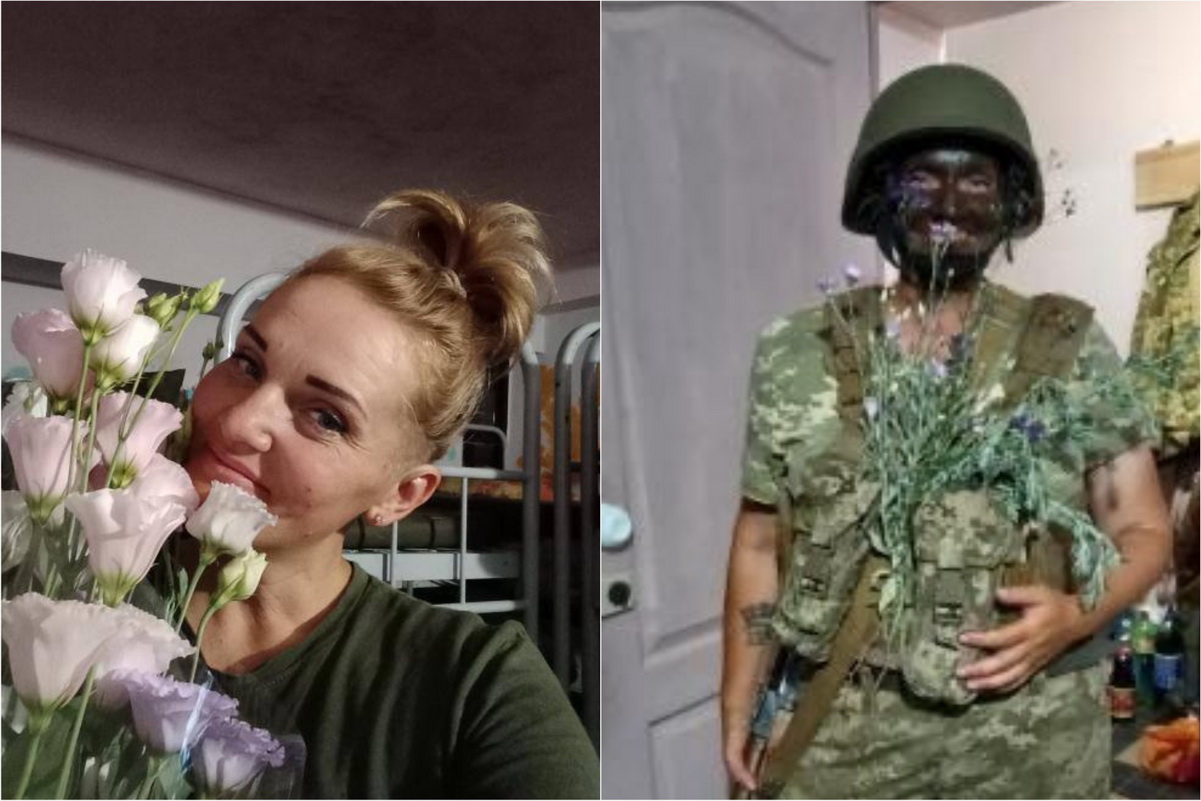
Kateryna Karputova — not just a servicewoman. She is a daughter, mother, wife and grandmother. Before the full-scale war began, the woman lived an ordinary civilian life in the Korabelnyi district of Mykolaiv, worked at an ANP network gas station and planned to move to Poland.
However, the Russian shelling she experienced forced her to look at her own future differently. At 40 years old she decided to sign a contract and become a servicewoman.
After the full-scale invasion began, the gas station employees where Kateryna Karputova worked helped volunteers who evacuated abandoned and injured animals from areas under constant Russian shelling.
The woman recalls that seeing the rescued animals was extremely difficult:
“We helped volunteers evacuate animals: we refueled their cars for free, and they drove to Kherson. Then they returned with cages in which frightened dogs sat. It was terrifying to look at them; even then I thought about signing a contract”.
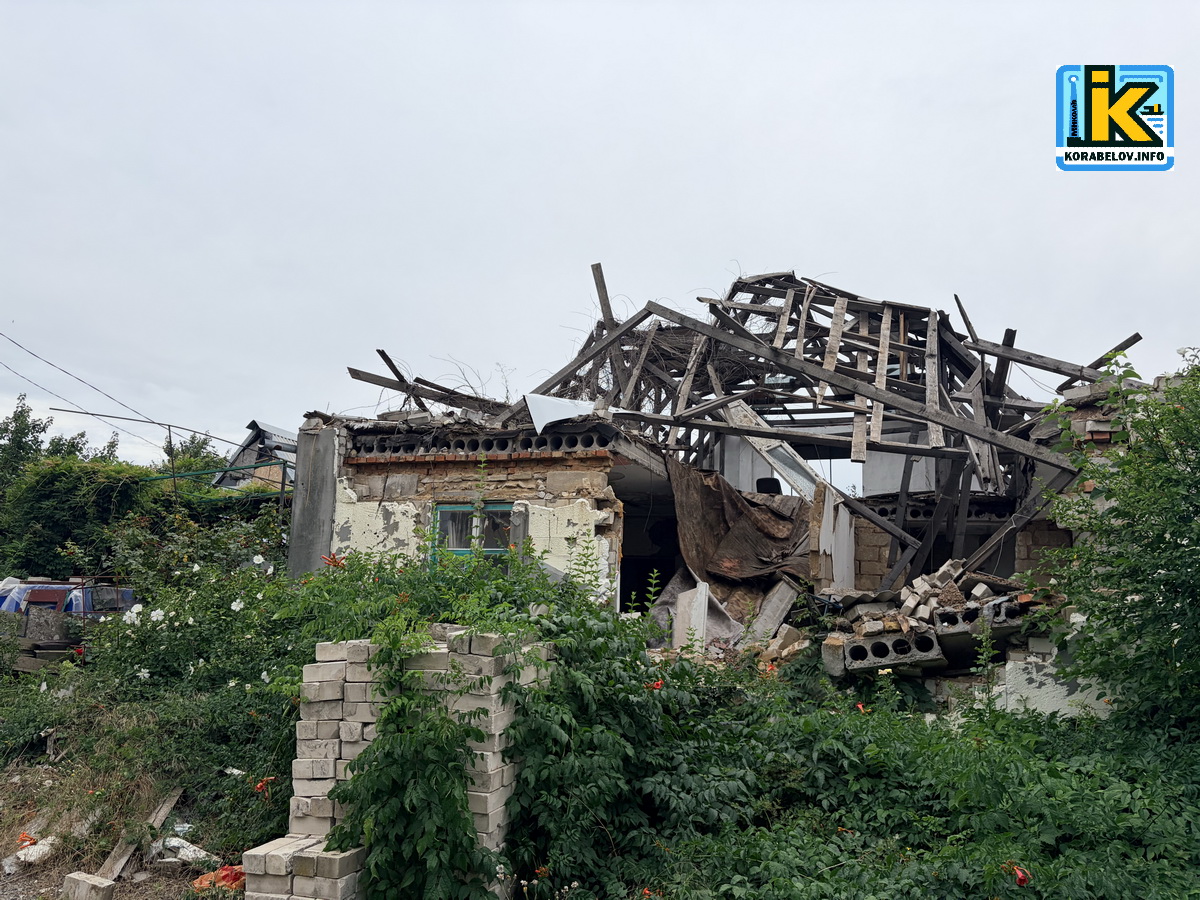
The main turning point after which life in Balabanivka was divided into “before” and “after” was the Russian shelling on 7 March 2022. That day the strikes on the neighborhood lasted from morning until evening. Russian rockets, shells and aerial bombs damaged residential houses, roofs and outbuildings. People lost their homes, and some families – their loved ones.
While showing a correspondent from Korabelov.info around the neighborhood streets, Kateryna Karputova showed houses that still bear traces of the Russian attack.
“You could say three streets were destroyed. There is a house into which a rocket flew but did not detonate. It then got stuck right in the wall,” the woman recalls.
After particularly intense shelling, a significant portion of residents left Balabanivka. Some later returned and began restoring damaged homes on their own, while others never dared to settle in their houses again… Over time, homeless people began to move into abandoned dwellings.
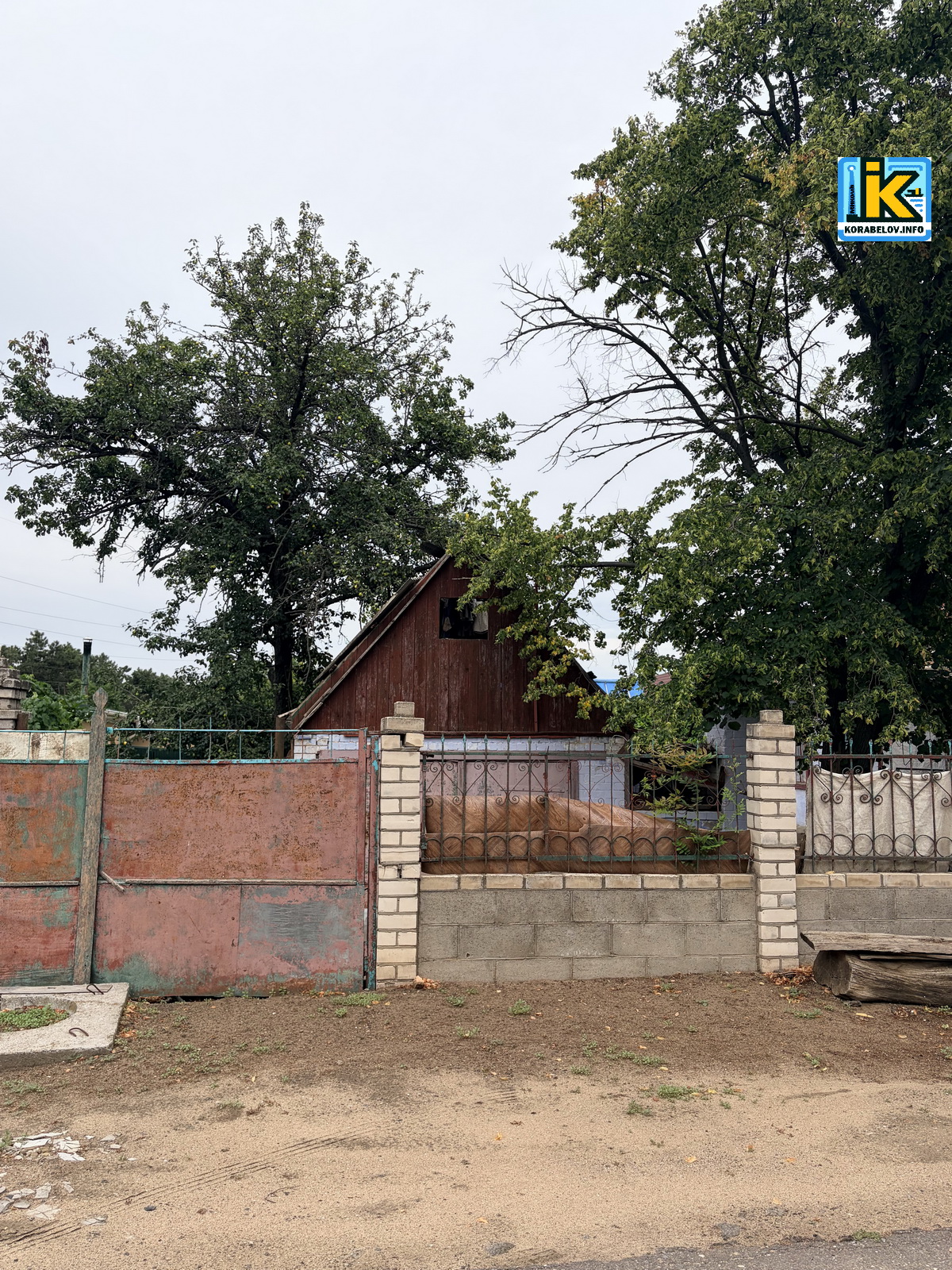
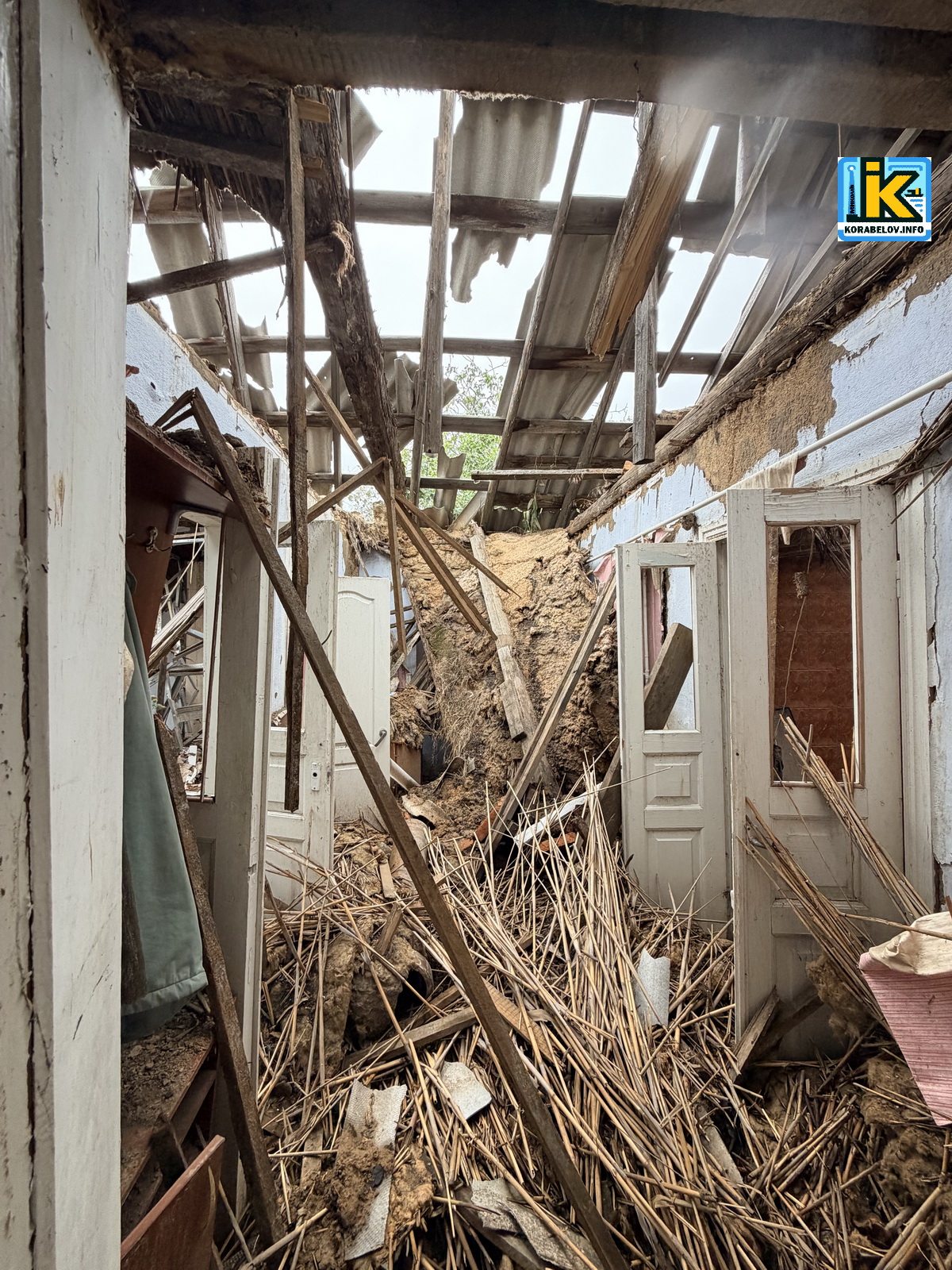
At the same time, there were people who, despite the danger, did not leave the neighborhood.
“There were residents who did not leave. In one of the houses they created a kind of shelter for animals and took in abandoned dogs and cats,” — Kateryna emphasized that even in the worst days people tried to save those who could not ask for help themselves.
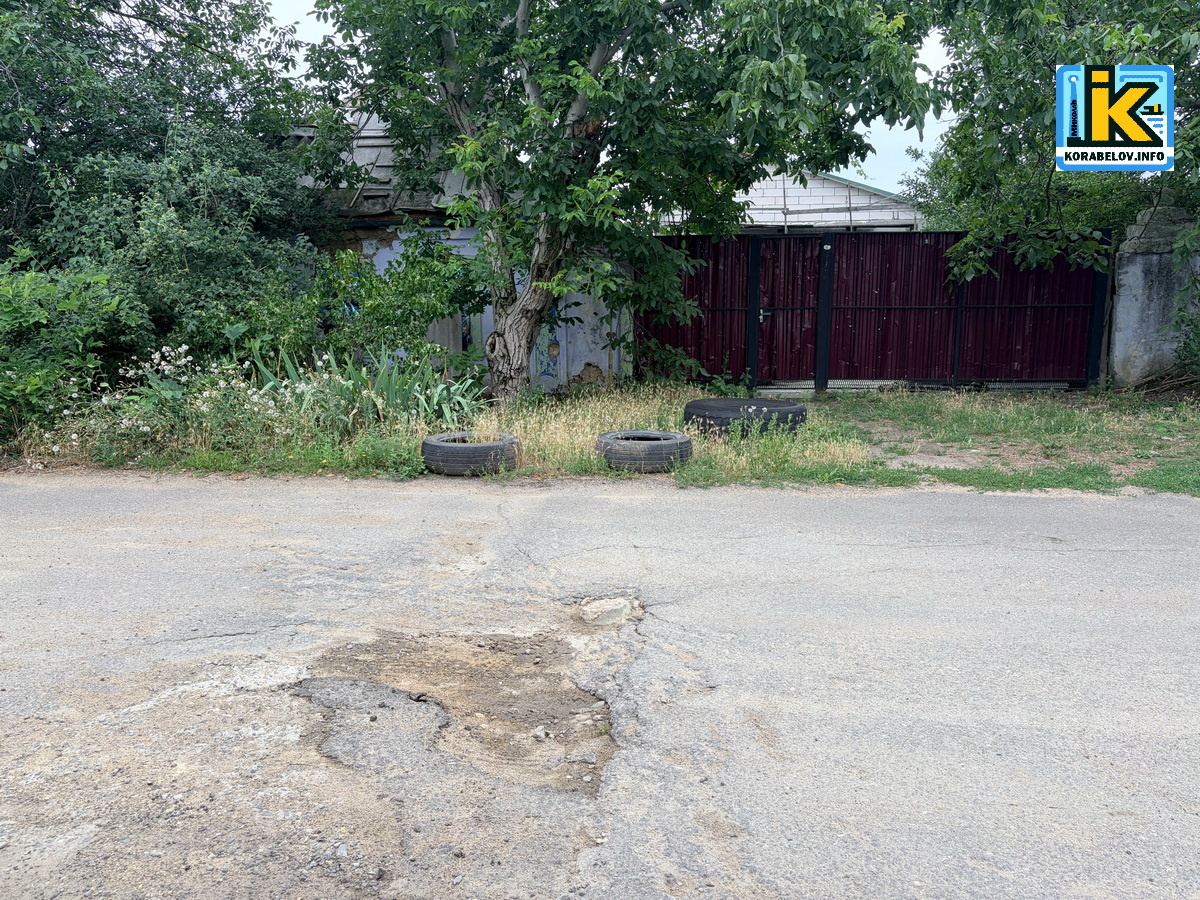
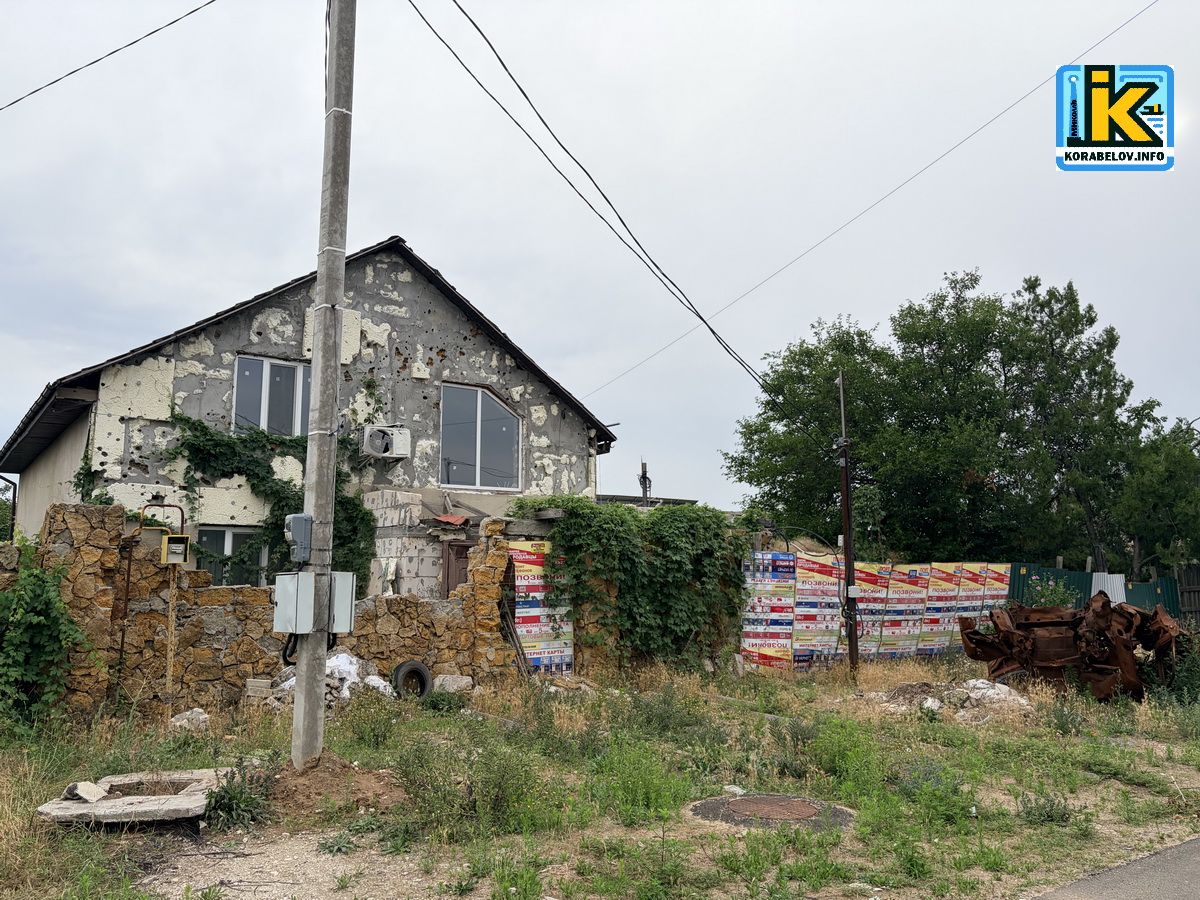
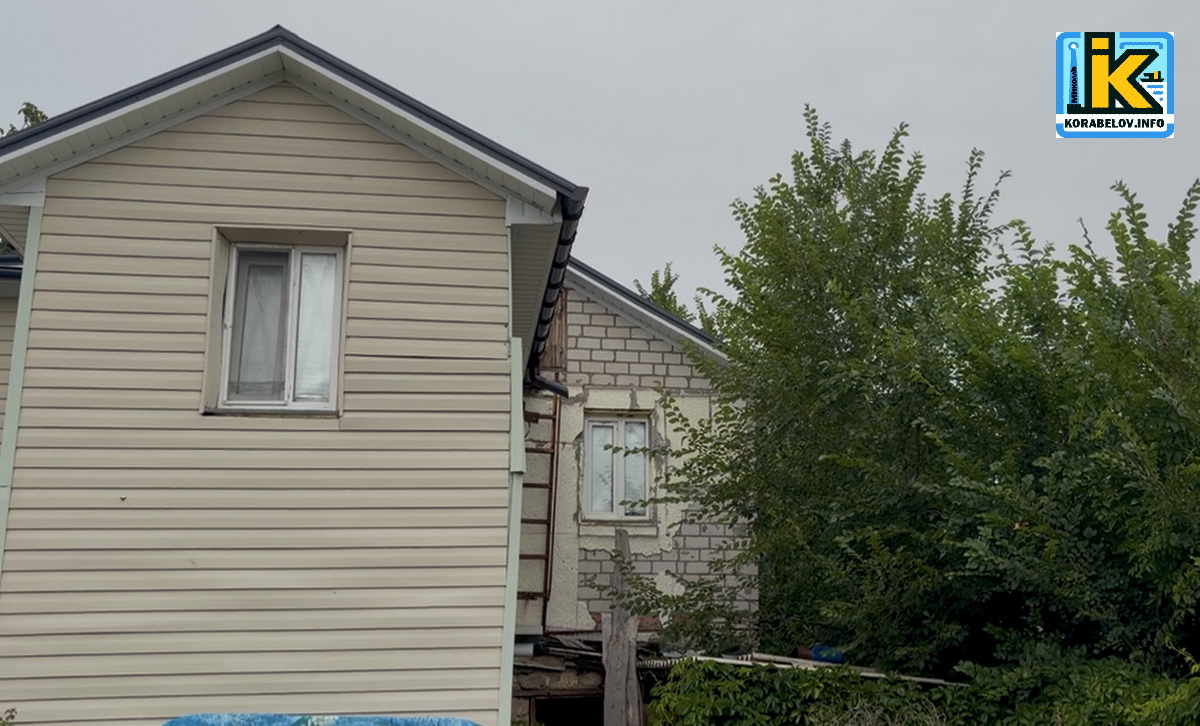
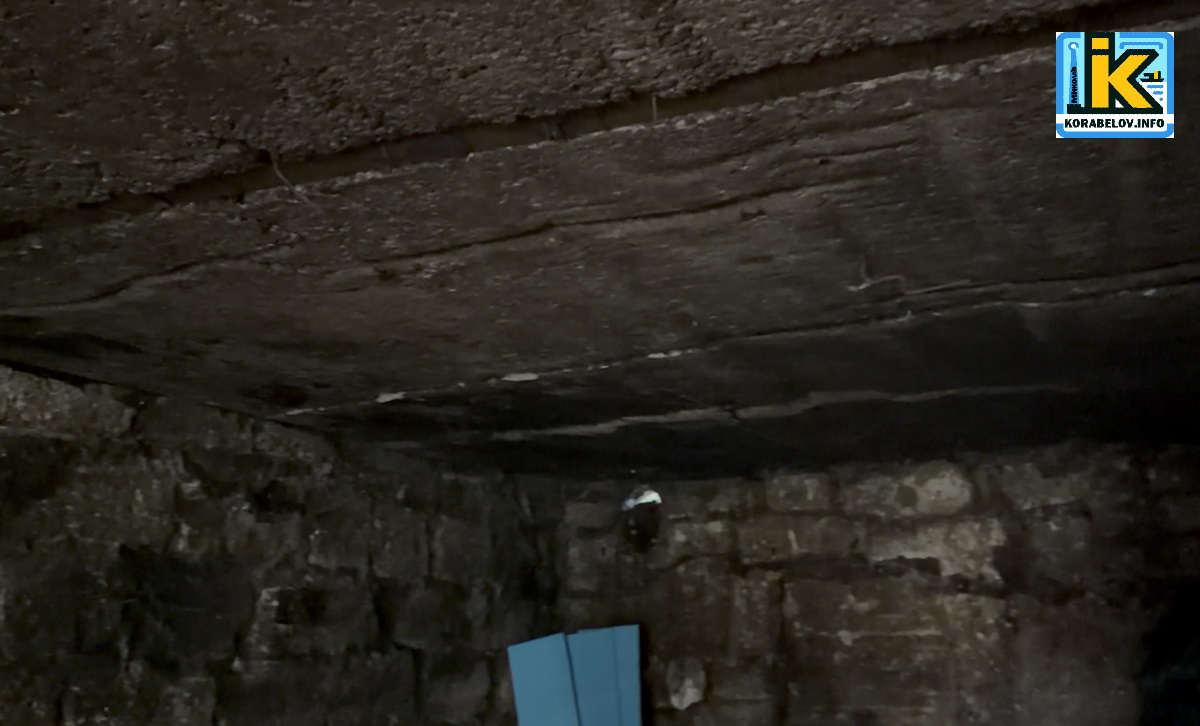
The house of Kateryna Karputova‘s family was also damaged during the attack. The roof and the floor between the first and second stories were damaged, cracks appeared in the walls and ceiling. The pool was completely destroyed, the foundation of the home pond cracked, and the damaged gates had to be replaced at the family’s own expense.
The family did not immediately receive compensation under the “єВідновлення” program. To prevent further damage, they installed windows themselves, and temporarily covered the roof with corrugated sheets. The required material with the correct curvature was found in one of the villages of the Halytsynivka community…
About restoring her house the servicewoman said:
“Only in 2025 did we fully restore the roof. We waited three years. They paid us about half a million hryvnias for the damage, but by that time we had already at our own expense installed windows and bought corrugated sheets to at least temporarily cover the house. We found a crew that agreed to work under shelling and rain, because no one wanted to go — it was dangerous. When the first part of the compensation arrived in 2025, we photographed the completed work and submitted reports. After that we received the second part of the funds. They were enough for the roof, the second-floor ceilings and part of the facade. But there is still work to be done. In addition, a significant portion of family funds goes to my mother’s medical treatment.”

The turning point, Kateryna Karputova says, was the Russian strike on her native neighborhood and its residents. The shelling she experienced in Balabanivka would not allow her to return to her former life. She increasingly thought that her skills and experience could be useful in the military. At first the woman doubted whether they would accept her because of her age and an injured knee:
“What affected me most was what happened on 7 March 2022 near my house and directly with my family. After that I was no longer afraid and I myself submitted documents to the recruitment center (TCC). I was 40 years old. I understood that my contribution might be small, but I could still be needed by someone. Innocent people suffered for no reason: some were left disabled, some died. Someone lost a house they had built all their life, and then someone came supposedly to ‘liberate’ us — from our homes and our lives.”
She made the decision to submit documents to the TCC on her own. Within a few days a recruiter contacted her. Kateryna Karputova joined the military in 2023. By education she is an economist, so at first she was assigned to work in a recruiting unit handling documents, where specialists with accounting knowledge were needed. However, office work soon began to seem too monotonous.
An additional problem was the distance. At first Kateryna had to travel about 40 kilometers from Mykolaiv. The route went through the whole city, across the Varvarivskyi Bridge and then towards one of the region’s villages. There was no permanent housing near the place of service, and daily commutes took a lot of time and energy.
Soon the woman transferred to the recruiting unit in Mykolaiv, but even there she realized she wanted to work in a combat unit.
Kateryna speaks about the first stage of her service with her characteristic straightforwardness.
“At first I worked in recruitment, but the conditions did not suit me. First, it was boring to constantly sit with accounting. Second, I had to travel far outside the city. I realized I wanted to transfer to a combat unit, I found a unit myself, submitted documents through ‘Army+’ and achieved the transfer.”
Before further service Kateryna Karputova completed basic general military training. Despite a knee injury and the absence of a meniscus, she performed exercises together with everyone: marched to the range in full gear, worked in dugouts, learned tactical medicine and underwent trials with combat equipment.
The final exam fell on her birthday — 30 June. Instead of celebrating there were the range, heat, heavy equipment and another endurance test.
In the training center she trained together with two other women. Instructors with combat experience warned from the start about discipline and the same requirements for everyone. According to Kateryna, after long daily hours the only wish was to get to the shower and sleep.
She noted that conditions for women in her training center were organized properly: separate showers, toilets and a living area. At the same time, Kateryna heard stories about much harsher conditions in other training units.
After training, the servicewoman worked in logistics and handled the paperwork for the fuel and lubricants service. The unit was in Chernihiv region, and later moved to Sumy region.
The first relocation closer to combat action was a real psychological trial for her. Broken roads, a car loaded with belongings, forest, dugouts and the prospect of living near the front caused panic. In the end, the servicemembers were allowed to look for housing in a neighboring village.
Recalling her first experience with field service conditions, the woman does not hide that she was not ready at first:
“When we arrived, they showed us the forest and dugouts and said that we would live and work here. I had a hysterical attack and panic. I was ready to work, but I could not imagine constantly living in a forest. Then we were allowed to look for a house in a village. There were wooden houses, often without water, a toilet or proper heating. It was a shock for me.”
It was during her service that Kateryna met her future husband, who is from the Poltava region. He is 10 years younger than her, but the age difference, she says, was never a problem for them.
In the hardest moment the man supported her and practically took her “under his wing”. They began living together soon after meeting, and later got married. Since then the couple try to serve nearby one another, transfer together and take leave at the same time.
About the relationship that began in the military, the woman speaks warmly:
“We met in the army. He is 10 years younger than me, but that does not bother us. We are on the same wavelength, have common interests. My daughter and granddaughter love him and call him ‘their guy’. We discuss everything and do not stay silent when problems arise. We are so used to each other now that we even try to take leave together.”
The process of the next transfer turned out to be complicated and contentious. The couple’s transfer requests were not approved immediately, so they had to resolve the situation legally and look for a way to continue service in another unit. After the formalities were completed they transferred to a combat unit.
Today Kateryna Karputova holds the rank of junior sergeant and serves as a sergeant for material supply. She is responsible for documents, fuel accounting, technical property and other logistical matters. Her husband also serves and performs command duties.
For security reasons the editorial office does not publish the exact name of the unit, its number of personnel, current locations, movement routes or details of material supply.
Kateryna — the only woman in her company. At first the servicemembers did not take her seriously. The situation changed when she demonstrated knowledge, responsibility and the ability to perform difficult work.
The servicewoman said that she had to earn authority in the unit gradually:
“I am the only woman in the company, and also the sergeant for material supply. At first they did not take me seriously: they said some girl had come. But I explained that a lot depends on my work and that I am responsible for it. Gradually the guys began to listen, clarify information and report. Now they accept me as one of their own.”
She says discipline can be demanded without shouting and humiliation. When someone forgets to pass necessary data, she calmly reminds them that they will be personally responsible for each document, liter of fuel or item of property.
At the same time the woman admits: in the military, as in civilian life, there are different kinds of people. There are responsible and disciplined servicemembers, and there are those whose behavior makes homeowners reluctant to rent to people in uniform.
During the unit’s relocations the couple repeatedly looked for housing in small settlements. Sometimes these were houses without water and heating, where after service they had to chop wood, light the stove and carry water.
When staying in large cities, servicemembers often rent housing at their own expense. In Dnipro, according to Kateryna, rent and realtor fees can cost tens of thousands of hryvnias…
Despite the difficulties, the servicewoman says that her unit generally provides necessary repair materials and spare parts. Volunteers help as well. After one of the unit’s vehicles detonated on a mine and burned out, the soldiers were given another vehicle from abroad. The crew survived in that case.
For Kateryna, who maintains documentation, even a foreign vehicle means extra work: odometer readings must be converted from miles to kilometers, fuel consumption accounted for, road coefficients considered and the vehicle properly staffed in the unit records.
She emphasizes that material supply is not just paperwork. The accuracy of calculations and the timeliness of requests determine whether servicemembers can complete their tasks, and whether they will have fuel, working equipment and necessary gear.
Even during leave Kateryna remains in contact. Officially she does not sign documents while resting, but she continues to consult colleagues, check information and help with current matters.
The phone stays nearby around the clock, sometimes even under the pillow. She cannot mute it, because a call or urgent message can come at any moment.
She describes her regular schedule as service in a 24/7 mode.
“Even when I’m on leave, my laptop and phone are nearby. I constantly receive service messages. You can’t put the phone on silent, because at any second someone can call and summon you. There are no normal days off — Saturdays or Sundays. Even if the day is shorter, you still work and are always on call.”
After midnight the couple often only finish work, and already at 06:00 or 07:00 get up again. Due to chronic lack of sleep, in a free moment Kateryna most of all wants silence, calm and the chance to just lie down.
She used to do bead embroidery and even tried to return to the hobby in the military. However, the house cat constantly scattered the beads, so she had to temporarily give up the hobby.
When possible, Kateryna travels with her husband. During service in Zaporizhzhia they visited Khortytsia, took excursions and looked for less crowded places where they could at least briefly get away from the constant noise, people and service messages.
The woman notes that after long service even at home she misses the unit, duties and the people she works with every day.
About her feelings during leave Kateryna Karputova speaks without pathos:
“I come home and no longer feel completely at home here. During service I got so used to being there that I need to be there. There are my duties, my work, my people. You could say that now my main life is there.”
The decision of a mother to join the military initially shocked her daughter and other relatives. The family agreed to let Kateryna go only on the condition that she would serve near Mykolaiv. However, she did not stay long in her hometown… The family gradually got used to constant relocations, but they still worry.
Every day Kateryna tells her daughter that she is okay. It was especially worrying during periods when she was near areas of active combat and her husband was conducting operations in another city.
About her daughter’s reaction to her decision to change her life at 40 the servicewoman said:
“My daughter was shocked. She was about 20 then. Everyone agreed to let me go to the military only because they thought I would stay somewhere in Mykolaiv. But then came Chernihiv region, Sumy region, Zaporizhzhia, Dnipro. Now they are used to it, although they worry. We report every day that we are alive, healthy and everything is fine.”
Despite her mother’s serious illness, constant relocations, lack of sleep and danger, Kateryna Karputova does not plan to leave the service. Acquaintances sometimes ask whether she should return home to care for her mother. However, the woman herself is convinced that leaving the military would not make her more useful to either her mother or her family.
She continues to help her relatives, stays in touch with her daughter and granddaughter, and during leaves she handles household chores and repairs the damaged home. At the same time, service has become an inseparable part of her life.
Kateryna’s mother believes that her daughter has finally found her calling. The servicewoman agrees.
“My mother says that perhaps this is my calling. I really like serving, and I do not want to quit. I understand why I am in the military and who needs my work. At 40 I radically changed my life, but I do not regret it.”
For a resident of the Korabelnyi district of Mykolaiv, the path to the military did not begin with romance or a desire to put on a uniform. It began with destroyed houses, a rocket stuck in a wall, abandoned animals, waiting for a roof repair and the realization that the war had come to her very doorstep.
Today Kateryna Karputova remains a mother, wife and grandmother. But at the same time she is a junior sergeant, whose work determines the supply of other servicemembers. A woman who at 40 years old had to find her place in life again: this time — in the ranks of the Defense Forces of Ukraine.
Earlier we wrote:
- “єВідновлення”: in Korabelnyi — already 1,375 applications for compensation after RF attacks
- Her son fought, and she also went to serve: a medic from Mykolaiv region received a state award
- Russia destroys — people collect documents: how “єВідновлення” works in Korabelnyi
- In the Korabelnyi district thousands of applications for “єВідновлення”: dozens of people are still waiting for decisions
- Stronger than fear: how a Mykolaiv family stood up to defend their native city