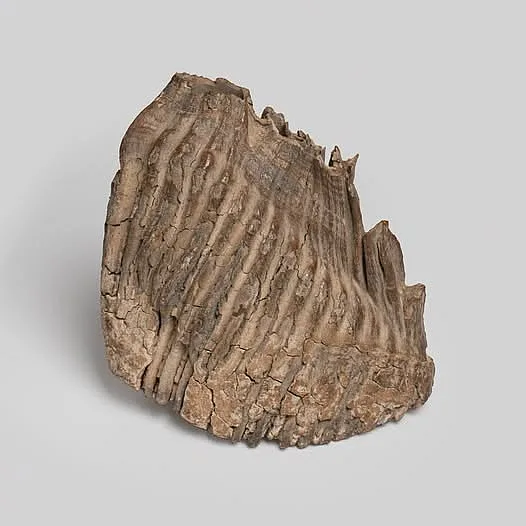
At the Mykolaiv Regional Museum of Local History, a unique paleontological exhibit is kept—a southern mammoth tooth. In 1975, schoolboy Oleh Popov found it: while walking near the Southern Buh, he came across an ancient tooth in an eroded riverbank.
The find became a valuable addition to the museum’s paleontological collection. More than half a century has passed since it was discovered, yet the exhibit remains tangible evidence of an era when ancient elephants roamed the territory of present-day Ukraine. Its significance lies not only in its age but also in the story of its discovery: the prehistoric tooth was found by an ordinary schoolboy.
The natural past of Mykolaiv region was quite unlike the present. In the distant past, much of what is now Ukraine was covered by the ancient Tethys Ocean. Marine waters stretched where today’s cities, steppes, and forests lie. Among their inhabitants were gigantic predators—the megalodons—as well as marine reptiles such as plesiosaurs and mosasaurs.
Over time, complex geological processes transformed the Tethys Ocean, and the Sarmatian Sea formed in its place. Eventually, it became disconnected from the World Ocean. Further changes led to the formation of the basins of today’s Black Sea and Sea of Azov.
Against the backdrop of this long history, the southern mammoth tooth represents another prehistoric era of the region. Every paleontological exhibit is more than a fossil or an ancient find: it is a page in the history of the Earth. Such objects help us imagine just how different the world was millions of years ago and how much the environment has changed.
We also wrote:
- Tours, a puppet show, and new exhibitions: October at the Mykolaiv museum
- A tram that turns a ride into a journey through history has been launched in Mykolaiv
- From a family home to a museum: a unique 19th-century chimney will enrich an exhibition in Mykolaiv
- Geneticists announce plans to bring mammoths back to life
- “Not a human bone”: a mammoth shoulder blade found in Mykolaiv (video)