Could Ukrainians be left without internet: what will happen after strikes by Russia on data centers
The Internet hasn't disappeared: the founder of MiroHost explained why Ukrainians don't need to panic yet

The Russian attack on Kyiv on 23 September 2026 damaged several data centers at once, causing some subscribers to experience internet outages and loss of access to certain services. According to RBC-Ukraine, the problems affected networks including UTELS and “Pavutina”, and the Ministry of Digital Transformation reported internet issues for roughly 100,000 households in Kyiv and the region.
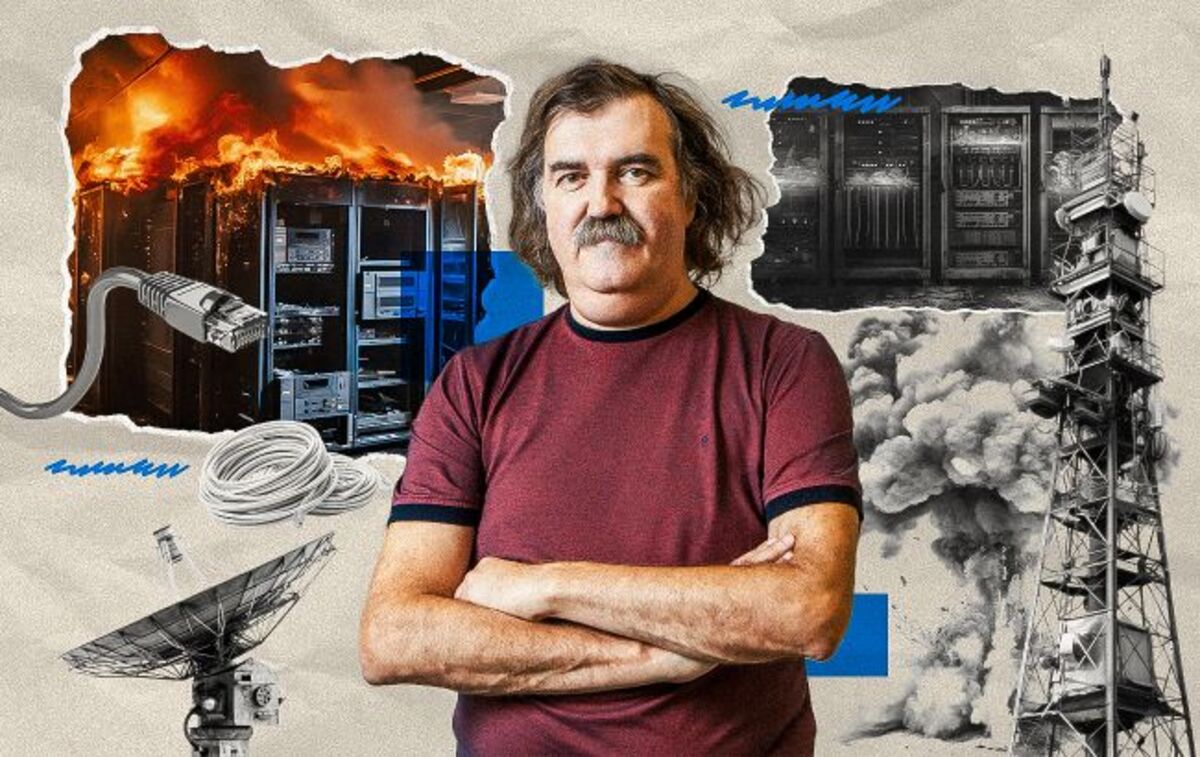
The founder of MiroHost and head of Internet Invest, Oleksandr Olshansky, in an interview with RBC-Ukraine spoke about how realistic the threat of large-scale destruction of Ukraine’s internet infrastructure is and whether Ukrainians could be left without communications.
According to him, strikes on data centers are not an entirely new phenomenon. However, this time the attack was more massive and simultaneous. Olshansky noted that large operators had preemptively reserved capacities abroad, mainly in Poland, the Czech Republic and Slovakia. He gave the example of his own company: approximately 95% of MiroHost’s clients were not affected because their resources run on capacities in Poland and the Czech Republic. At the same time, the clients themselves can be located in Ukraine, since modern technologies allow using servers without knowing their physical location.
According to Olshansky, after the attack he was left with about 150 clients out of roughly 20–25 thousand who, for various reasons, did not move or reserve their infrastructure abroad.
“I was left with about 150 clients — out of 20,000 or 25,000 — who for some reasons did not move, duplicate, or reserve their infrastructure, etc. Maybe they reserved it but for some reason couldn’t switch yesterday, there are such cases too. But, in principle, no tragedy occurred. There’s a lot of talk, but in reality everything works for everyone. After all, we’re communicating now.”
Olshansky does not rule out interruptions in the operation of some services, but believes the complete destruction of Ukrainian communications is unlikely given the current network architecture.
“Everything is possible in this life. During World War II, it seems about 60% of buildings in London were damaged. That happens too. So you can’t say it’s impossible. It’s no different from strikes on warehouses. You can see what’s happening. But it doesn’t lead to famine. These are completely different measures. Maybe someone will have occasional glitches, something will run slower. That’s possible. But completely, it seems to me, is not very realistic.”
At the same time, the head of Internet Invest commented on Foreign Minister Andriy Sybiga‘s statement that Russia might have struck data centers trying to interrupt the flow of information and alerts about aerial threats. Olshansky himself called such a goal not very realistic, but noted that one cannot completely rule out the possibility of large-scale destruction of infrastructure. Andriy Sybiga stated that Russian strikes on data centers were aimed at disrupting the flow of information and the operation of threat alert systems.
“I don’t think that’s a very realistic goal. To destroy infrastructure to such a state that there would be no communications at all, well, I don’t know. I can’t assert that this can’t be done. You could drop an atomic bomb. There would be no communications either. There are special types of nuclear weapons with an electromagnetic pulse that destroy all electronics within a radius of about 50 km. Can it be done? It can. Will it be done? I don’t know. I can’t read Putin’s mind, right? Modern communications are arranged so that to completely destroy them you’d have to use some kind of unconventional weapon.”
According to Olshansky, attacks on data centers will have significant financial consequences for individual companies. He reported that the MiroHost data center was effectively destroyed. At the same time, reserving capacities abroad allowed the majority of the company’s clients to continue operating. He also noted that strikes on data centers have occurred repeatedly since the beginning of the full-scale war. In his opinion, the situation during the Russian offensive on Kyiv in 2022 was much more difficult for telecommunications infrastructure due to damage to bridges and cable lines.
Separately, Olshansky advised Ukrainians not to rely solely on electronic systems. In particular, he recommends having paper copies of important documents, a cash reserve, and a prepared emergency bag. Regarding Starlink and walkie-talkies, he believes that ordinary citizens do not necessarily need to buy walkie-talkies at the moment, and satellite internet is more appropriate as a backup for large companies and offices.
“In the fifth year of the war it’s, I think, simply too late to create panic. So it’s better to treat this more calmly.”
At the same time, he emphasized that the destruction of data centers can cause large financial losses for some companies, but on the scale of the war he compared these consequences to damage to power plants, railways, the front and occupation.
Earlier we wrote:
- Phone catches the cosmos: Viber, WhatsApp and Google Maps can now work via Starlink
- Four resilience points in the Korabelny district are ready to support Mykolaiv residents in case of a blackout
- Internet in a carriage for 120 UAH: rail romance in a new way
- Starlink for occupiers for $100: the SBU exposed 8 Russian agents recruited via Telegram
- The SBU detained a Russian Federation agent who attempted to carry out a terrorist attack in Mykolaiv