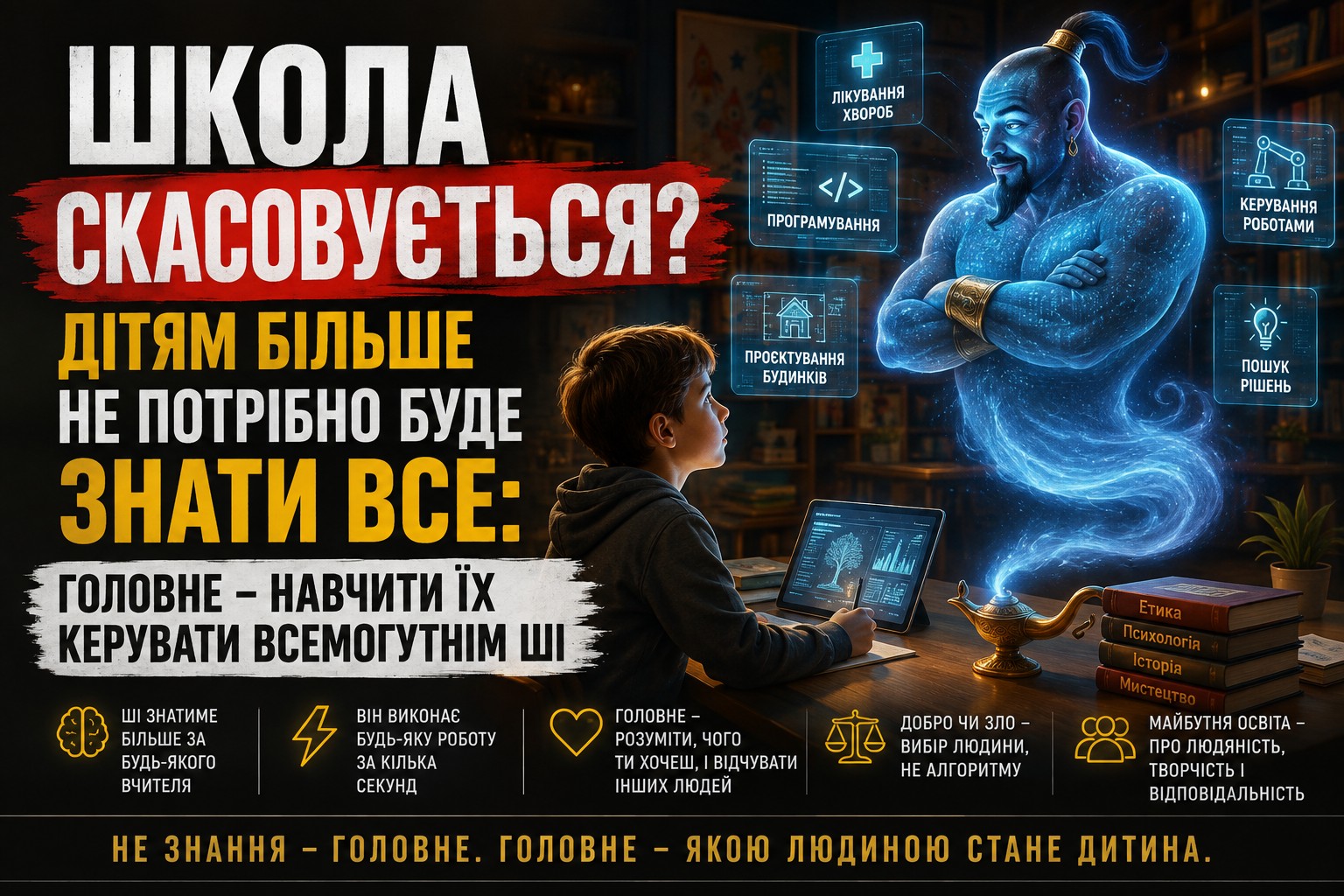
Will school be canceled? Children will no longer need to know everything — the main thing is to teach them how to control the all-powerful AI
AI will become an omnipotent genie: then why is education needed and what should children be taught?


When we talk about the future of education, we often imagine artificial intelligence as an improved version of ChatGPT: it explains math, checks homework, writes texts, and helps find information.
But that is too narrow a view.
The AI of the future may resemble not an electronic textbook, but a genie from the story of Aladdin. It will know more than any person, be able to create programs, design houses, operate robots, cure diseases, build enterprises, write music, and find solutions where humans see only hopelessness.
And then the main question will not be how smart a person is. Next to them there will still be a power that is smarter, faster, and more productive.
The main question will be different: what will a person ask their genie?
Why the almighty genie obeys Aladdin
Aladdin is not stronger or smarter than the genie. He cannot do even a thousandth of what the genie can. But Aladdin sets the goal.
The genie has power, but does not have human desire. It can carry out an order, but it does not decide what is worth acting for. It does not know what love, dignity, beauty, family, homeland, memory, freedom, or happiness mean to a person.
That is why the owner of power remains not the one who knows more, but the one who is able to understand what they want.
The person of the future will not have to build a house with their own hands, write a program, or calculate a complex system. Perhaps it will be enough to describe the result, and AI will do all the technical work.
But if a person does not know what kind of house they want to build, for whom it is needed, what life inside it should be like, and what they consider beautiful, even an almighty AI will not save them from emptiness.
Desire will matter more than intelligence
Today school teaches a child to answer other people’s questions. The teacher sets a problem, and the student must find the correct answer.
In the future, answers will almost always be given by AI. Therefore the main ability will be the skill to formulate questions independently.
What do I want to create? What kind of life do I want to live? What problem do I want to solve? What do I consider just? What am I not willing to do even for gain? Whom do I love and for whom am I responsible?
These are no longer technical questions. You cannot get a ready-made answer to them from a machine.
AI can suggest a thousand professions to a person, but it will not determine which of them will fill their life with meaning. It can calculate the ideal compatibility of two people, but it will not fall in love for them. It can write a brilliant song, but it will not feel which melody is tied to a particular person’s childhood.
A child must be taught to feel
The education of the future should develop not only logic, but also emotionality.
A child must learn to understand their own feelings, empathize with another person, grieve a loss, make friends, love, forgive, protect the weaker, and cope with loneliness.
These are not secondary skills. They will determine how a person uses enormous technological power.
One owner of the “genie” will ask to create medicine. Another — a system of total control. One will want to build a beautiful city, another — the most profitable one possible. One will apply AI to free people from hard labor, another — to gain unlimited power over them.
The difference between them will not be in their level of technological mastery. The difference will be in their inner world.
Culture will become more important than formulas
Today culture, literature, music, and art are often perceived as an addition to “serious” subjects. In the future they may become the foundation of education.
AI will be able to instantly calculate a formula, translate a text, or write code. But it should not decide for a person what is beautiful, ugly, worthy, or vulgar.
A child needs a cultural foundation: books, music, theater, family history, the traditions of their people, and encounters with other cultures.
Without this they will remain a person with an almighty tool but without their own taste. They will ask AI to create what gets the most views, brings the most money, or influences others the most, because they will not have their own sense of value and beauty.
Love cannot be transferred to a machine
Even a very advanced AI will be able to imitate care, say the right words, and remember every detail about a person. It might be easier to communicate with it than with living people.
But precisely for that reason children will have to learn especially how to build real relationships.
A living person is awkward. They may disagree, be hurt, leave, change, or demand reciprocity. A machine can always adapt to the user.
If a child becomes used only to a perfect digital interlocutor, they may lose the ability to love a real person — imperfect, contradictory, and independent.
Therefore future education must create space for friendship, conflicts, teamwork, care, responsibility, and live contact. Not merely to “socialize” a child, but to teach them to be with other people.
Moral choice cannot be handed to AI
A machine can calculate the consequences of every decision. It can show which option will bring more profit, save more resources, or provide greater efficiency.
But efficiency does not always mean justice.
AI may conclude that it is cheaper not to treat a seriously ill person. That it is simpler to limit freedom for the sake of security. That it is more profitable to manipulate people than to persuade them.
Someone must say: “No, we will not do that.”
It is precisely the human who should remain the source of values and bear responsibility for the order they gave their “genie.”
Therefore children will need to study not only technologies, but also ethics, philosophy, the history of crimes and human mistakes. They must understand not only what can be done, but also what must not be done.
The school of knowledge can truly disappear
If AI can explain any topic in a few minutes and teach a specific skill exactly when it is needed, keeping a child at a desk for eleven years just to accumulate information will become senseless.
A person will not need to know everything in advance. It will be enough to have a basic understanding of the world and the ability to quickly obtain necessary knowledge with the help of AI.
The traditional school can be replaced by small communities, clubs, workshops, sports sections, theater studios, natural science laboratories, and cultural centers.
There children will be taught not to recite paragraphs, but to live: to communicate, create, argue, lose, win, help, fall in love with art, feel nature, and understand themselves.
The teacher of the future is not the one who knows more
A teacher will no longer be able to compete with AI in the volume of knowledge. Nor should they.
Their task will be to help the child form a personality. To notice talent, support in a difficult moment, introduce a great book, teach respect for others, and show an example of dignified behavior.
The teacher will be not a source of information, but a guide into the human world.
Perhaps in the future the most important educators will not be math or geography teachers, but mentors, artists, coaches, psychologists, craftspeople, and people with strong character, next to whom a child can understand who they want to become.
Future education must answer one question
Today we ask: what knowledge will a child need in ten years?
But in conditions of rapid AI development that question may lose its meaning. We do not know what professions will exist even in five years and what tasks a machine will learn to perform as soon as next year.
Therefore education must answer another question: what kind of Human should the child become if an almost almighty assistant stands beside them?
Capable of loving or indifferent? Free or obedient? Creative or dependent on ready-made answers? Responsible or one who shifts the blame onto an algorithm? A person with their own taste and convictions or merely a consumer of what the machine offered?
Perhaps the main task of education will not be to prepare a child for work. Work will increasingly be done by AI.
The main task will be to raise a person to whom one can trust a genie.