8,130 students and 250 teachers abroad: how Mykolaiv Oblast lost children and educators
The number of schoolchildren with IDP status in the region has tripled


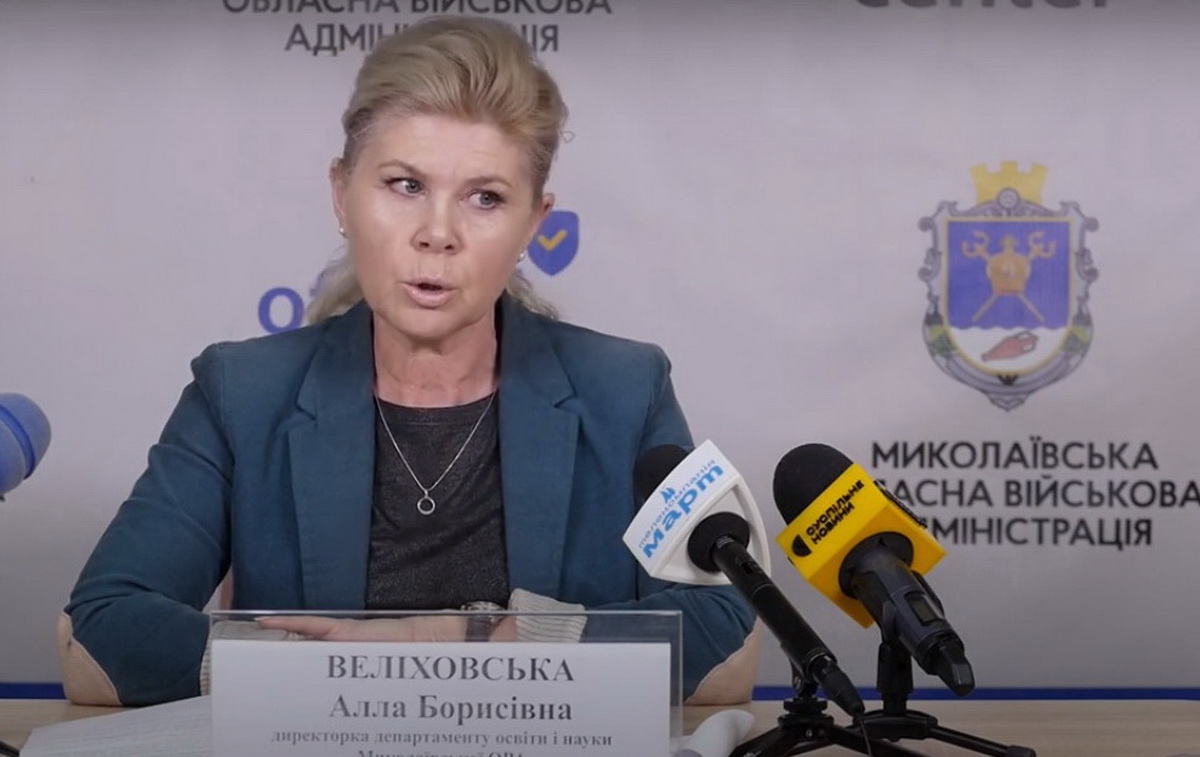
Thousands of children continued studying at Mykolaiv Region schools from abroad, but, according to a regional official, the state did not provide appropriate funding for their education. At the same time, 250 teachers were working outside Ukraine, while other countries began actively recruiting the most promising young professionals. The director of the Mykolaiv Regional Military Administration’s Department of Education and Science, Alla Velikhovska, spoke about these issues during a meeting of the regional council’s relevant committee dedicated to preparations for the 2024/2025 school year.
Details of the discussion are available in the meeting video. The transcript shows that regional education officials were already warning about pupils and teachers leaving the region, shortages of teachers in certain subjects, and difficulties organizing distance learning. Later figures from 2026 confirm that staffing shortages remain a pressing issue, although the number of teachers abroad has changed significantly.
Thousands of children are studying abroad while schools lose funding
According to figures presented at the meeting, in 2024, 8,130 pupils were outside Ukraine but remained enrolled in Mykolaiv Region schools. They continued their studies remotely, completed assignments, and received grades from their Ukrainian schools.
However, a problem arose with the state education subvention, which is based on pupil numbers and used to fund teachers’ salaries.
Alla Velikhovska explained to the committee members that schools continued teaching children who were abroad but would not receive the corresponding subvention for doing so.
“We teach them, but we won’t receive a subvention for it.”
This placed an additional burden on the education system: the number of children in the region was declining, funding depended on pupil enrollment, while teaching staff remained almost unchanged.
According to the official, compared with the previous school year, the number of pupils in the region had fallen by 6%, and 15% fewer first-graders had enrolled.
The regional authorities attributed this not only to forced migration caused by Russian aggression but also to a prolonged demographic crisis.
Families are not returning because their children are already attending other schools
The meeting also addressed the reasons families with children were leaving Mykolaiv Region and were in no hurry to return.
According to Alla Velikhovska, parents who moved to Chernivtsi, Lviv, and other regions of Ukraine were granted internally displaced person status and enrolled their children in local kindergartens. Later, the children started first grade there, and families gradually built new lives in their new locations.
She also cited the lack of in-person learning options at some schools in Mykolaiv Region as another factor. Parents who wanted their children to attend classes in person chose other cities.
At the same time, the number of children with internally displaced person status in Mykolaiv Region schools had tripled compared with the start of the full-scale war, reaching 3,711 pupils.
Thus, the region was losing local families with children while also receiving displaced people from other affected areas.
250 teachers abroad: receiving salaries and teaching online
The work of Ukrainian teachers outside the country was another topic of discussion.
According to figures shared in 2024, 250 teachers from Mykolaiv Region were abroad but remained on the staff of their educational institutions.
Committee members asked whether they were still paid even though they were not physically present at their schools.
The department director explained that the teachers continued to perform their professional duties remotely: they taught classes according to the approved timetable, marked assignments, and recorded grades.
According to her, regulations in force at the time allowed teachers to work from abroad during martial law. At the same time, educators were waiting for clearer rules from the Ministry of Education and Science on how such work should be organized.
The situation was particularly difficult in schools where some children studied in person and others remotely. The official noted that questions arose about how to calculate the salaries of teachers working with such classes.
Large schools could set up separate distance-learning classes. This was much more difficult in small rural schools with only a few pupils.
The possibility of designating several institutions in the region to operate exclusively online was also considered.
Poland recruits Ukrainian teachers as Mykolaiv Region loses young professionals
The official identified the departure of promising young teachers as another serious problem.
According to her, Poland was particularly active in recruiting Ukrainian professionals, creating opportunities for them to work with Ukrainian children.
Teachers were offered the opportunity to teach in Ukrainian for a period of time while learning Polish. This could later open up employment opportunities in the local education system.
Alla Velikhovska expressed concern that young professionals were moving with their entire families to safer countries and might not return to work in Mykolaiv Region once they had established new lives there.
“And as for thinking that they will return, you know, I don’t think they will if they settle there.”
According to the department director, special education professionals — including special education teachers, speech therapists, and psychologists — were particularly in demand abroad.
At the same time, schools in Mykolaiv Region were already facing a shortage of mathematics teachers. Recruiting and training biology and chemistry teachers also remained difficult.
The official noted that local higher education institutions were not training enough specialists in certain subjects. In the past, some staffing shortages had been addressed by teachers moving to the region from other areas, including those relocating with the families of military personnel.
To attract new teachers to Mykolaiv, the possibility of providing service housing began to be considered. The aim was to create conditions that would enable professionals to move to the city and stay on to work in its schools.
Ukrainian education for children abroad: another unresolved issue
The meeting also discussed introducing a special learning format for pupils who live permanently outside Ukraine.
Many of these children were already attending foreign schools, spending the full school day there and completing homework. At the same time, their parents wanted them to maintain a connection with Ukrainian education and be able to receive Ukrainian education certificates.
The option of studying only the Ukrainian curriculum component was being considered, including:
- Ukrainian language;
- Ukrainian literature;
- the history of Ukraine;
- the geography of Ukraine;
- art.
This would reduce the academic workload, as children would not have to complete the full curricula of both countries.
However, as noted at the 2024 meeting, the introduction of the relevant changes was being postponed, and schools were waiting for regulatory guidance from the Ministry of Education and Science.
What changed in 2026
According to figures Alla Velikhovska released on April 22, 2026, 9,447 education staff were working in the Mykolaiv Region education system, excluding employees with secondary jobs.
Of these, 68 were abroad, while another 45 were working remotely. As of April 1, 2026, there were still 353 vacancies at educational institutions in the region.
Psychologists were in shortest supply, with 69 vacancies. There was also a shortage of 31 music directors, 23 preschool educators, 21 social pedagogues, 19 teacher assistants, 14 English teachers, and 13 mathematics teachers.
Thus, the number of teachers abroad, according to figures from different years, fell from 250 to 68. However, this does not mean that all the others returned to Ukraine. Some may have resigned or changed jobs. No statistics have been provided on the reasons for this decrease.
The decline in pupil numbers has also continued. For the 2026/2027 school year, the regional education department’s forecast put the number of children expected to attend schools in Mykolaiv Region at around 88,500 — 5,800 fewer than the previous year.
Thus, the problems educators were already discussing in 2024 remain pressing: schools are losing pupils, staff shortages continue, and the return of families and teachers depends not only on learning conditions but, above all, on safety and the opportunity to live and work in the region.
At the same time, verified 2026 data do not separately specify the current number of Mykolaiv Region pupils who are abroad. Therefore, the previously reported figure of 8,130 pupils cannot be used as a current estimate.
Previously, we wrote:
- 264 educational institutions in Mykolaiv Region are planned to open for in-person learning
- More than a third of pupils in Mykolaiv continue to study remotely
- Education crisis: Mykolaiv schools lose 3,000 pupils in a year
- Controversial Ministry of Education order: school closures in Mykolaiv Region and hundreds of unemployed teachers
- Where are Mykolaiv’s schoolchildren disappearing to? Shocking statistics from the city council