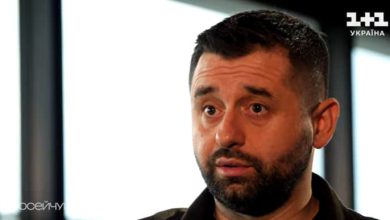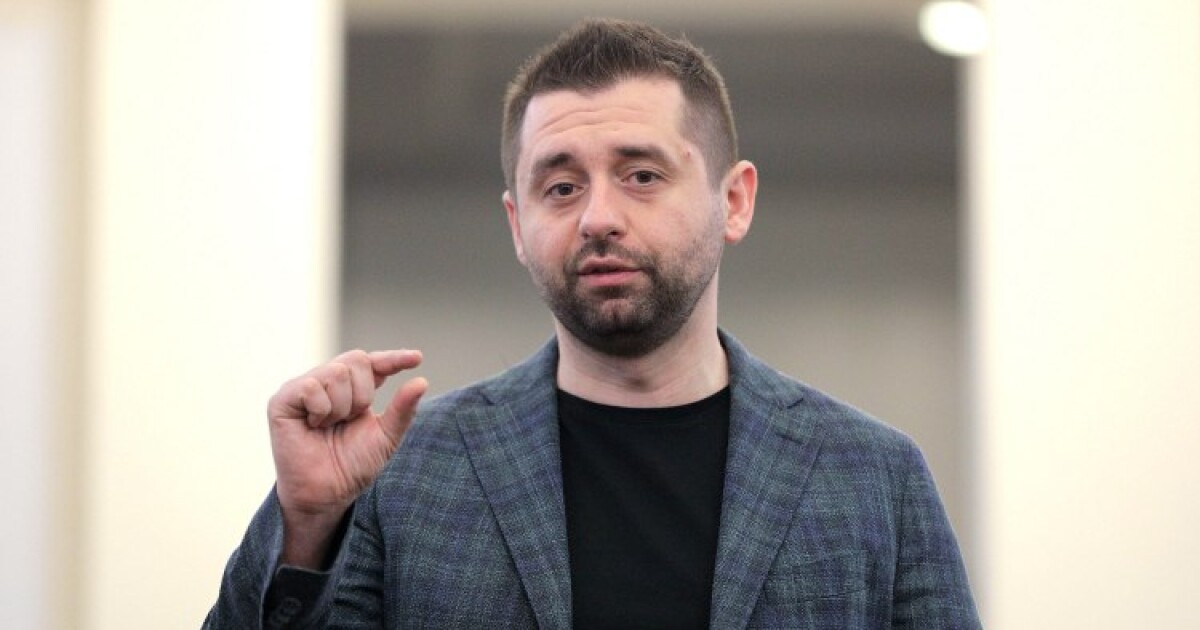
Head of the parliamentary faction “Servant of the People” David Arakhamia spoke about his difficult childhood, the move to Mykolaiv in the 1990s from Abkhazia and the environment in which he had to quickly learn to “survive”. A long interview with the politician published by BBC News Ukraine, whose journalists spoke with about 40 people from his circle.
Childhood of David Arakhamia was spent in Gagra. After the start of the war in Abkhazia in 1992 his family was forced to leave home. The future politician’s father led the local resistance and was later captured. According to Arakhamia, the family had to spend about 50 thousand dollars to secure his release — virtually all their savings.
After fleeing Abkhazia the family lived for some time in various places — first in Penza, then in Riga. Eventually relatives from Mykolaiv, who themselves were planning to move to Kamchatka, offered them their house. Thus David Arakhamia, who was a teenager at the time, ended up in Mykolaiv.
According to the politician’s recollections, the first encounter with the new school immediately made clear that life would be tough: on the first day he saw the police near the school after a serious conflict between older students and a teacher. Arakhamia later humorously recalled that his ability to play football helped him adapt among his peers to a large extent. It was then that he formed the sense that Mykolaiv is a city where you have to know how to survive.
The difficult childhood of David Arakhamia is also linked to a character trait that, he says, has remained with him in adult life: in a critical situation he tries to help people.
“I’m a lousy friend in good times, sometimes I even forget to say happy birthday. But when someone is in trouble, I’ll help with everything I can. Perhaps this is the result of a ‘savior complex’ that I have had since childhood. Maybe it developed because childhood was hard: sometimes there was even no food,” — David.
BBC interlocutors believe that life in Mykolaiv and the need to constantly negotiate with very different people could have influenced the politician’s future negotiating skills. One of the interviewees separately noted a characteristic trait of Mykolaiv residents, in his view.
“For some reason everyone I know from Mykolaiv has a sharp tongue. You definitely can’t out-talk David.”
A large part of the BBC piece is devoted not to Arakhamia’s past but to his current role in Ukrainian power. One of the interlocutors described the head of the presidential faction as a person who is entrusted with unconventional and difficult tasks.
“In the military there are officers with special assignments. In our political system there is also such a special officer. That is David Arakhamia.”
According to BBC sources, David Arakhamia is communicative, flexible, energetic and not inclined to show authoritarian arrogance. They explain his ability to maintain contacts even with people who hold political positions opposite to his by these qualities.
“No one is allergic to David. Everyone loves him,” — one of the BBC interlocutors described the attitude toward Arakhamia in political circles.
Another interlocutor linked this to the behavior style of the leader of the parliamentary majority.
“David doesn’t pretend to be a general who shouts: ‘I said so!’, — and that is very disarming.”
David Arakhamia remains one of the few representatives of the first team of President Volodymyr Zelensky who have retained significant political influence. The BBC notes that the politicians may have been brought closer by similar life experiences: both are connected to large industrial cities in the southeast of Ukraine and before entering politics built careers that relied heavily on negotiating and managerial skills. A BBC source close to the president claims that Arakhamia himself clearly emphasizes his subordination to the head of state.
“David constantly reminds the president that he is the boss who hired him, and that he is the subordinate who will do what Zelensky says.”
After the start of the full-scale Russian invasion the political weight of Arakhamia, the publication estimates, only grew. One factor named is that in the first months of the large-scale war he was together with the president in the same protected command environment.
At the same time, during this period the influence of the then head of the President’s Office Andriy Yermak was also strengthening; BBC sources say that his relations with Arakhamia were complicated. One member of the parliamentary majority said that there was competition between them, but it did not prevent Arakhamia from working with the then head of the President’s Office.
“They competed, although David continued to work with Andriy when needed, because he is not the kind to worry whether someone likes him or not. That is why David’s position during Yermak’s time did not wobble much.”
Now several BBC interlocutors speak of a significant expansion of Arakhamia‘s influence after changes at the top of power. Similar assessments have recently been made by other Ukrainian media, calling him one of the key informal coordinators of parliamentary and negotiation processes.
“David today is a key person in the country. Previously he only had parliament and a bit of the government, and now David has everything,” — one of the ‘Servant of the People’ members assessed his current role.
Another BBC interlocutor named several officials who in political circles are associated with Arakhamia.
“Kim, Butenko, Shmyhal, Bezgin — here are at least four people in the current government who can be called ‘David’s’.”
Arakhamia himself does not agree with such an interpretation. He says that among current government officials he practically considers only his long-time friend and former head of the Mykolaiv Regional Military Administration Vitaliy Kim to be his man.
Arakhamia separately told the BBC about Prosecutor General Ruslan Kravchenko and a possible criminal case against him in the autumn of 2025.
“Regarding Prosecutor General Kravchenko, I had no relations with him and I was pleasantly surprised when he insisted on pursuing a possible suspicion against me and effectively saved me from prison,” — Arakhamia.
According to Arakhamia, this was during a period when his conflict with the then head of the President’s Office Andriy Yermak particularly escalated. BBC interlocutors claim that Oleksandr Poklad may have been involved in the possible case, but Oleksandr Poklad himself did not publicly comment on these accusations.
“They tried to imprison David with Poklad’s involvement, and for that reason it’s unlikely there will be votes now for his appointment as head of the SBU,” one member of the parliamentary majority said about the possible role of Oleksandr Poklad in this story.
According to the BBC, inside “Servant of the People” they even discussed how they would react in the event of the faction leader’s arrest or criminal prosecution. One member of the majority said deputies were ready for serious political resistance.
“We would definitely have shown some resistance and, I don’t rule it out, refused to work without David. Bankova would simply have lost the parliament.”
Arakhamia himself said he knew about such moods among colleagues and was impressed by them:
“Despite all the fatigue and disappointment with various things, they were ready to show themselves as a large pack. That inspired me to move forward,” — David Arakhamia said.
The BBC piece shows David Arakhamia’s journey from a teenager whose family lost their home due to war and ended up in Mykolaiv, to one of the most influential figures in the current Ukrainian government. And Mykolaiv, judging by the politician’s memories and assessments of his acquaintances, became one of the places where his character, ability to quickly adapt and negotiate with people were formed.
Previously we wrote:
- No surnames, but with Arakhamia in the frame: Fedorov announced a crisis of governance
- “That’s nonsense”: Johnson distanced himself from the collapse of peace in 2022, refuting Arakhamia’s words
- “Two million wanted”: Arakhamia hinted that mobilization may change
- Kim hopes for the de-occupation of Kinburn through negotiations: without it Mykolaiv’s ports will not revive
- Negotiations on ending the war have entered a real hard phase, — Vitaliy Kim