A Russian wife exposed her military husband to a handler: The Naval Court handed down a verdict for treason
A serviceman received 15 years with confiscation of property for collaborating with the Russian Federation


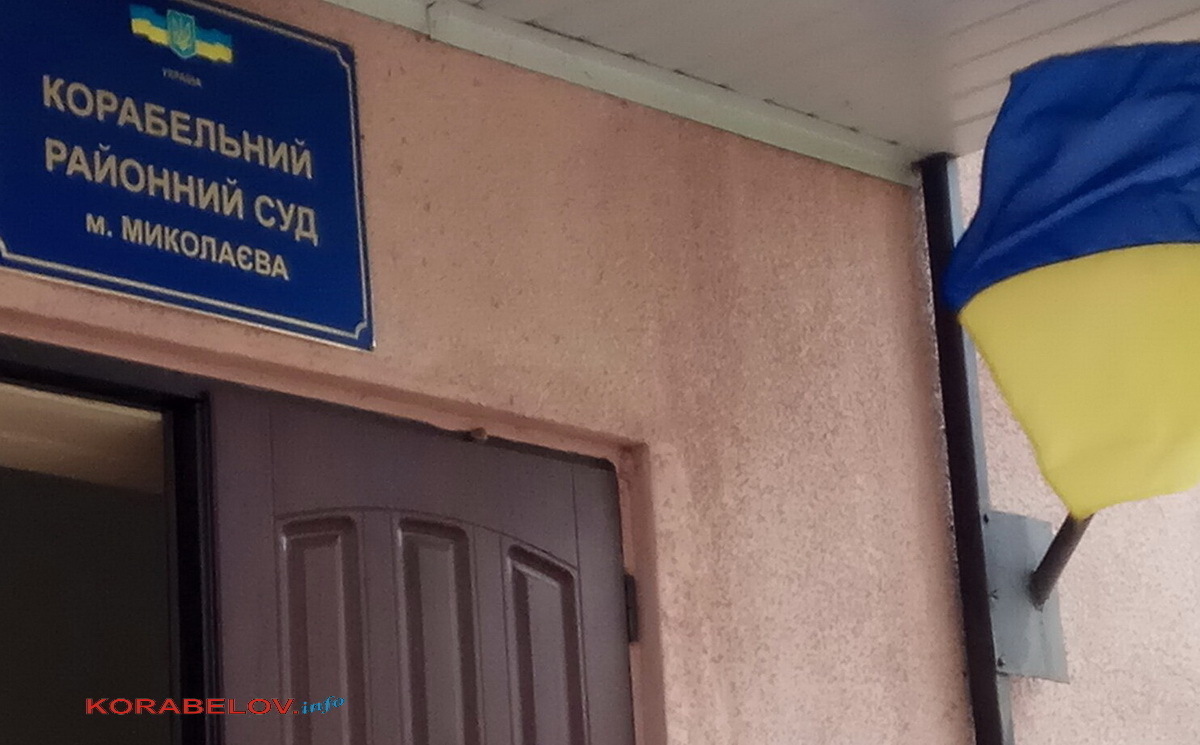
Korabelnyi District Court of Mykolaiv found a service member guilty of treason and sentenced him to 15 years in prison with confiscation of all his property.
The court decision was handed down on 19 June 2026 by a panel consisting of the presiding judge and two judges, with seven prosecutors, the accused and his two defenders present.
The accused was a citizen of Ukraine, had no prior convictions and served under contract with the rank of seaman. He held the position of senior rifleman in the guard platoon of the guard company of the security battalion of one of the units of the Naval Forces of the Armed Forces of Ukraine.
As the court found, the service member’s wife, who is a citizen of Russia, through unidentified intermediaries contacted a representative of the aggressor state on Telegram.
She provided the interlocutor with information about her husband and his intention to leave Ukraine. Later the Russian representative gave the couple instructions on covert correspondence.
They used a shared email account for communication. Messages were left in drafts and then deleted after being read, without sending emails directly.
According to the case materials, the Russian representative instructed the service member to provide his biography, information about his place of service, his immediate commanders and service members whose relatives live in Russia.
While in Ochakiv, the accused provided autobiographical details and named the commander of the military unit and two of his deputies. Information about the unit’s leadership had not been officially published in open sources.
After receiving the information, the Russian handler said he would “process” it and gave a new task. The service member was to describe his duties in detail, explain which facilities he guards, and provide information about the security and defense systems of military facilities.
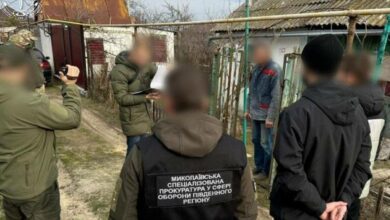
He did not have time to complete this task. On 21 May 2024 his activities were uncovered and stopped by officers of the Security Service of Ukraine.
During the trial the service member denied treason. He claimed that the correspondence with the Russian representative was allegedly conducted by his wife, and that he himself did not transmit military information.
The accused explained that after being informed about a possible deployment to the Kherson direction his wife sought ways to transfer him to another military unit or help arrange his discharge from service.
According to him, questions about commanders and military facilities made him suspicious, so he allegedly refused further communication.
The court treated these explanations critically.
During a search, photos of correspondence with the Russian handler were found on the service member’s phone.
In particular, the Russian representative asked whether the front was moving toward the accused’s location. He replied that there were no changes.
The correspondence also discussed the service member’s duty schedule to determine times for using the shared email account.
Fragments of an autobiography were found on the phone that matched the text left in the email drafts. The court also took into account materials from covert investigative actions, phone examinations, mobile operator data and expert conclusions.
The panel of judges found it proven that the service member intentionally assisted a representative of a foreign state in conducting subversive activities against Ukraine during martial law.
At the same time the court excluded from the indictment the wording about an “intellectual switch to the enemy’s side,” since the Criminal Code provides liability for an actual switch to the enemy’s side.
The service member was found guilty under Part 2 of Article 111 of the Criminal Code of Ukraine.
He was sentenced to:
- 15 years’ imprisonment;
- confiscation of all property;
- an order to pay UAH 15,145.60 in costs for expert examinations.
Time spent in custody will be credited toward the sentence, starting from 31 May 2024.
The convict’s mobile phone was left under arrest pending further confiscation. The court ordered the return of his wife’s phone to its owner.
The verdict may still be appealed to the Mykolaiv Court of Appeal within 30 days.
Earlier we wrote: