Two Against Russian Infantry: How “Mandryk” from Mykolaiv Oblast Held the Island
A group on Khomka was saved by precise mortar fire from the shore


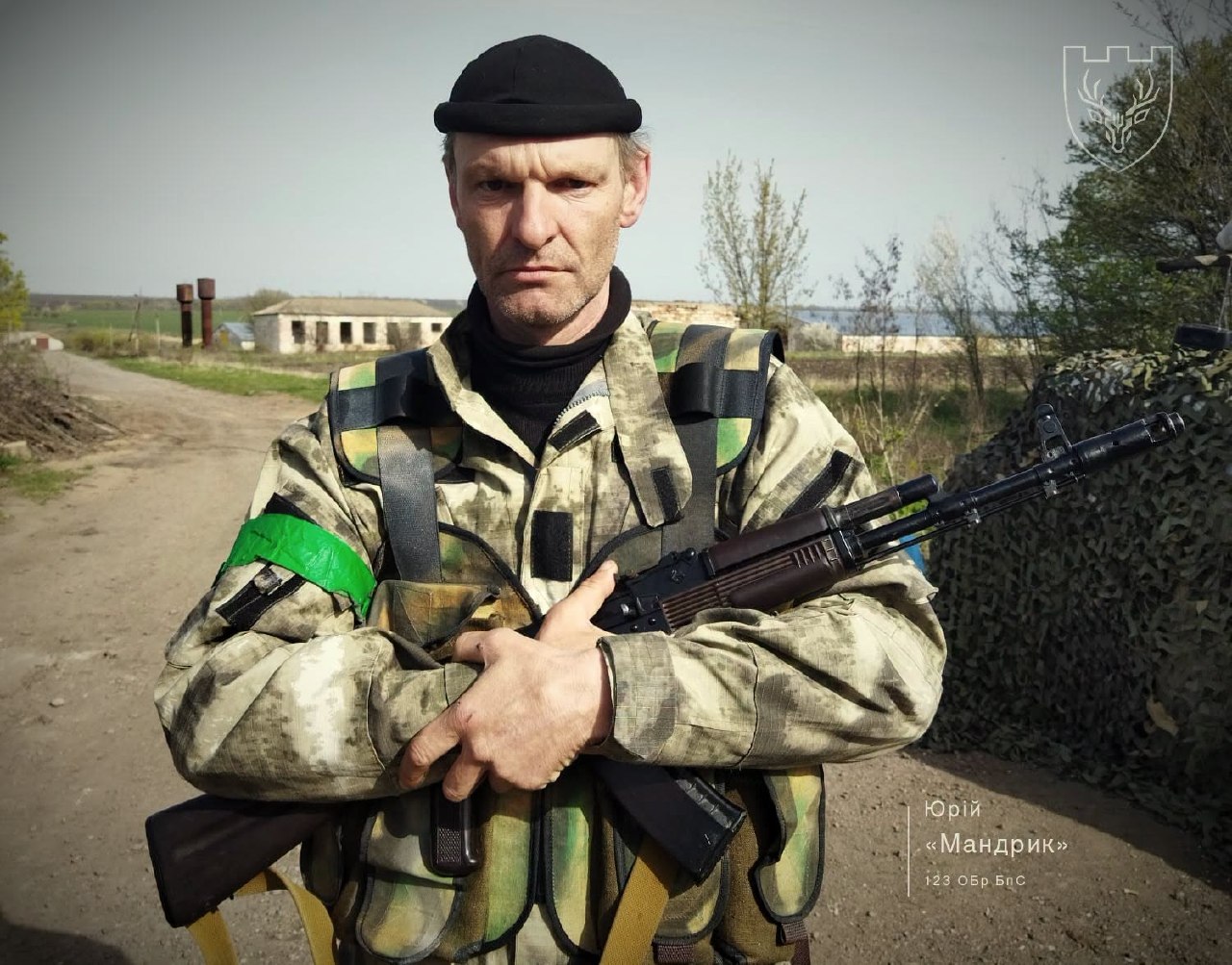
A serviceman from Mykolaiv region, Yurii, call sign “Mandryk”, shared his memories of fighting in Kherson region and on the islands of the Dnieper — dangerous rotations, clashes with Russian infantry, and the loss of fellow soldiers. His story was published by the 123rd Separate Unmanned Systems Brigade, according to the brigade.
Yurii received military training long before the full-scale invasion: in 1993, he graduated with honors from the sergeants’ school in Bohodukhiv. In civilian life, he farmed in Pervomaisk region, owning fields and machinery and running a small pig farm. When the full-scale war began on February 24, 2022, he went to the military enlistment office with fellow villagers.
In late 2022, his unit was redeployed to the Snihurivka and Bereznehuvate sector. The soldiers served as part of the 61st Brigade, advancing through settlements and entering Krasnoliubynsk as Russian troops retreated from the right bank of Kherson region.
Yurii recalls that residents who had survived the occupation hugged the Ukrainian defenders and thanked them. At the same time, the unit was constantly under mortar and tank fire and suffered losses.
The soldiers did not stay long in Krasnoliubynsk. From there, they were withdrawn to rest and replenish their ranks in the area between Nova Odesa and Mykolaiv. About two months later, they returned to Kherson region and set up positions near Veletenске, on the banks of the Dnieper. The opposite bank remained under Russian control.
According to the serviceman, local residents’ attitudes toward Ukrainian units varied greatly:
“It was different. Some people hugged us and thanked us, while others didn’t even say hello and turned away. There were also those who gave us away. We would move into houses, and then they would be hit. Later, we found out that people had passed on information. So the contrast was striking: where the Russians had abused people, we were welcomed with hugs, while in places where the occupiers hadn’t had time to cause as much harm, more people were waiting for them,” Yurii said.
Later, the units began moving onto the islands of the Dnieper. Building shelters there was difficult: in some places, the ground was so waterlogged that digging trenches was impossible. The shelling never stopped, and Yurii’s fellow soldiers were wounded.
The soldier recalls another challenge of island duty with humor:
“There’s nowhere to take cover on an island, and you can’t dig in either. And the biggest danger is the island mosquitoes! I’ve never seen anything so awful. They bit us around the clock, and no ointments, sprays, or smoke helped. The only thing that saved us was the rubberized ponchos we were issued, which the mosquitoes couldn’t bite through. But it was summer and hot, and you’d cover yourself with the poncho and sit there like you were in a microwave. I’ll never forget those mosquitoes,” “Mandryk” recalled.
To prevent the enemy from figuring out when a rotation was happening, the soldiers changed the boats’ departure times. The serviceman described his group’s departure from the island and the fate of the soldiers who arrived to replace them:
“The worst part was the handover itself. They tried to catch us when one group was leaving and another was coming in. That’s what happened then: we fought our way out, and the guys fought their way in. Within two hours, they were gone. They’re still lying on that island. We couldn’t get them out. May they rest in peace. They were strong men,” Yurii shared.
Another tough battle took place on Khomka Island. Three servicemen went to the position:
- Mykhailo “Pixel” — team leader;
- Slavik “Ship”;
- Yurii “Mandryk”.
At first, the soldiers hoped the enemy would not attack the island, since it was closer to the Ukrainian-controlled shore. However, the position came under tank fire, and then a Russian infantry group entered the island. During the clash, the team leader was wounded in the pelvic area and had to leave the fight.
“At around three in the afternoon, Slavik spotted the infantry and said, ‘Guys, infantry!’ We barely had time to understand what was happening; we just got our weapons ready. They hit us with a grenade launcher, and the team leader suffered two shrapnel wounds. And then there were just two of us fighting. Special forces are special forces. They’re very hard to deal with. They move fast, and it’s hard to hit them. It was terrifying. What saved us was our mortar unit on the shore, led by my first company commander, opening fire. The guys did a precise job, very close to us but without hitting us. They pushed the enemy back, and we held the island,” Yurii explained.
The group stayed at the position until morning. When soldiers from the Special Operations Forces arrived on the island, the position was handed over to them. However, according to the serviceman, a Russian sniper was still on the island. The next day, his shot took the life of their fellow soldier Pavlo. They were never able to locate the sniper.
Yurii describes the island battles as some of the hardest memories of his life: he says many Ukrainian servicemen died there. At the time, the units did not have the number of drones available today.
“Back then, we defended the islands ourselves. Now, the islands are defended with drones. The guys can monitor the situation from the shore instead of constantly risking their lives by going in on foot. Technology has changed the war. And that’s a good thing, because the main thing is to save people,” “Mandryk” emphasized.
We previously reported:
- Marines advance on the left bank of Kherson region and the islands of the Dnieper
- Russians storm islands near Kherson: the enemy could keep the city under fire
- Ukraine’s Armed Forces are restoring control over key islands in Kherson region!
- Occupiers tried to land on Kozatskyi Island near Kherson but suffered losses — Ukraine’s Armed Forces
- They won’t make it: Russians are sinking their own boats on the Dnieper