Food is running out, and they’re not allowed to leave: people trapped on occupied Kinburn Spit
In Vasylivka, a displaced resident says, people have been waiting to leave for a third month


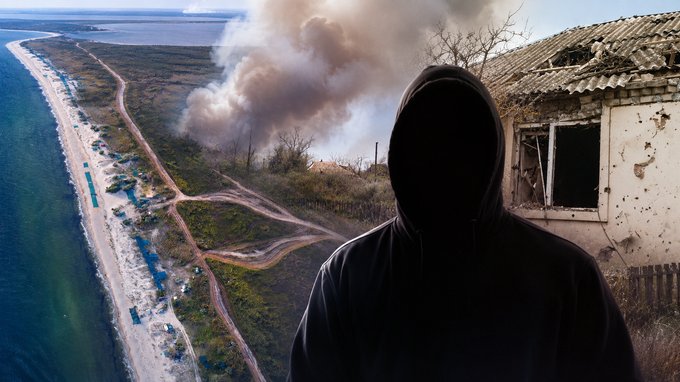
In the occupied villages of the Kinburn Spit in Mykolaiv Oblast, fewer than 100 civilians remain, according to estimates by local residents who managed to leave. They lack food, medicine, and fuel for heating, and attempts to leave the peninsula drag on for months. Russian occupation of the area has continued since February 2022.
A displaced man named Serhii, whose family managed to escape the occupation, told journalists from Suspilne about the situation. To protect the interviewee, his name has been changed and his face concealed.
The man says the spit’s isolation makes the situation especially dangerous. He compares it to Oleshky, but notes that Oleshky are on the mainland, while the spit is cut off. Between the Dnipro and the bay near Rybalske, he explains, there are only 4 kilometers. The last delivery of food he recalls took place in the spring of last year.
“People will eat up the food they have now, and that will be it. If nothing changes, I don’t know what will happen there,” says Serhii.
In his account, the displaced man gives the following information about people still living in the settlements on the spit:
- In Pokrovske, there are a little over ten residents. He believes food and other necessities have probably not been delivered to the village for a long time.
- In Vasylivka, there are 42 people. They have been preparing to leave for the third month; their belongings are packed, but, the man says, they are not being allowed to leave.
- Speaking about Pokrovka, he puts the number of residents at 12 or 13.
- Civilians also remain in Heroiske, but the interviewee does not know how many.
Serhii says people are living on the verge of starvation. According to him, Russian troops shot and ate the livestock that could have provided them with food long ago. Even the most basic household items are in short supply.
“There’s no firewood. People are already dismantling things, dragging out whatever they can from ruined houses, some kind of firewood. People are even running out of ordinary matches; there are simply no matches left,” says Serhii.
The man recalls that about eight months to a year ago, there were still ways to leave. Now, travel is made more difficult by mined roads. He knows of one family that tried to leave the occupied area: one of their cars hit a mine, but no one was hurt.
The displaced man calls the residents, cut off from supplies and unable to move freely, hostages. He also describes how mines deprive people even of the opportunity to find food.
“In Heroiske, they laid nets there, where people used to catch fish for food. Two people hit mines. That’s it, no one lays nets anymore, there’ll be no more fish, no more food. There’s no flour, no fats, there’s nothing like that. How are people supposed to live?” says Serhii.
The displaced man says the Russian military presence has also changed. Previously, by his rough estimate, there were 200 or more troops in each village. Now they appear less often and act more cautiously. The man has not seen heavy equipment lately; instead, he has noticed a shift to lighter vehicles:
- At first, Ural and KamAZ trucks were arriving constantly.
- Later, “loaves” and “tablets” were used more often. “Loaves” is the nickname for the UAZ SGR, or UAZ-452 — old Soviet four-wheel-drive minibuses or vans.
- According to him, the armored Tigers and Bars disappeared; there were also gradually fewer “tablets” and command vehicles.
- Then quad bikes and buggies began to appear — lightweight off-road vehicles with exposed wheels and a light tubular frame instead of a conventional solid body.
At the same time, according to Serhii, pressure on civilians continues. He describes threats to take someone prisoner over a look that displeased the soldiers. The man says drunk Russian soldiers often harass residents. After an altercation like that, they may return the next day and turn the house upside down.
“Two women were killed. One was shot, another had her neck broken. People were taken away. An old man was taken and never seen again; it’s now the fifth year he’s been ‘missing.’ They took a young man, a healthy, decent guy — he became disabled and now receives disability benefits. They beat people and tortured them,” says Serhii.
The man also describes degrading searches: people were made to undress, and their backpacks, fingers, and tattoos were checked. According to him, locals were forced to obtain Russian passports, and young men fit for military service were handed a draft notice along with their passport.
“When they held the referendum, they told everyone to gather at the club, saying there would be some kind of meeting. People gathered, and they surrounded the club — about 15–20 armed men. And that was the referendum,” recalls Serhii.
The spit’s military significance is linked to its location near the outlet to the Black Sea and the seaports of Mykolaiv and Kherson oblasts. Ukrainian Navy spokesperson Dmytro Pletenchuk explains that Ukrainian forces have continuously inflicted losses on Russian troops in the area since 2022, but an operation to liberate it requires reliable logistical support.
“It would be quite risky to provide support for a liberation operation without reliable logistics, evacuation, and resupply, especially given that the landing itself would be difficult,” explains Ukrainian Navy spokesperson Dmytro Pletenchuk.
“So for now, I wouldn’t talk about the possibility of de-occupation while the left bank (ed. — Kherson Oblast) remains occupied, while we are unable to establish a foothold there. It is too early to talk about liberating Kinburn. Every life matters to us, every person, especially a citizen of Ukraine. The Russians used houses there as hiding places; there aren’t that many of them, especially now — fewer remain. As they have always done, they are effectively using the local population as a shield,” adds Dmytro Pletenchuk.
The occupation and fighting are also destroying the peninsula’s natural areas. The head of the research department at the Biloberezhia Sviatoslava National Nature Park describes the destruction as extensive, with long-lasting consequences.
“Most of the pine forests burned down in the first two years of the full-scale invasion. At present, the entire area appears on maps as a burned landscape of herbaceous vegetation,” says Svitlana Melnychuk, head of the research department at Biloberezhia Sviatoslava National Nature Park.
Without access to the occupied peninsula, specialists cannot directly calculate the full extent of the environmental damage. They monitor the condition of the area, among other things, by tracking the extent of the burned forests.
Oleksandr Yarmoshevych, deputy head of the specialized environmental prosecutor’s office at the Mykolaiv Regional Prosecutor’s Office, cited the established damage figures for three protected natural areas located on the spit:
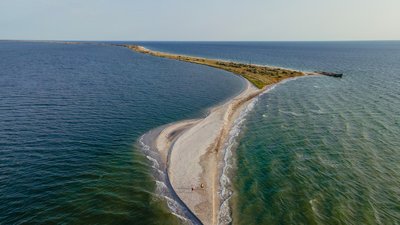
- Biloberezhia Sviatoslava National Nature Park — fires affected 6,800 hectares. Damage from forest fires and air pollution amounts to nearly 28 billion hryvnias.
- Kinburn Spit Regional Landscape Park — the official cited an area of up to 600 hectares, clarifying that he believed the figure was 578 hectares. The established damage amounts to 1 billion 276 million hryvnias.
- Black Sea Biosphere Reserve — 121 hectares were affected, with damage totaling nearly 283 million hryvnias.
According to Oleksandr Yarmoshevych, the calculation of damage from air pollution has been confirmed by an environmental engineering assessment. It was carried out as part of the pre-trial investigation into proceedings under Part One of Article 438 of the Criminal Code of Ukraine — violations of the laws and customs of war. The investigation is ongoing.
For residents, the destruction of nature goes hand in hand with losing the ability to use the surrounding area. The displaced man believes the effects of the fires and mines will be felt for a long time.
“They started planting the forest in 1961; it’ll be like it was before 1961. No one will be able to live there for decades. There’s nowhere to live there. You can’t go into the forest, you can’t wade into the sea or the estuary — everything is mined,” says Serhii.
According to his account, Russian troops throw “petal” mines — Soviet pressure-activated anti-personnel mines — from boxes into the reeds. Speaking about Kovalivka and the coastline, the man describes mines laid in three to four rows. He says each new rotation adds more mines, extending the mined area inland from the sea. In his estimate, areas as far as 200–250 meters from the sea have now also been mined.
People remain on the spit for various reasons. As Serhii explains, some have nowhere to go; others cannot even afford the journey. Some do not want to abandon their homes and outbuildings, which they built with their own hands, and are prepared to stay until the very end.
The man calls the arrival of the Russian army the greatest crime, and describes the spit as burned and polluted. He stresses that the Russians were neither expected nor welcomed there: Ukrainians remain on the peninsula, with relatives living outside the occupied territory. In his view, this occupied corner of Mykolaiv Oblast lacks public attention and efforts to help its people.
“In Oleshky, the whole community rushed in there, so to speak. There are a lot of people, a lot of children. There may be few people on the spit, but they are people too. When winter comes, I don’t know what they’ll do,” says Serhii.
We wrote earlier:
- Without food or water in basements: 6,000 Ukrainians near Oleshky and in the city itself await rescue
- He tortured both women and men: Russian GRU special forces officer sentenced in absentia for torture on the Kinburn Spit
- Kinburn Spit in flames: 96% of the national park turned into a burned wasteland
- “The villages are mined, and people are being used as a ‘human shield’”: Humeniuk on Russian forces’ actions on the Kinburn Spit
- “All our efforts are focused on surviving,” say residents of occupied Kinburn