Almost UAH 68 million disappeared in three days: a strategic substation in Mykolaiv Oblast was left unprotected
New Questions for Ukrenergo Over a Substation in Mykolaiv Oblast


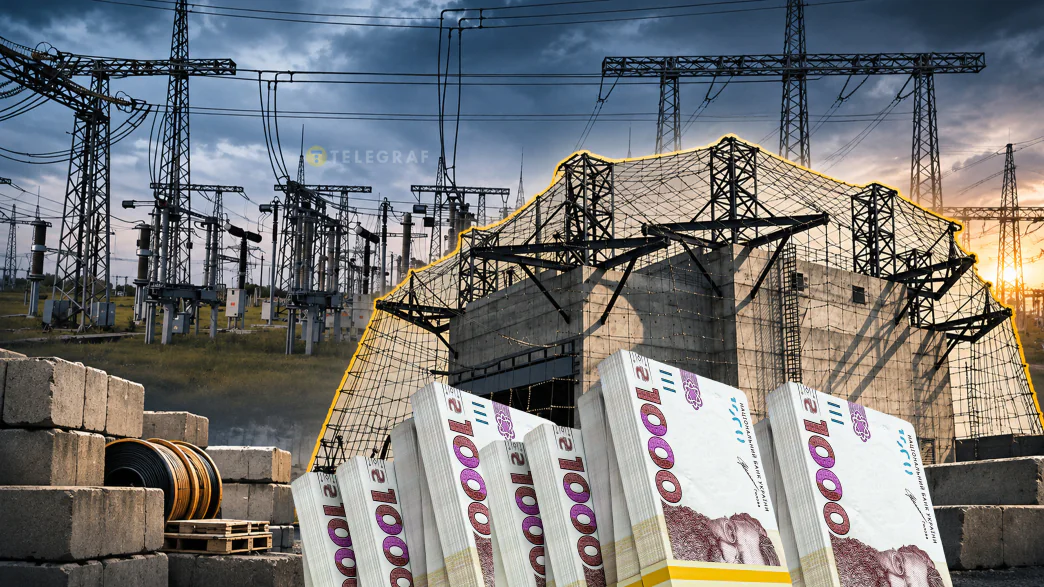
The “Prohresivka” substation in Mykolaiv Oblast was left without the protection planned for it against Russian attacks, even though UAH 89.3 million in loan funds from the European Bank for Reconstruction and Development had been allocated for its construction. The contractor received an advance of nearly UAH 68 million, but within three days distributed the money among other companies and sole proprietors. Construction was never completed.
What draws particular attention is not only what happened to the money, but also how the state-owned enterprise selected the contractor, assessed its capacity, and monitored the use of the multimillion-hryvnia advance. As journalists from Telegraf found out, the contractor later became the subject of criminal proceedings, its director was arrested, and the company itself was declared bankrupt.
On November 4, 2024, PrJSC NPC Ukrenergo signed a contract with Kryvorizke Promenergo LLC to build protective structures for the strategically important Prohresivka substation. The total cost of the work was UAH 89.3 million, including VAT.
The contract was awarded without an open tender through the Prozorro system. On October 8, 2024, Ukrenergo had sent the company an individual invitation to enter into a direct contract.
The contractor submitted documents intended to confirm that it had the necessary equipment, employees, and production capacity. Ukrenergo forwarded these materials to the EBRD, which on October 29, 2024, stated that it had no objections to the contract being signed.
At the same time, journalists note that the company had little experience with government contracts: its participation in public procurement over the entire preceding period was valued at approximately UAH 200,000. The report also mentions the business ties the company’s co-owners previously had with Ruslan Tkachenko, a member of the Kryvyi Rih City Council from the Servant of the People party. He was a beneficiary of Kryvorizke Promenergo from 2017 to 2021, after which he formally left the company.
The contract required the work to be completed by July 2, 2025. Instead of constructing the protective structures, however, the case became an investigation into the movement of tens of millions of hryvnias.
On December 27, 2024, Ukrenergo paid the contractor an advance of 80% of the contract value — UAH 67.96 million.
According to the journalistic investigation, between December 27 and 30, 2024, the company’s director, Eduard Kesil, made 14 transfers to the accounts of other companies, sole proprietors, and the company itself.
In particular:
- UAH 30 million was transferred to the Kharkiv-based Bud Stroy Postach LLC as an advance payment for subcontracted work;
- UAH 14 million was sent to other accounts belonging to Kryvorizke Promenergo under the guise of replenishing working capital;
- UAH 4.7 million went to Isma Group KR, which was supposedly to supply concrete;
- nearly UAH 5.7 million was distributed among sole proprietors for formwork rental, design, fuel supplies, and accommodation;
- UAH 13.6 million was transferred to Bank Alliance as cash collateral for the bank guarantee it had issued.
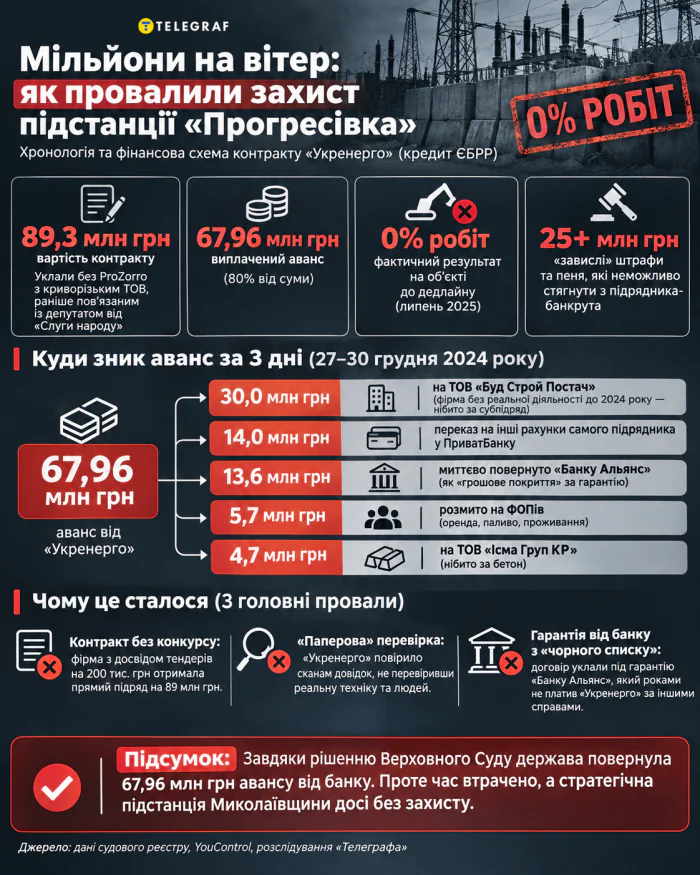
Thus, a substantial portion of the advance had been distributed among other recipients before the main construction work had actually begun.
The company was required to complete the work specified in the contract by July 2, 2025. However, according to Nikcenter journalists, no major construction work on the protective structures had in fact been carried out at the substation.
The contractor tried to explain the missed deadlines by citing force majeure circumstances related to the war. However, as court documents note, the company did not provide convincing evidence to support this claim. According to the journalistic investigation, Ukrenergo repeatedly notified the contractor that it was behind schedule. This did not help complete the project on time. In February 2026, the National Police opened criminal proceedings into the possible misappropriation of funds allocated to protect the substation.
On July 14, 2026, Eduard Kesil, director of Kryvorizke Promenergo LLC, was notified of suspicion under Part 5 of Article 191 of the Criminal Code of Ukraine — misappropriation, embezzlement, or seizure of property through abuse of office on an especially large scale. The article carries a penalty of up to 12 years in prison, with additional restrictions on the right to hold certain positions or engage in certain activities.
In July 2026, the court ordered Kesil to be held in pretrial detention. His detention was subsequently extended until December, with bail set as an alternative at UAH 47.96 million. It is important to note that this is a suspicion, not a conviction. The director’s guilt must be established by a court. The company’s problems were not limited to the criminal proceedings. According to journalists, Kryvorizke Promenergo had previously featured in Bihus.Info investigations into the construction of fortifications in Sumy Oblast. Those reports concerned contracts worth nearly UAH 640 million, possible overpricing of anti-tank barriers, and unpaid wages.
On March 26, 2026, the company was officially declared bankrupt and liquidation proceedings were opened. Ukrenergo was able to recover the money it had transferred to the contractor by calling on the bank guarantee provided by JSC Bank Alliance.
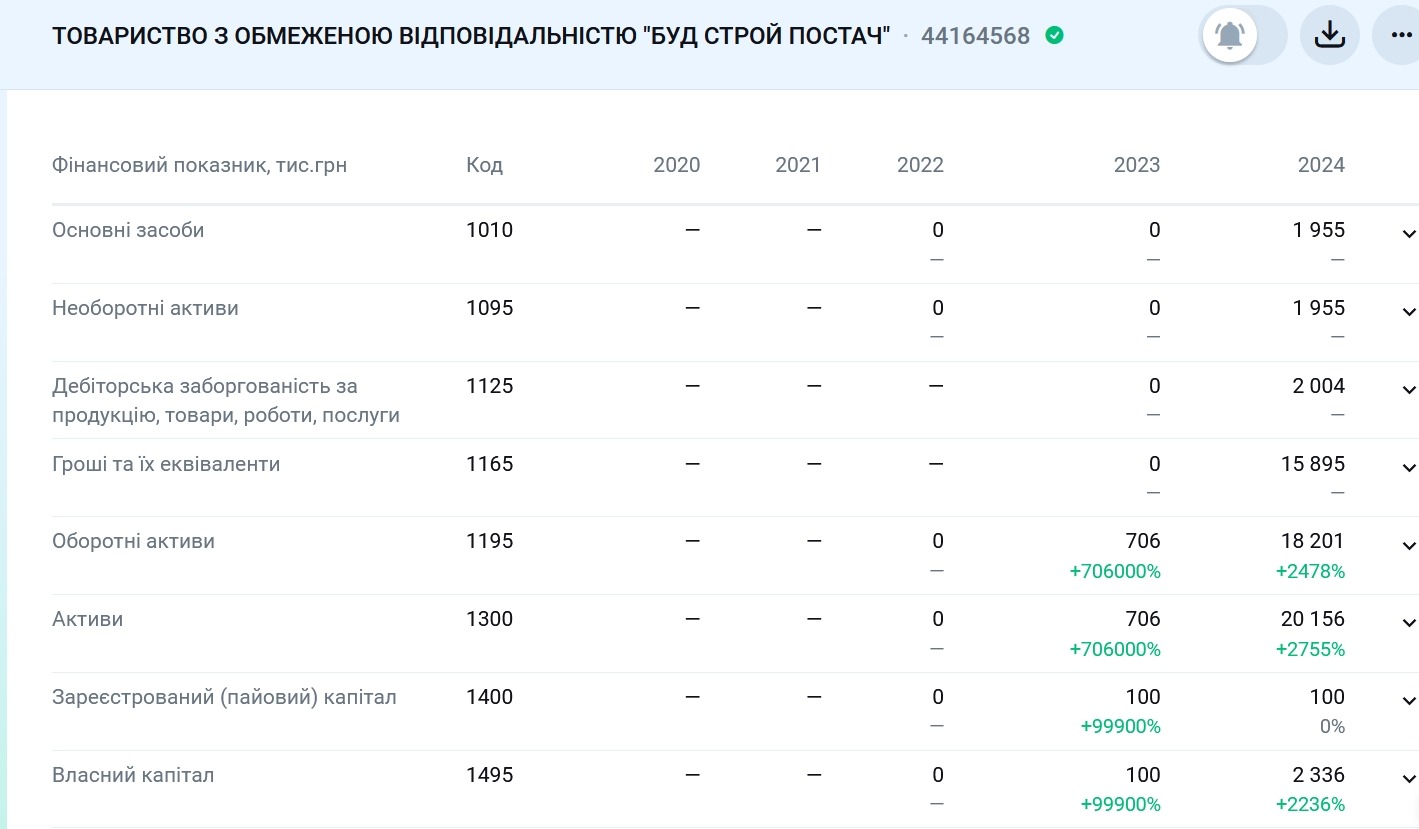
On August 27, 2025, the bank transferred the full advance payment of UAH 67,961,386.91 to Ukrenergo. However, the guarantee itself also raises questions. It was secured by a surety from the Kharkiv-based Budservice-Dnipro LLC. According to Telegraf, the company’s financial condition cast doubt on its actual ability to meet obligations of nearly UAH 68 million. In particular, its assets in 2024 amounted to approximately UAH 1.8 million.
However, recovering the advance does not mean the construction obligations have been fulfilled. The strategic energy facility in Mykolaiv Oblast did not receive the planned protection by the deadline. In addition to recovering the principal, Ukrenergo is seeking to collect around UAH 25 million in late-payment penalties and fines from the contractor through court proceedings. But because the company is bankrupt, the prospects of actually recovering this money remain uncertain.
A separate part of Telegraf’s investigation concerns the responsibility of officials at the state-owned energy company who selected the contractor, approved the contract, and monitored the work. Journalists point out that a contract worth nearly UAH 90 million was signed without an open tender with a company that had little prior experience in public procurement.
Questions have also been raised about how the documents on the company’s equipment, construction capacity, and staff were checked. Did Ukrenergo representatives verify the company’s actual capacity before transferring an advance of nearly UAH 68 million?
The report also mentions the role of Ukrenergo’s investment director, Oleh Pavlenko, who, according to journalists, was involved in approving and signing the contract on behalf of the state-owned company. The investigation’s authors also draw attention to Ukrenergo’s previous problems with bank guarantees issued by JSC Bank Alliance, including the case involving United Energy LLC, which concerned UAH 716 million.
At the same time, the circumstances cited by the journalists do not, in themselves, prove that Ukrenergo officials were involved in the misappropriation of funds. Their actions and any possible procedural violations require a proper investigation by law enforcement. The main problem is that even after the money was recovered under the bank guarantee, the substation in Mykolaiv Oblast was still left without the planned protection. This is happening amid a full-scale war, as Russian forces continue to deliberately attack Ukraine’s energy infrastructure.
The question, then, is not only what happened to nearly UAH 68 million. It is equally important to establish who was responsible for selecting the contractor, why the problems with the contract’s performance were not identified in time, and whether the actions of all responsible officials will receive an appropriate legal assessment.
We also wrote earlier:
- They stole from the substation’s protection project twice: how millions disappeared in Mykolaiv Oblast
- Three million for free sand: Kim’s subordinate “stole” from energy substation protection projects
- More than half of Ukrenergo’s energy facilities are already protected from Russian attacks, and work continues
- Is Mykolaiv ready for winter? Shmyhal inspects energy projects
- Equipment damaged: energy workers show the aftermath of shelling in Mykolaiv Oblast