November 16 in the history of Korabelnyi District and Mykolaiv marks the creation of an anti-Nazi underground resistance group, the laying down of two major warships, the rehabilitation of an eminent shipbuilder, and debates about the city’s future. Since 2022, the date has also been remembered for a dangerous effort to restore the water supply, Russian ammunition caches, and a missile strike.
November 16, 1942: Shipyard workers formed an underground group to fight the Nazis
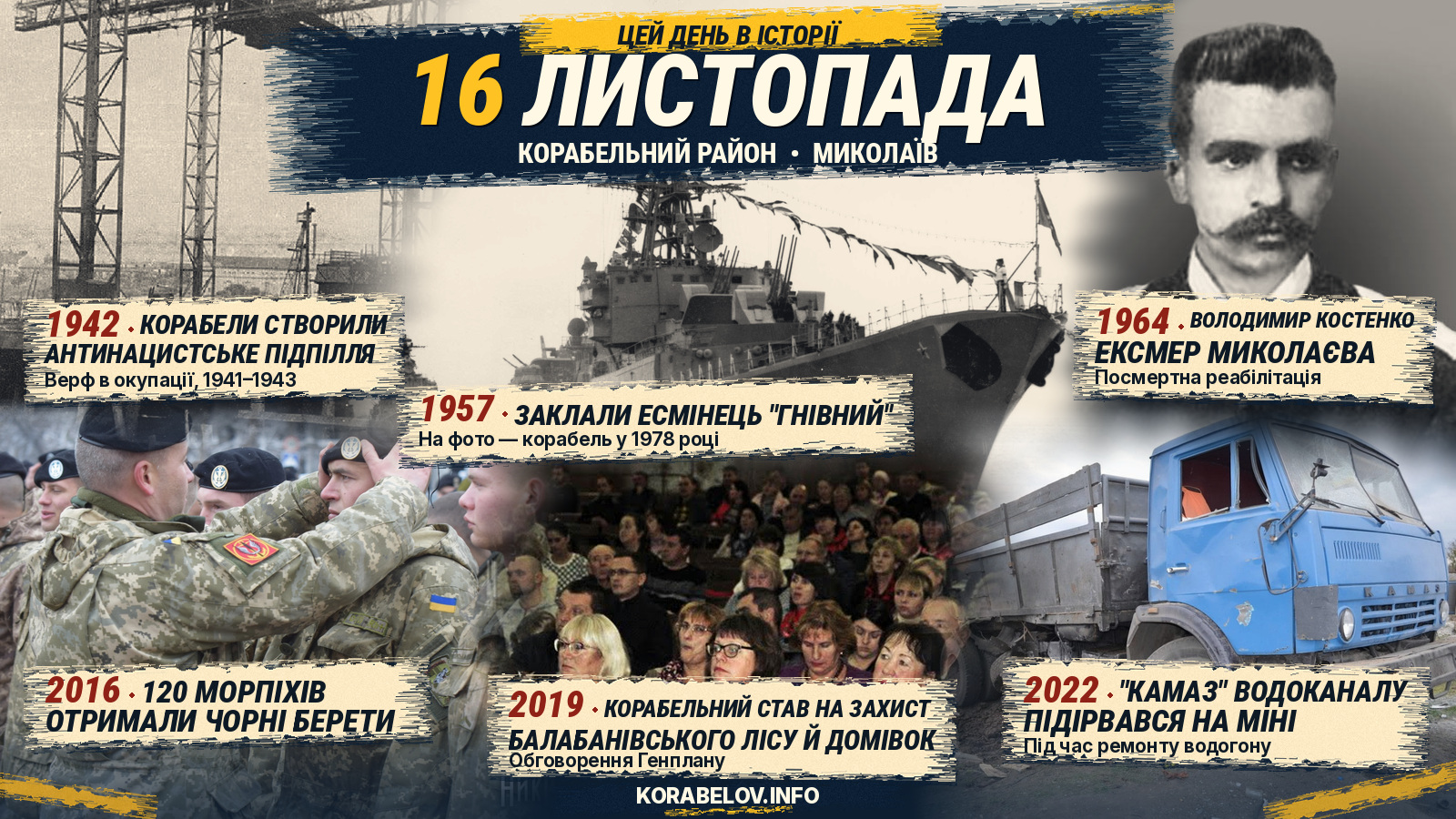
In occupied Mykolaiv, the first meeting of the future members of the anti-Nazi organization “Patriot of the Motherland” took place. It was led by shipyard foreman Ivan Vasylovych Kozoderov. As a published collection of archival documents shows, that day the participants decided to form a group and approved its name; they had begun preparations in the summer. Later, the underground members distributed leaflets, organized sabotage, and helped prisoners of war. The organization remained active until the city was liberated in March 1944.
November 16, 1951: the cruiser “Admiral Kornilov” was laid down in Mykolaiv
The light cruiser “Admiral Kornilov,” Project 68-bis-ZIF, yard number 395, was laid down at Plant No. 444, named after André Marty. The vessel was launched on March 17, 1954, but was never completed: construction was halted on September 2, 1959. It is one of the stories of Mykolaiv’s large-scale shipbuilding, in which a completed hull never became a fully operational warship.
November 16, 1957: the “Gnevny” missile destroyer was laid down
Construction began on the “Gnevny” destroyer, Project 57-bis, yard number 1401, at the shipyard named after the 61 Communards in Mykolaiv. It was launched on November 30, 1958, and entered the fleet on January 10, 1960. The ship later made long-distance voyages, underwent modernization, and served as a large antisubmarine ship.
November 16, 1964: an eminent Mykolaiv shipbuilder was posthumously rehabilitated
The Military Collegium of the Supreme Court of the USSR rehabilitated Volodymyr Poliyevktovych Kostenko—a shipbuilding engineer, former mayor of Mykolaiv, and chairman of the city council during the Ukrainian Revolution. He was arrested and imprisoned, including at Solovki, but his expertise was used to design shipbuilding enterprises. Kostenko died in 1956; historian Larysa Leonidivna Levchenko cited the exact date of his posthumous rehabilitation in a scholarly study.
November 16, 2012: billions in road spending linked to the “Nika-Tera” port were brought to light
Korabelov.info published an investigation by “Nashi Hroshi” into state funding for road repairs in the region after the “Nika-Tera” port was acquired by a group linked to Dmytro Firtash. According to the journalists’ calculations, UAH 1.72 billion was allocated to roads over the previous year, compared with UAH 473 million from 2008 through the fall of 2011. The possible connection between road spending and the port owner’s business interests was the journalists’ theory, not a fact established by a court. The investigation was published on November 16.
November 16, 2015: Mykolaiv officially announced its new mayor
The city election commission published the results of the runoff election: Oleksandr Senkevych received 80,636 votes (54.90%), while his opponent, Ihor Dyatlov, received 63,567 votes (43.28%). A total of 146,863 voters cast ballots. Voting took place on November 15, and the official figures were announced the following day.
November 16, 2016: 120 marines received their black berets
In the central square of Mykolaiv, 120 soldiers of the 1st Feodosia Marine Battalion named after Konstantin Olshansky swore their oath as marines. At the memorial to the airborne heroes, the service members honored their fallen comrades, after which their commanders presented them with black berets.
November 16, 2019: Korabelnyi residents spoke out against threats to Balabanivskyi Forest and homes
During a public discussion of Mykolaiv’s new master plan, residents of Korabelnyi District objected to changes that, in their view, threatened part of Balabanivskyi Forest and private homes in the 8th microdistrict. The meeting also covered planned tram and trolleybus lines to the district, bypass roads, and a railway branch to the “Olvia” port. Residents were promised that their comments would be included in the minutes; no decision to demolish homes was made that day.
November 16, 2022: a municipal water utility vehicle hit a mine while restoring the city’s water supply
In Kherson Oblast, a municipal “KamAZ” truck hit an antitank mine and exploded while repairs were underway on the “Dnipro-Mykolaiv” water pipeline. According to Mykolaivvodokanal, no employees were injured, and work to restore the centralized water supply continued. At the time, the utility estimated its losses since the start of the full-scale invasion at more than UAH 26 million.
November 16, 2023: the first “Shahed hunters” in Mykolaiv Oblast went on duty
Vitaliy Kim, head of the Mykolaiv Regional Military Administration, showed the first vehicles equipped to counter Russian attack drones as they set out on combat duty. The vehicles were purchased for the Ukrainian Armed Forces’ mobile fire groups, tasked with strengthening the defense of Mykolaiv Oblast against drone attacks.
November 16, 2024: a Russian missile struck Mykolaiv
At 7:25 p.m., Russian forces struck a city infrastructure facility, reportedly with an “Iskander-M” ballistic missile. According to the regional military administration, no one was killed or injured in the strike. The next massive drone attack, which caused casualties, took place on November 17 and should not be confused with the events of this day.
This day in Ukraine
On November 16, 1994, the Verkhovna Rada of Ukraine adopted Law No. 248/94-VR on accession to the Treaty on the Non-Proliferation of Nuclear Weapons. It entered into force on December 5, 1994, after security assurances from the nuclear powers had been formalized. This was one of Ukraine’s key steps toward nuclear-weapon-free status.
For Mykolaiv and Korabelnyi District, November 16 brings together shipbuilding history, resistance to the occupiers, residents’ fight for the environment, and the efforts of those who restored the city’s water despite the threat of mines.
We wrote earlier:
- Five seconds for an image instead of lengthy processing: a new X-ray machine in Korabelnyi
- To “Okean” for 2 hryvnias, and barges to Holland: November 11 in Mykolaiv’s history
- From 500 ships for “Okean” to the liberation of Snihurivka
- Water in Mykolaiv is chlorinated according to summer standards: what the analyses show
- Billions in investment and a suspended concession: the future of the “Olvia” port