Four-day workweek and minus trillions: Russia's economy is cracking
The economy is crumbling: KAMAZ cuts production, oil posts a loss, Russia's budget has already breached the annual deficit


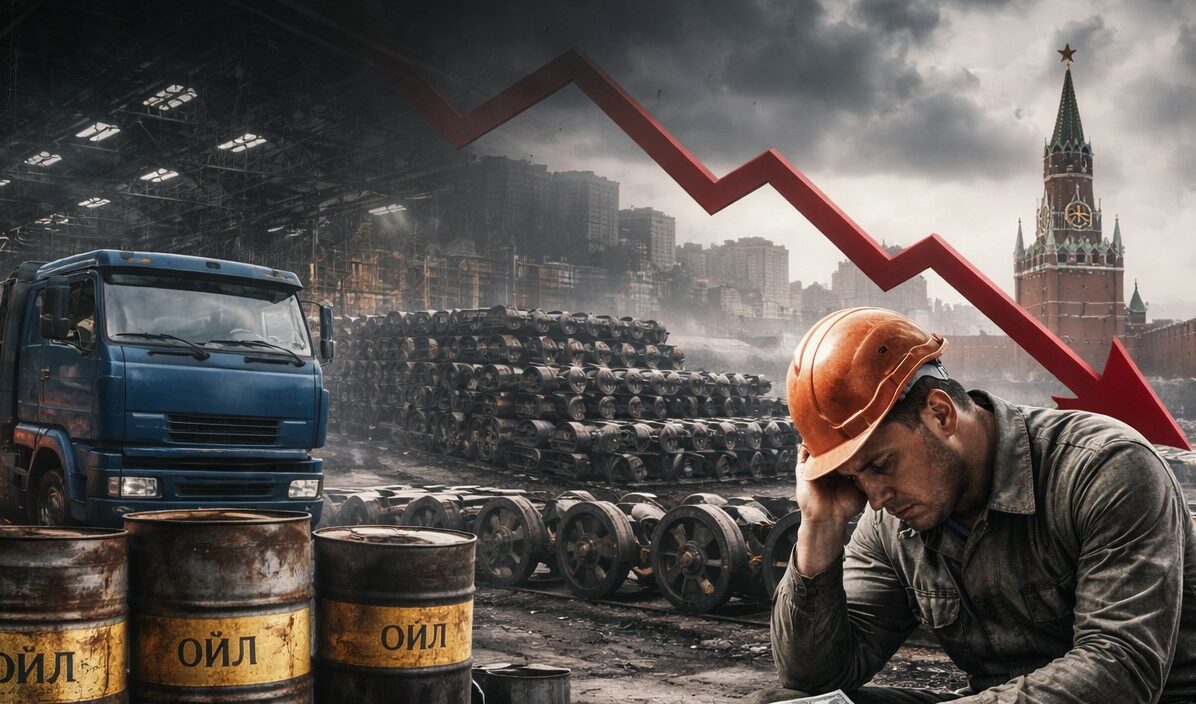
In the Russian Federation, alarming signals continue to accumulate across various sectors of the economy. This is most evident in industry: large enterprises are being forced to cut production, and in some places — even change their operating mode due to falling demand.
Thus, auto giant KAMAZ announced a possible switch to a four-day workweek from June 2026. The reason is a sharp drop in heavy truck sales of about 40% year on year. At the same time, the company is forced to revise its production programme and reduce the volume of equipment output.
The situation is no better in railway engineering. According to Russian media estimates, freight car production in 2026 may fall to 37–45 thousand units, whereas in 2025 this figure was almost 53 thousand. This actually amounts to a possible decline of up to 45%. Moreover, according to Rosstat, car production had already collapsed by almost half at the beginning of the year.
The problems have also affected the oil sector, which has traditionally been a pillar of the Russian economy. For 2025, “Surgutneftegaz” reported a net loss of 251 billion rubles, whereas a year earlier it showed substantial profit. Another key company — “Rosneft” — remained profitable (about 293 billion rubles), but its financial result fell by approximately 73% compared with 2024.
Against this backdrop, the situation with public finances is rapidly deteriorating. The federal budget deficit of the Russian Federation for the first three months of 2026 reached 4.6 trillion rubles, which already exceeds the planned annual figure (3.8 trillion rubles). For comparison: over the same period in 2025 the deficit was half as large — 1.9 trillion rubles.
The government is trying to curb the economic decline through massive injections. In particular, spending on preferential loans in 2025 exceeded the plan by more than 1 trillion rubles. Spending on housing and communal services also rose sharply — to 2.5 trillion rubles, which is one and a half times higher than a year earlier. This indicates growing pressure on the budget due to worn-out infrastructure.
Overall, according to official statistics, industry in the Russian Federation was already teetering on the brink of decline: the production index at the start of 2026 fell below 100%, which effectively means stagnation.
The combination of these factors — falling production, a downturn in profits in key sectors and a sharp rise in the budget deficit — points to systemic problems in the country’s economy, which is under sanctions pressure and forced to spend significant resources on the war.
- Previously we wrote:
- In the Russian Federation, the number of stores fell for the first time since 2000: Moscow down 4,500
- To “save” the RF economy: Deripaska proposes a 12-hour workday and working Saturdays in Russia
- Russian ports on the Baltic halted oil shipments due to attacks by Ukrainian drones
- “Rusal”, the former owner of MGZ, reported a loss of 455 million dollars
- The budget hole has reached the heart of the Russian Federation: Moscow is cutting, the regions are crumbling