Not by Starlink alone: Ukraine has set its sights on its own Space Forces
Shoot down "Oreshnik" while it's still in space: a plan that could change the rules of war was announced in Kyiv


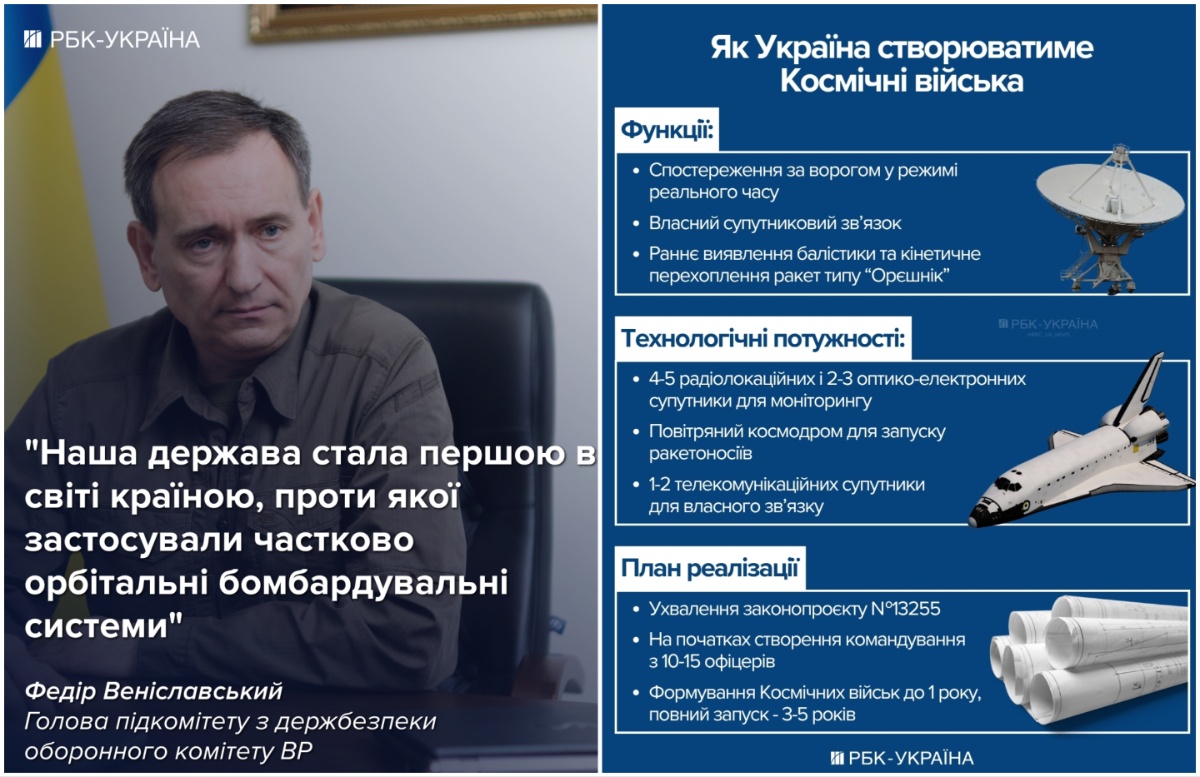
April 13 2026 the publication RBC-Ukraine published an interview with Member of Parliament Fedir Venislavskyi, in which he said that Ukraine is preparing to create Space Forces as a separate branch within the Armed Forces of Ukraine. According to him, the new structure should provide the state with its own space intelligence, satellite communications and the ability to respond to new types of missile threats, in particular to systems of the “Oreshnik” type.
The basis for this is bill No.13255 “On Amendments to the Law of Ukraine ‘On the Armed Forces of Ukraine’ regarding clarification of the structure of the Armed Forces of Ukraine.” It was registered in the Verkhovna Rada on May 2, 2025, included in the agenda on February 10, 2026 and currently officially has the status “awaiting consideration.” The main committee already on September 25, 2025 recommended that parliament adopt it as a basis and in full.
Venislavskyi explains the need for such a step by saying that Ukraine still remains critically dependent on partner or leased satellite capabilities. In the conversation he directly mentioned pauses in partners’ provision of space intelligence, as well as problems with communications due to temporary outages of Starlink, which, he said, affected coordination on the battlefield. That is why, the deputy claims, the country needs its own satellites — both for early warning of ballistic threats and for protected communications of the military-political leadership.
According to Venislavskyi, at the start this involves at least 4–5 radar, 2–3 electro-optical and 1–2 telecommunications satellites. Such a configuration, he said, would allow not only to warn about missile launches, but also to obtain in real time a picture of enemy movements deep into Russian territory. He separately stated that Ukraine must prepare its own kinetic interception means to shoot down a missile carrier like the “Oreshnik” before the warheads separate in space.
The loudest part of the interview concerns already achieved results. Venislavskyi said that during the full-scale war units of the HUR twice launched rocket carriers into space: first to an altitude of over 100 kilometers, and the second to 204 kilometers. He also said that during the war Ukraine carried out for the first time in Europe and for the second time in the world a launch of a rocket carrier from a transport aircraft at an altitude of approximately 8 thousand meters, effectively testing the basis for an “air spaceport.”
The deputy also voiced the financial and timing framework. According to him, one satellite can cost from 20 to 50 million dollars, and a starter constellation requires 8–10 spacecraft. The first practical results, in his assessment, may appear no earlier than in a year, while full deployment of the Space Forces with all components will take 3–5 years.
In fact, this is no longer just a nice military-technological dream, but an attempt by Ukraine to get out of the dangerous dependence on foreign satellites, foreign communications and foreign decisions at the moment when the enemy launches missiles on exoatmospheric trajectories and the front needs information here and now. And that is why the topic of the Space Forces, once a futuristic idea, is gradually moving into the realm of real defense policy.
Earlier we wrote:
- Ballistics didn’t stop: Russia struck Ukraine with missiles and hundreds of drones
- The EU assesses Ukraine’s need for 2,000 interceptor missiles per year
- Ukraine is creating its own air-defense dome against mass drone attacks
- Defense forces reached the Oreshnik launch training ground deep inside Russia
- Ukraine is preparing for space wars: the Ministry of Defense launched a space policy directorate